

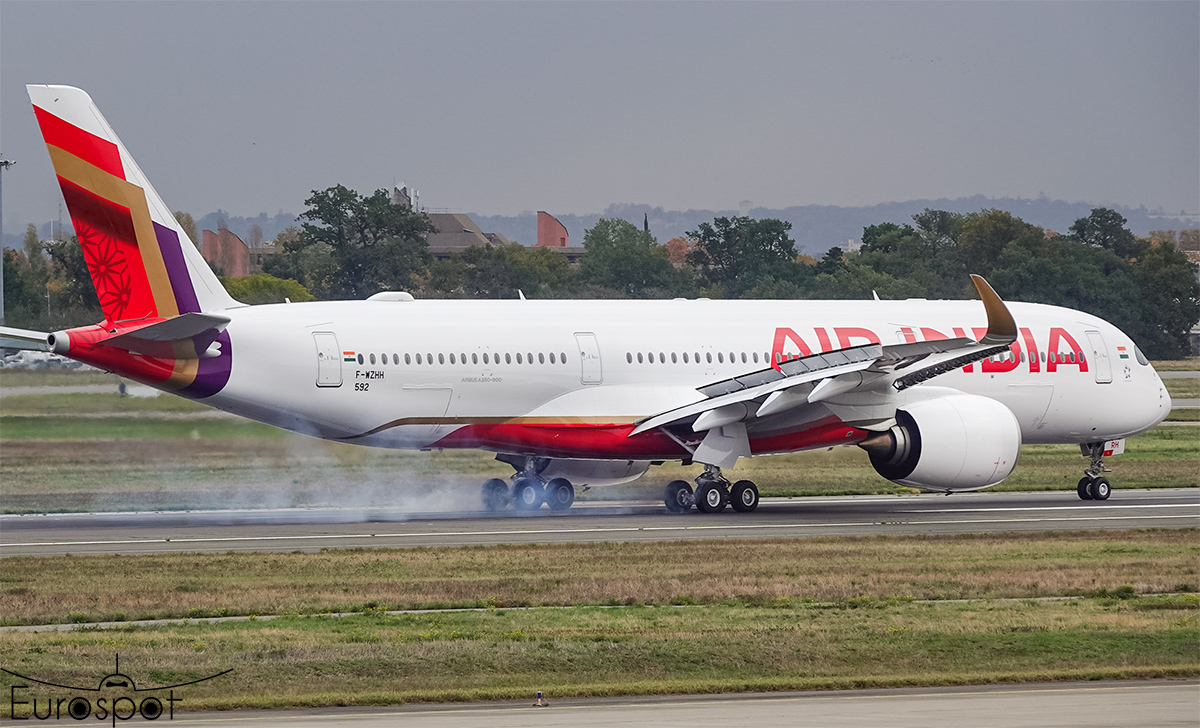
DELHI- Tata Group-owned Air India (AI) has grounded an Airbus A350 after engine damage during taxiing at Delhi Indira Gandhi International Airport (DEL), raising concerns over long-haul schedule stability.
The aircraft had earlier returned mid-journey due to Iran airspace restrictions and later sustained damage on arrival in dense fog, prompting a full technical inspection.
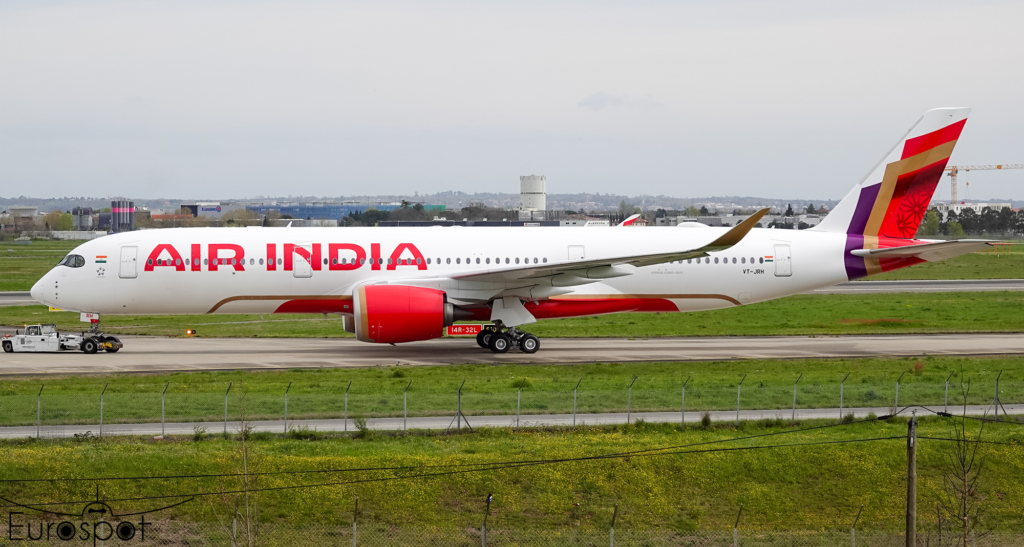
Air India A350 Grounded
The Airbus A350 encountered a foreign object while taxiing after landing in Delhi, damaging its right engine. Air India confirmed the incident occurred in low-visibility conditions caused by dense fog. The airline stated that standard safety protocols were followed immediately after the issue was identified.
Before arriving in Delhi, the same aircraft had already faced operational disruption. It was forced to return to its origin after Iran temporarily closed its airspace, affecting the planned routing. This sequence of events placed the aircraft under added operational stress before the ground incident occurred.
The aircraft involved in the incident is an Airbus A350, registered as VT-JRB. Further, it is a two-year-old aircraft powered by two RR Trent XWB-84 engines.
The affected aircraft remains grounded for a detailed investigation and required repairs. Air India currently operates six Airbus A350 aircraft, which form a key part of its long-haul fleet.
These widebody jets are primarily deployed on premium international routes, including services to London Heathrow Airport (LHR) and New York John F. Kennedy International Airport (JFK). With one aircraft out of service, the airline has warned of possible disruptions on select A350-operated routes.
Iran reopened its airspace after a nearly five-hour closure triggered by geopolitical tensions involving the United States and Iran. The shutdown led several airlines to cancel, delay, or reroute flights across the region.
Although operations have since normalized, the temporary closure continues to highlight the vulnerability of long-haul flight planning to sudden geopolitical developments, especially for carriers operating ultra-long routes.
Similar Incident
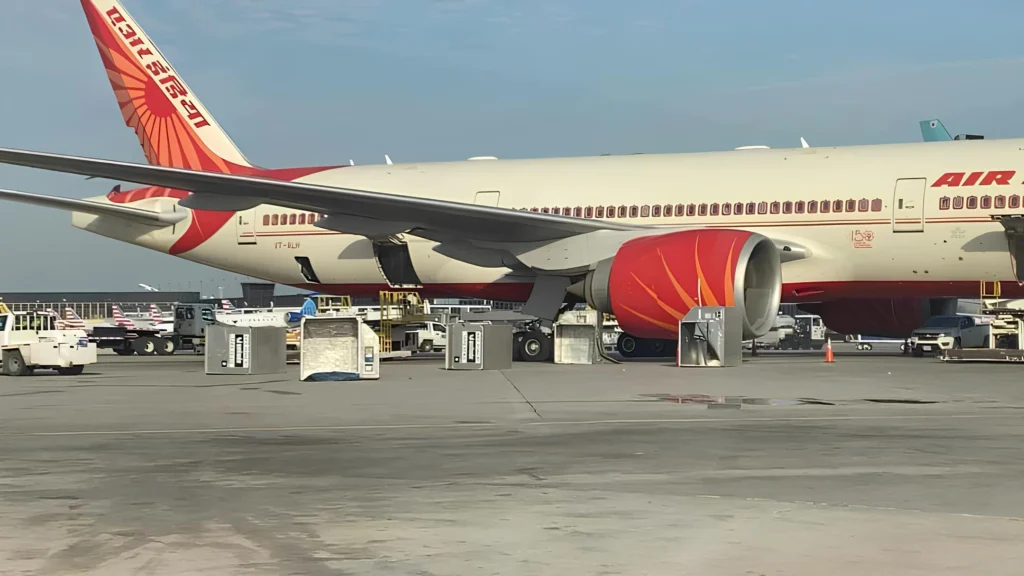
An Air India Boeing 777 sustained minor damage after loose cargo containers struck the aircraft at Chicago O’Hare International Airport (ORD). The incident did not disrupt flight operations but renewed scrutiny of ramp safety procedures.
The aircraft was parked at the gate during a routine turnaround window when the containers moved toward it, reportedly pushed by jet blast from another widebody aircraft operating nearby.
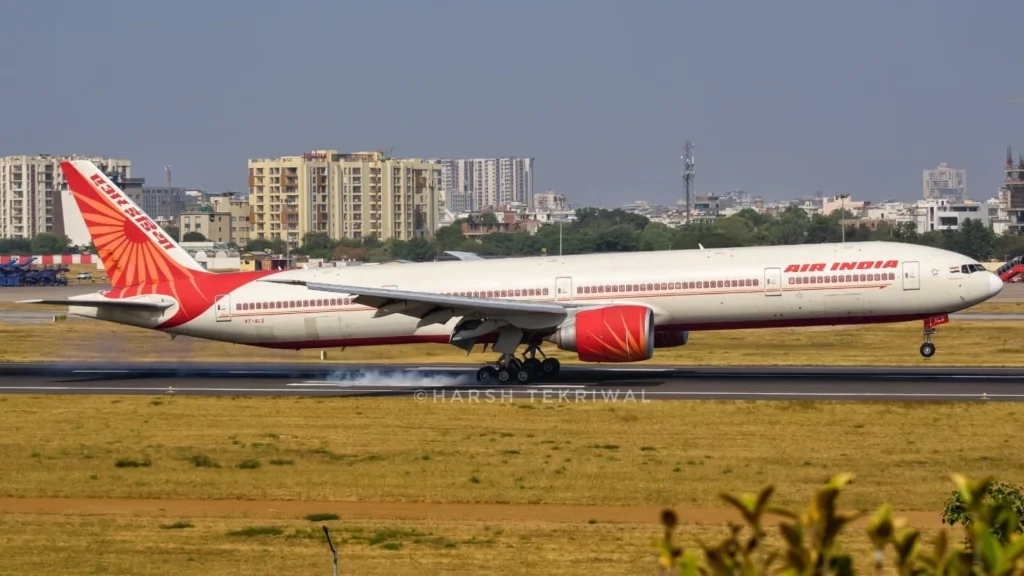
The incident occurred on October 29, 2024, involving a Boeing 777-200 registered as VT-ALH. The aircraft was operating Air India flight AI127 on the Delhi (DEL) to Chicago (ORD) route. It landed at Chicago O’Hare at 7:47 AM local time.
The return service departed on schedule at 12:13 PM local time. The four-hour ground window between arrival and departure is when the cargo container strike took place. Despite visible minor damage, there was no reported impact on aircraft availability or passenger schedules.
Jet Blast Identified as Primary Trigger
Chicago-based driver Windy City Wheelman, who documented the incident, stated that the cargo containers were displaced by jet blast from a passing ANA Boeing 777-300. The containers nearly struck the Air India aircraft while it was parked at the gate.
This was reportedly the third such occurrence in under two weeks at Chicago O’Hare. Each incident involved cargo containers moving uncontrolled toward parked widebody aircraft, pointing to a recurring operational risk rather than an isolated event.
The Boeing 777-200 is smaller than the 777-300 variant, which would typically lower exposure to jet blast effects. However, recent events suggest that standard AKE cargo containers are behaving unpredictably under certain ramp conditions.
Empty cargo containers weigh between 200 and 300 pounds. When displaced, they often require two or three ground staff to reposition manually if a forklift is not immediately available. This creates both safety and efficiency concerns during peak traffic periods.
Stay tuned with us. Further, follow us on social media for the latest updates.
Join us on Telegram Group for the Latest Aviation Updates. Subsequently, follow us on Google News
