

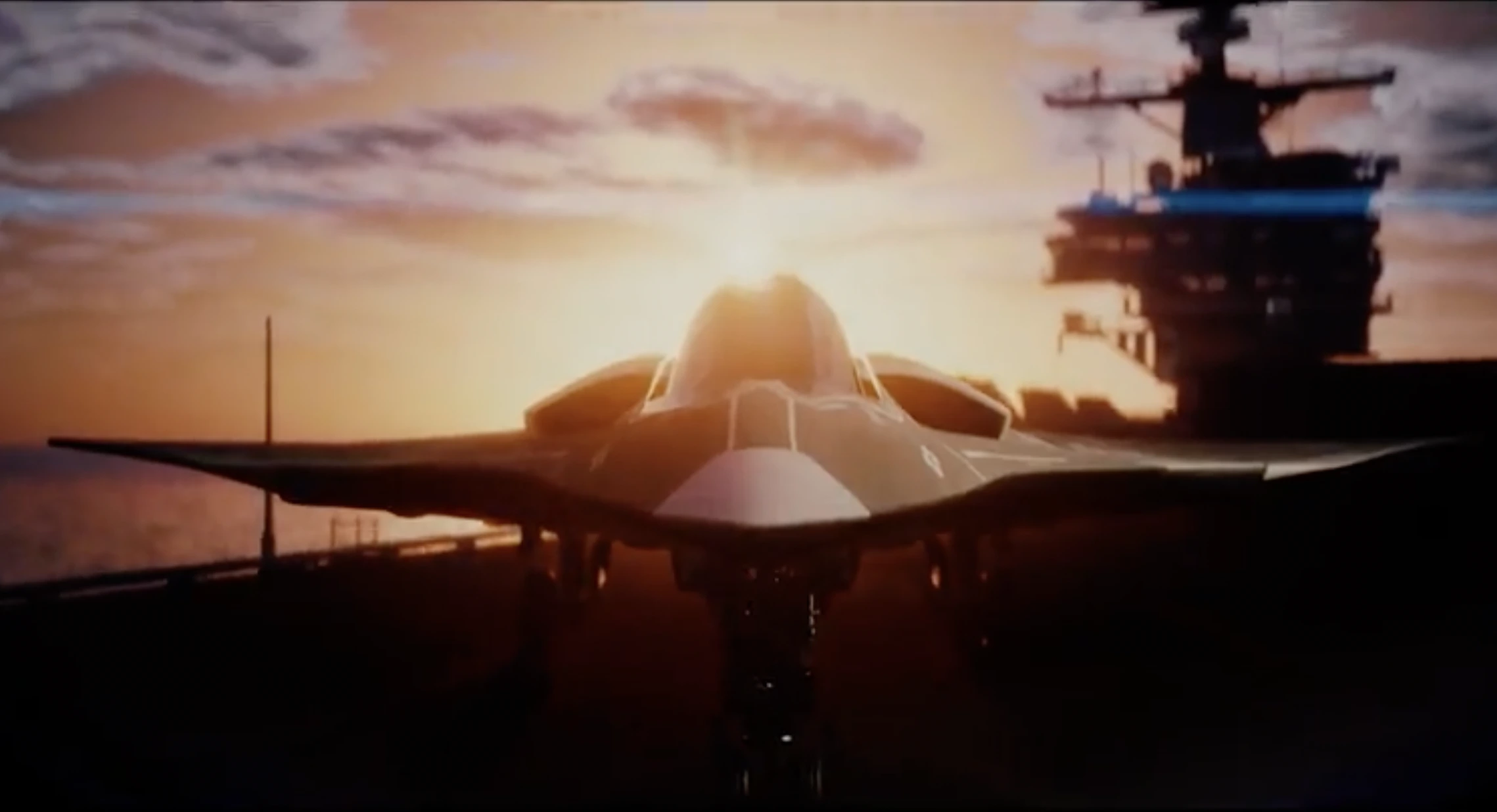
FALLS CHURCH- Northrop Grumman has publicly shared a new rendering and concept video of an advanced carrier-based combat fighter, widely understood to represent its bid for the US Navy’s sixth-generation F/A-XX programme.
The release came hours after the Chief of Naval Operations confirmed a contract award decision is expected in August 2026.
The unnamed aircraft, depicted aboard what appears to be a Ford-class carrier, features a tailless design, folding wings, and dorsally positioned air intakes — key hallmarks of sixth-generation stealth design.
As reported by Flight Global, Northrop Grumman is widely regarded as one of two remaining finalists for the contract, alongside Boeing (BA).
Northrop Grumman’s New F/A-XX Fighter
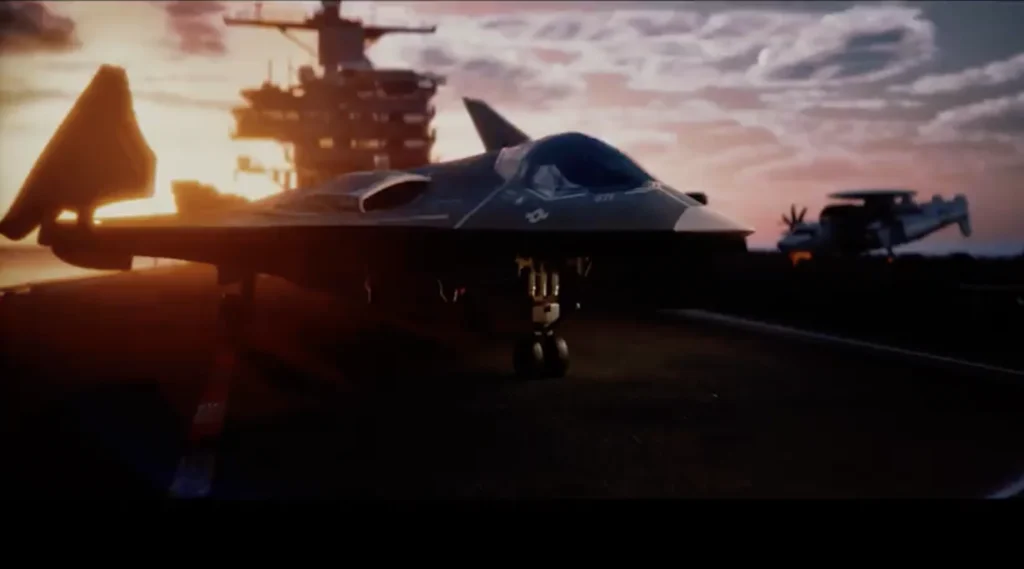
The concept rendering places the fighter on the deck of a US Navy (USN) Ford-class carrier, with a Northrop Grumman E-2D Hawkeye airborne early warning aircraft visible on the flight deck behind it.
The fighter carries the low-visibility white star roundel worn by all USN and Marine Corps aircraft, a deliberate visual signal of its intended service branch.
Its folding wings confirm a carrier-based role, a non-negotiable requirement for all deck-based US Navy aircraft.
The aircraft’s stealth configuration draws directly from Northrop’s bomber lineage. The air intakes are recessed and positioned dorsally on either side of the fuselage centerline, a placement that mirrors the intake geometry on both the B-2 Spirit and the B-21 Raider stealth bombers.
Removing the vertical tail surfaces reduces the aircraft’s radar cross-section across high- and low-frequency bands, a critical requirement for operating in heavily contested environments.
“We’re ready to close the distance of next-gen naval aviation with unmatched speed and capacity,” Northrop stated alongside the release.
The timing of the video was not accidental. On April 20, 2026, at the Navy League’s Sea-Air-Space 2026 exposition, US Chief of Naval Operations Admiral Daryl Caudle told reporters that a contractor downselect is expected in August 2026. Within hours, Northrop published the new concept video.
CEO Kathy Warden responded directly to Caudle’s remarks during an earnings call, stating the company expects “upside to sales and earnings from current guidance” if selected, and described F/A-XX as a top corporate priority.
“Our suppliers and we are prepared to bring the workforce and infrastructure needed to execute the programme,” Warden said, pointing to the B-21 Raider as evidence of Northrop’s ability to deliver complex, classified aircraft on schedule.
F/A-XX Programme Background and Narrowing Competition
The F/A-XX is the crewed strike fighter component of the US Navy’s Next Generation Air Dominance (NGAD) Family of Systems.
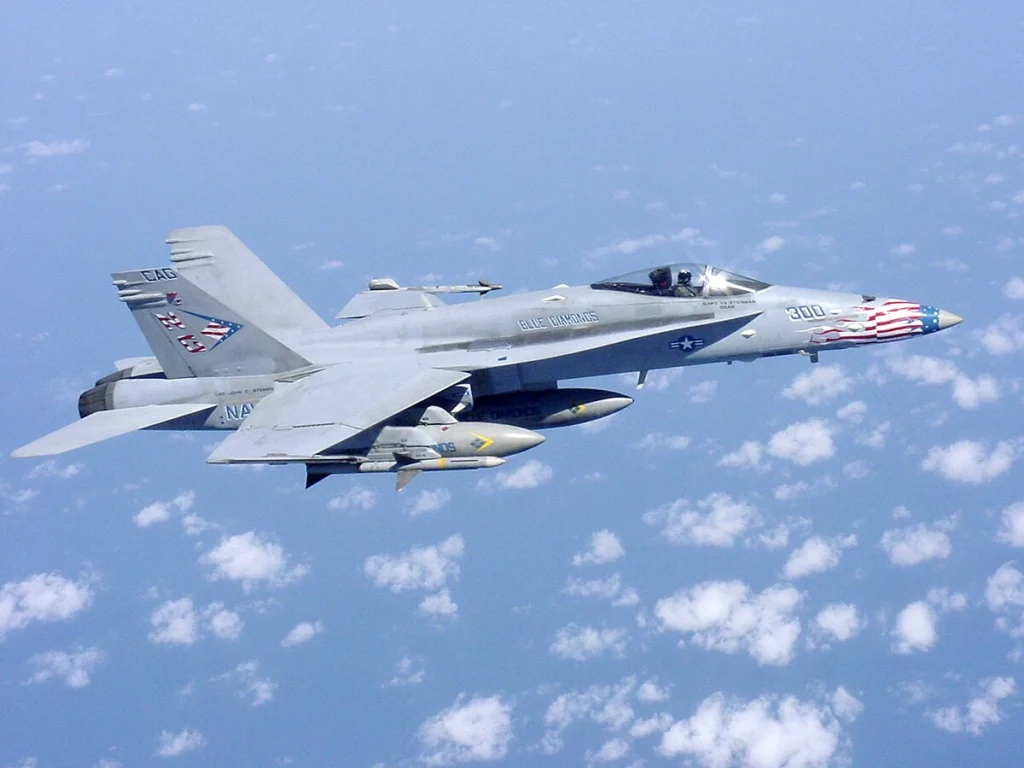
It is designed to replace the Boeing F/A-18E/F Super Hornet in carrier air wings from the 2030s onward.
The Super Hornet production line is winding down, with the final batch expected to be delivered by the end of 2027, though those aircraft are expected to remain in service into the 2040s.
Lockheed Martin was publicly eliminated from F/A-XX contention in early 2025, leaving Boeing and Northrop as the only two American manufacturers of combat jet aircraft still competing for the contract.
Northrop voluntarily withdrew from the US Air Force’s parallel NGAD competition in 2023, citing concerns about aggressive price targets and potential financial losses associated with a complex new development programme.
Subsequent reporting indicated the company’s bid had already been close to elimination before that withdrawal.
Northrop is already managing the financial weight of the B-21 Raider stealth bomber programme, which is generating losses during its early test and low-rate production stages. Two B-21s are currently in active flight testing.
Despite that exposure, the company’s concerns about engaging in another high-complexity development contract appear to have been mollified when it comes to the Navy’s F/A-XX programme, perhaps in part because of the substantial funding Washington is directing toward Boeing’s F-47 development, which has set a precedent for how generously the government is prepared to back a sixth-generation fighter prime contractor.
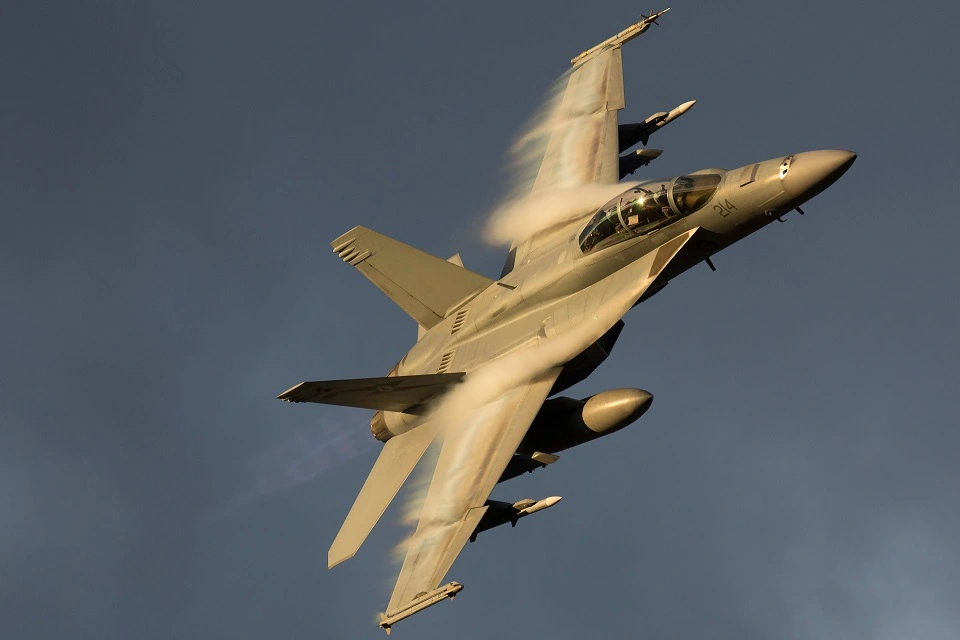
The F/A-XX is required to fly more than 25% farther than current carrier-based platforms, including the F/A-18E/F Super Hornet and the Lockheed Martin F-35C, before needing to refuel.
The aircraft is also expected to incorporate AI-assisted systems and support manned-unmanned teaming operations as part of a broader networked strike capability.
Budget Pressures and Political Infighting
The F/A-XX programme has been marked by bureaucratic delays and persistent funding instability.
The Trump administration sought to cut the programme, while Congress has continued to push for its development.
In its proposed fiscal year 2026 budget, the Pentagon allocated only $74 million for F/A-XX, prompting the Navy to submit an additional $1.4 billion request through its Unfunded Priorities List.
Congress ultimately stepped in, appropriating approximately $1.69 billion in FY2026 to keep the programme active.
The pattern is repeating in FY2027. The Navy has again requested only $140 million for F/A-XX in its budget draft.
By contrast, the Trump administration is requesting more than $5 billion for the Air Force’s F-47 in FY2027, on top of the $3.4 billion already allocated to that programme in FY2026. Congressional intervention is widely expected once again to close the gap.
Admiral Caudle added a note of urgency alongside the contract timeline announcement, indicating that one of the two competing companies may not be able to deliver the aircraft within the Navy’s required schedule.
He declined to name the company. The Navy has reportedly been close to announcing a source selection for months but has made little visible progress until now.
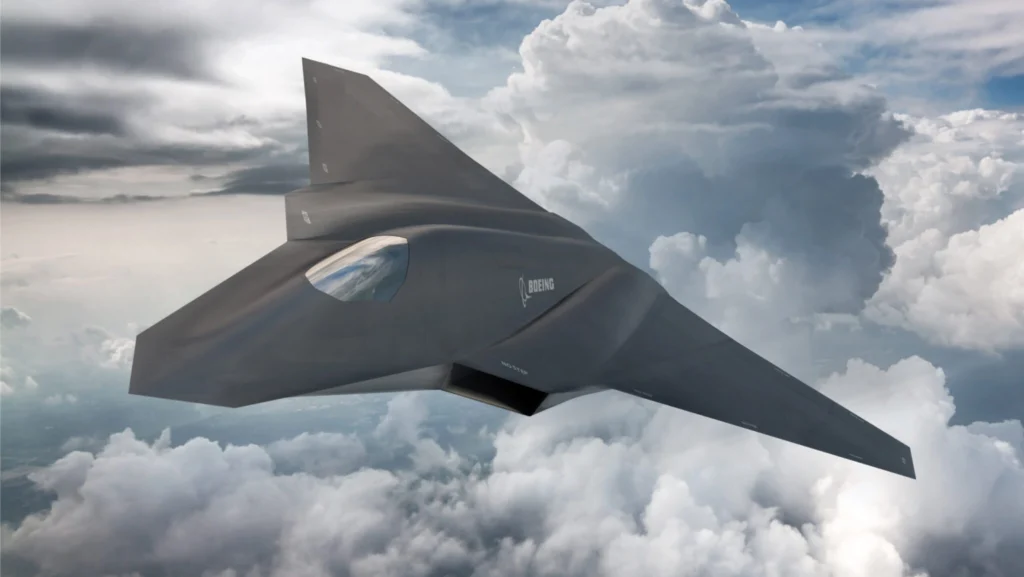
F-47 Moves Forward as F/A-XX Waits
The US Air Force’s parallel sixth-generation effort is advancing at a notably faster pace. Boeing was selected as the prime contractor for the F-47 Next Generation Air Dominance fighter in 2024, with a first prototype flight currently projected for 2028.
The programme carries strong backing from both the White House and the Pentagon, a level of institutional support the F/A-XX has not enjoyed.
Boeing beat out Lockheed Martin for the F-47 contract. Northrop had previously withdrawn from that competition voluntarily, but the generous funding the administration is committing to Boeing’s F-47 development appears to have influenced Northrop’s calculus on F/A-XX, giving the company greater confidence that a similarly funded naval programme could be financially viable.
With a contract decision expected in August 2026, Northrop has made clear it intends to compete aggressively for the Navy award.
Stay tuned with us. Further, follow us on social media for the latest updates.
Join us on Telegram Group for the Latest Aviation Updates. Subsequently, follow us on Google News
