

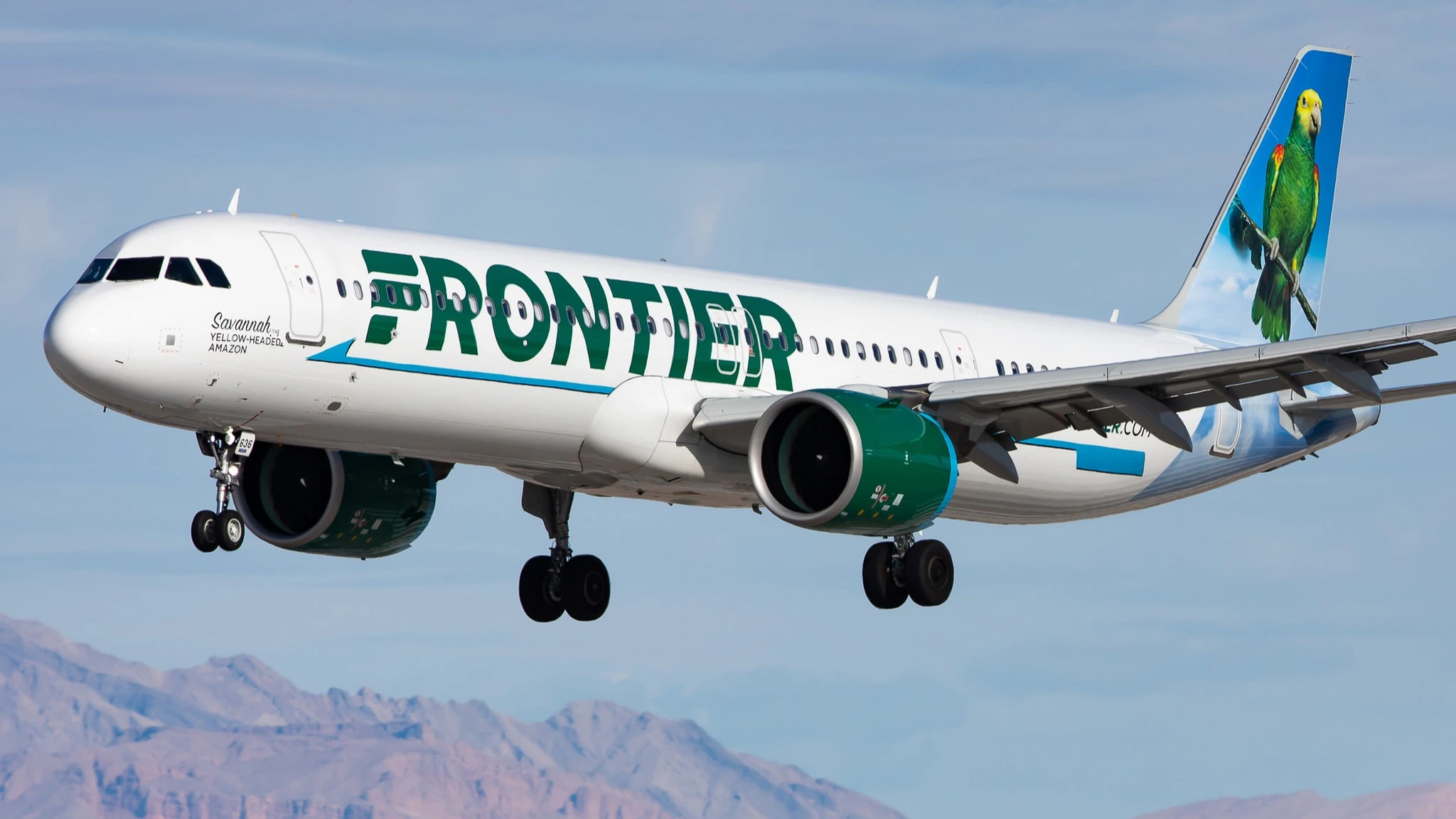
DENVER- Frontier Airlines (F9) faces scrutiny over involuntary denied boardings after a reported aircraft change left passengers without seats. The incident involved Las Vegas Airport (LAS), where a passenger’s boarding pass was rejected after Frontier changed to a smaller aircraft.
Federal rules generally require compensation for qualifying involuntary denied boardings, but an aircraft-substitution exception applies when a smaller aircraft is used for operational or safety reasons. Frontier’s 2025 data shows that this exception accounted for an unusually large share of its involuntary denied boardings.
Frontier Airlines Aircraft Swap Loophole
A Frontier passenger returning from Las Vegas reportedly watched his wife’s boarding pass scan successfully while his own was rejected at the gate. The airline had changed aircraft, leaving 186 passengers for an aircraft with only 180 seats.
The passenger said it took about 45 minutes before an agent explained what had happened. Frontier reportedly offered a $250 voucher as a goodwill gesture.
A passenger can be involuntarily denied boarding even when the original flight was not oversold in the ordinary sense. If the airline replaces the planned aircraft with one that has fewer seats for an operational or safety reason, the passenger can fall under an exception to mandatory denied-boarding compensation.
The issue received attention from View from the Wing, which highlighted Frontier’s unusually high number of involuntary denied boardings attributed to smaller aircraft substitutions.
What Happened When Frontier Changed Aircraft
The reported flight had 186 passengers, while the replacement aircraft had 180 seats. That created a 6 seat capacity shortage.
The passenger’s account raises a separate customer service issue. Passengers reportedly were not clearly told at the gate that the flight had become capacity constrained because of the aircraft change. Instead, some passengers discovered the problem when their boarding passes failed to scan.
The distinction between a normal oversale and an aircraft substitution is important. If an airline sells 186 seats on an aircraft with 186 seats and then replaces it with a 180 seat aircraft, the capacity problem arises from the equipment change rather than from selling more seats than the original aircraft could accommodate.
That is the situation the federal exception is designed to address.
How Federal Compensation Rules Work
Under 14 C.F.R. § 250.5, passengers involuntarily denied boarding from qualifying oversold domestic flights can be entitled to compensation based on the delay caused by the denied boarding. The current domestic limits are:
- No compensation when alternate transportation is scheduled to arrive within 1 hour of the original arrival time.
- 200% of the one-way fare, capped at $1,075, when alternate transportation is scheduled to arrive more than 1 hour but less than 2 hours after the original arrival.
- 400% of the one-way fare, capped at $2,150, when alternate transportation does not meet the 2 hour threshold.
The current $1,075 and $2,150 caps took effect January 1, 2025 after DOT’s inflation adjustment to the denied-boarding compensation limits.
The rules also require airlines to follow procedures for soliciting volunteers and determining boarding priority when too few passengers volunteer to give up their seats.
Aircraft Substitution Exception
The key provision is 14 C.F.R. § 250.6(b). It says a passenger is not eligible for denied-boarding compensation when the aircraft cannot accommodate the passenger because the airline substituted equipment of lesser capacity when required by operational or safety reasons.
DOT’s consumer guidance also identifies a smaller aircraft substitution as an exception to denied boarding compensation.
The exception exists because an aircraft change can reduce capacity without the airline having intentionally sold more seats than the aircraft it originally planned to operate.
That distinction becomes more complicated when a flight was already oversold before the aircraft change.
Why Exception Can Create Compensation Gap
Consider a flight with 190 confirmed passengers and an original aircraft with 186 seats.
The airline already has 4 passengers who cannot be accommodated. If the airline then substitutes a 180 seat aircraft, 10 passengers cannot board.
The arithmetic is:
- Original aircraft capacity: 186
- Confirmed passengers: 190
- Original shortage: 4 passengers
- Replacement aircraft capacity: 180
- Total shortage after substitution: 10 passengers
- Additional shortage caused by the aircraft change: 6 passengers
The 6 additional denied boardings are directly attributable to the smaller aircraft.
This distinction explains the regulatory logic. The exception was not created specifically for ordinary overbooking. It was designed for situations where a carrier cannot accommodate a confirmed passenger because the equipment changed for an operational or safety reason.
The concern is that the same exception can affect compensation when an already heavily booked flight receives a smaller replacement aircraft.
Could an Aircraft Swap Become a Loophole?
An airline could have a heavily booked flight and then substitute a smaller aircraft. In an extreme scenario, a carrier could maintain a spare aircraft with slightly fewer seats and use it when a flight faces a capacity problem.
If the aircraft substitution qualifies under the regulation, passengers denied because of the smaller aircraft may not receive the mandatory cash compensation that would otherwise apply to an involuntary denied boarding.
That does not establish that Frontier is deliberately doing this.
There is also a practical economic problem with the theory. Keeping a dedicated spare aircraft on the ground solely to avoid denied-boarding payments would have a cost of its own. An aircraft generally produces revenue when it operates, so deliberately keeping one idle would have to make economic sense against the potential compensation expense.
The stronger question is therefore not whether the regulation can theoretically be used as a loophole. It is whether individual aircraft substitutions actually meet the regulation’s requirement that the smaller aircraft be needed for operational or safety reasons.
Frontier’s 2025 Numbers Are Unusual
DOT’s 2025 Air Travel Consumer Report shows that Frontier reported 8,087 involuntary denied boardings among 32,269,775 passenger boardings, producing a rate of 2.51 involuntary denied boardings per 10,000 passengers.
That was the highest rate among the reporting operating airlines in the 2025 table. The industry rate was 0.28 per 10,000 passengers.
DOT explains that its involuntary denied-boarding totals include passengers who received compensation and passengers who did not qualify because of regulatory exceptions, including smaller-aircraft substitutions.
Frontier separately reported that:
- 8,087 passengers were involuntarily denied boarding.
- 3,760 qualified for mandatory denied-boarding compensation.
- 4,327 did not qualify because Frontier reported an aircraft substitution.
That means approximately 53.5% of Frontier’s involuntary denied boardings fell into the aircraft-substitution category.
Frontier also accounted for approximately 62.7% of all passengers that reporting airlines categorized under the smaller aircraft exception in 2025, according to the underlying analysis of DOT’s denied boarding data.
That concentration is the central reason Frontier’s figures deserve scrutiny. The data shows an unusually high use of the aircraft-substitution classification, but it does not establish why each substitution occurred.
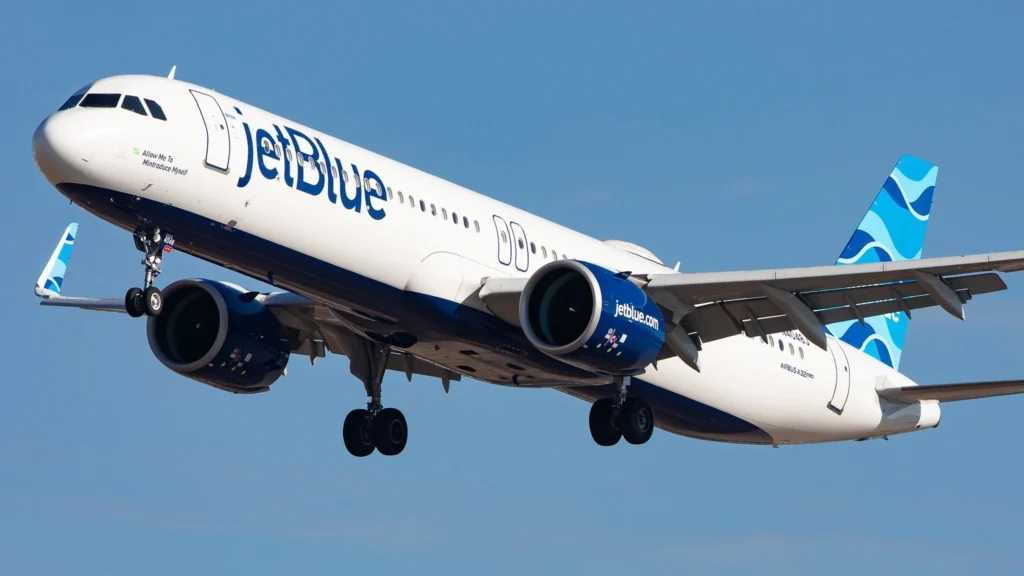
JetBlue Provides Useful Comparison
JetBlue’s history shows that aircraft substitutions can produce large numbers of involuntary denied boardings without necessarily reflecting a conventional overbooking strategy.
In 2016, JetBlue reported 3,176 involuntary denied boardings, of which 3,121, or 98.3%, were attributed to smaller aircraft substitutions.
The underlying pattern was largely associated with aircraft downgrades, including substitutions from Airbus A321 aircraft to smaller A320 aircraft.
JetBlue’s numbers later changed substantially:
| Year | Total involuntary denied boardings | Compensation eligible | Aircraft substitution exception | Exception share |
|---|---|---|---|---|
| 2016 | 3,176 | 54 | 3,121 | 98.3% |
| 2024 | 283 | 256 | 27 | 9.5% |
| 2025 | 195 | 171 | 24 | 12.3% |
DOT’s 2025 report confirms JetBlue had 195 involuntary denied boardings for the year.
The comparison is significant because it demonstrates that the aircraft-substitution exception can be used extensively without proving that an airline intentionally overbooked a flight to avoid compensation.
JetBlue now also overbooks flights, unlike its earlier approach of avoiding intentional overbooking. Its current denied-boarding figures are therefore not directly comparable with the circumstances surrounding its earlier aircraft-substitution cases.
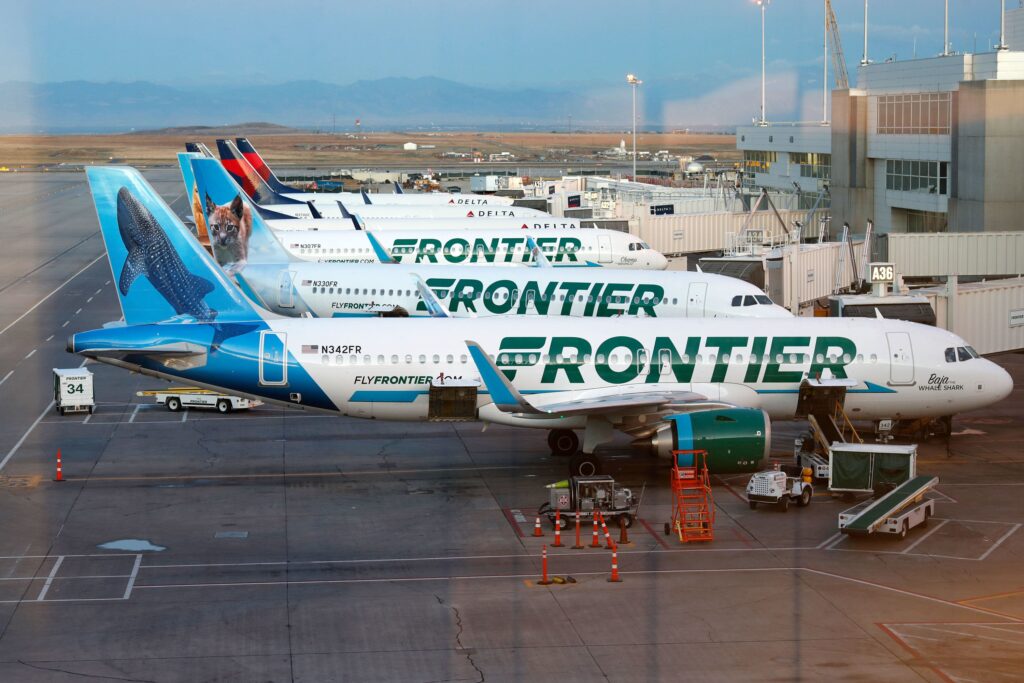
Oversales Enforcement
Frontier’s current aircraft substitution figures also deserve context because DOT has previously taken enforcement action against the airline involving its denied boarding practices.
In 2017, DOT fined Frontier $400,000 for violations involving its oversales and passenger-protection requirements.
The Department found that Frontier failed to seek volunteers before involuntarily bumping passengers, failed to provide required written notices describing passengers’ rights and failed to provide proper compensation in a timely manner.
The enforcement record does not establish that Frontier violated the rules in its 2025 aircraft-substitution cases. It does, however, show that compliance with denied-boarding procedures has previously been an issue for the airline.
The 2017 DOT order also found that Frontier failed to provide complete and accurate denied-boarding statements at certain airport ticket-selling positions and boarding gates and failed to display required disclosures concerning deliberate overbooking and boarding procedures.
Involuntarily Bumped Passengers
Frontier has reported that all involuntarily bumped passengers received compensation, regardless of the form of compensation, including cash or vouchers.
That statement does not mean every passenger received the mandatory federal denied-boarding payment.
A voluntary goodwill voucher and federal denied-boarding compensation are different concepts. The federal payment applies only when the passenger qualifies under the regulation. An airline can also provide a voucher or other assistance voluntarily.
For passengers affected by an aircraft substitution, the central question is therefore whether the passenger was legally excluded from mandatory compensation under the smaller-aircraft exception.
Stay tuned with us. Further, follow us on social media for the latest updates.
Join us on Telegram Group for the Latest Aviation Updates. Subsequently, follow us on Google News
