

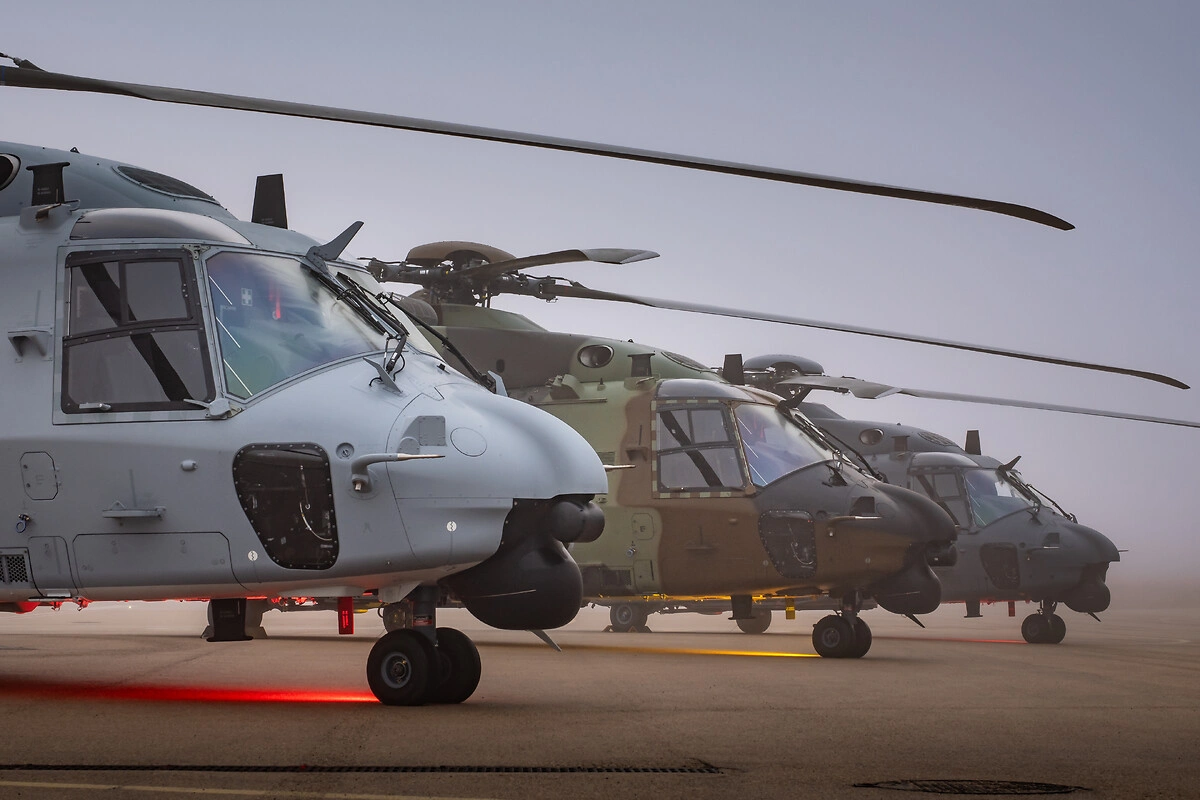
MADRID- Spain has confirmed a major procurement plan from its base in Madrid (MAD) to acquire 100 Airbus helicopters through the Directorate General for Armament and Material. The move marks one of the country’s largest helicopter investments in recent years.
The orders fall under the National Helicopter Plan and expand the capabilities of the Spanish Armed Forces while supporting Airbus Helicopters’ industrial presence in Spain.
Spain Orders 100 Airbus Helicopters
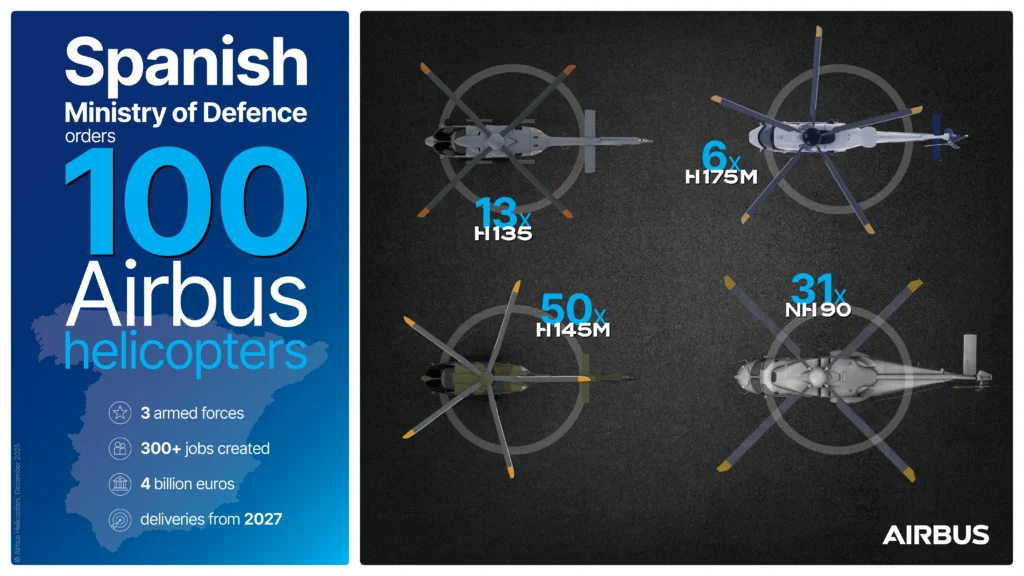
Spain’s Ministry of Defence has approved four contracts covering 100 helicopters across multiple models. Each platform serves a defined mission set aligned with the operational needs of the Army, Navy, and Air and Space Force.
The purchase is structured to modernise legacy fleets, strengthen interoperability, and raise mission readiness across all branches.
The acquisition includes 13 H135 units for advanced training, observation, and light utility roles, primarily assigned to the Air and Space Force with one unit for the Navy.
The Army will receive 50 H145M helicopters configured for pilot training, light attack missions with the HForce system, utility operations, and disaster support.
Six H175M super-medium helicopters will join the Air and Space Force for governmental transport and authority movement, replacing older aircraft previously operated by Wing 48.
The package also covers 31 NH90 helicopters distributed among all services for tactical transport, manoeuvre, special operations, and amphibious roles.
Senior defence officials describe the programme as a decisive step toward enhanced national autonomy in aerospace capabilities.
Airbus Helicopters leadership highlights the investment’s impact on Spain’s industrial footprint and its role as a key contributor within Europe’s aerospace sector.
Industrial Growth and Workforce Expansion
The procurement plan strengthens the existing Airbus Helicopters ecosystem in Spain. More than 300 skilled jobs are expected to be created over the next three years.
Albacete will see further expansion with a dedicated military helicopter customisation centre and an international H145M training hub for pilots and technicians.
These developments align with the continuing build-out of facilities supporting the Tiger mid-life upgrade.
Digital Development and Capability Enhancement
Airbus aims to evolve the Albacete site into a Centre of Expertise for digital operations. A Digital Campus is underway in partnership with the University of Albacete and the regional Science and Technology Park.
The centre will specialise in cybersecurity and digital tool development for Airbus Helicopters. Broader engineering, software, connectivity, and sustainment functions for Spain’s military helicopter fleet will also be reinforced.
About Airbus Helicopters
Airbus Helicopters continues to shape the global rotorcraft market with a portfolio that serves military, civil, and government operators. Its H135, H145, H175, and NH90 platforms stand out for training, multirole performance, and mission readiness. Each aircraft brings proven capability backed by strong fleet experience.
The following breakdown explains how these helicopters operate across training, naval, public service, and demanding military environments, along with the technology that drives their safety and performance.
H135: A Modern Training Benchmark
The H135 sits in the three-tonne class and is widely recognised as a leading military training platform. More than 1,400 units operate worldwide with over seven million accumulated flight hours. Its low operating cost and simple maintenance profile make it a logical fit for countries building long-term pilot training pipelines.
The aircraft is used for advanced training programmes ranging from IFR and tactical manoeuvres to night operations and crew coordination. Its quick role change capability supports utility, surveillance, and medical evacuation training. Airbus’ Helionix avionics give pilots a modern cockpit experience with strong situational awareness and flight envelope protection.
The Spanish Navy adopted the H135 for naval training and utility operations, with the first aircraft reaching initial operational capability by late 2024. The helicopter performs well in high sea states, hot climates, and confined environments. It also delivers one of the lowest certified sound levels in its class, which helps during extended training cycles.
Composite rotor blades, a Fenestron tail rotor, and modern crashworthiness design enhance operational safety. The cabin layout, energy-absorbing seats, and redundant systems further support risk-controlled operations.
H145: High Performance in the Four Tonne Class
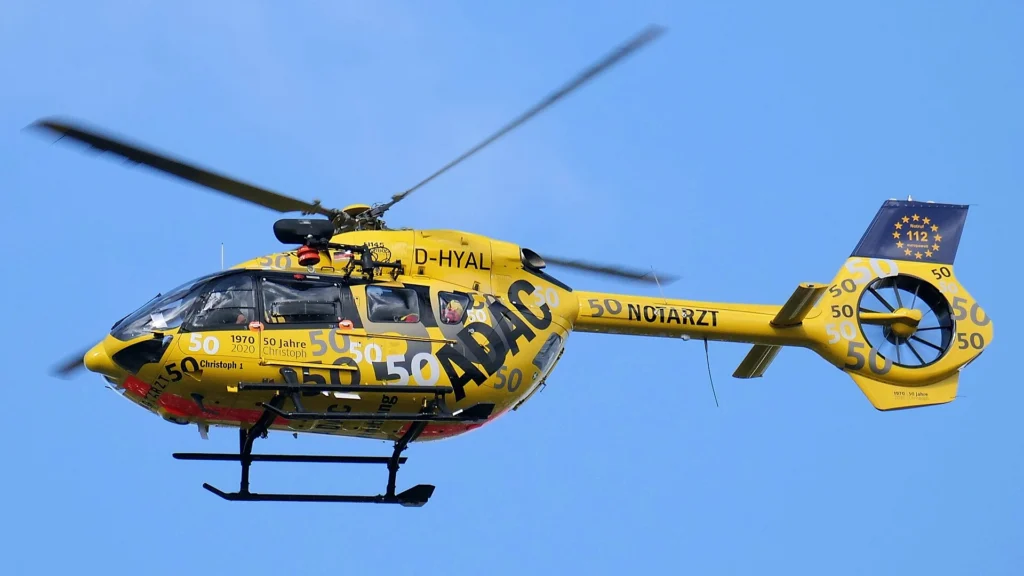
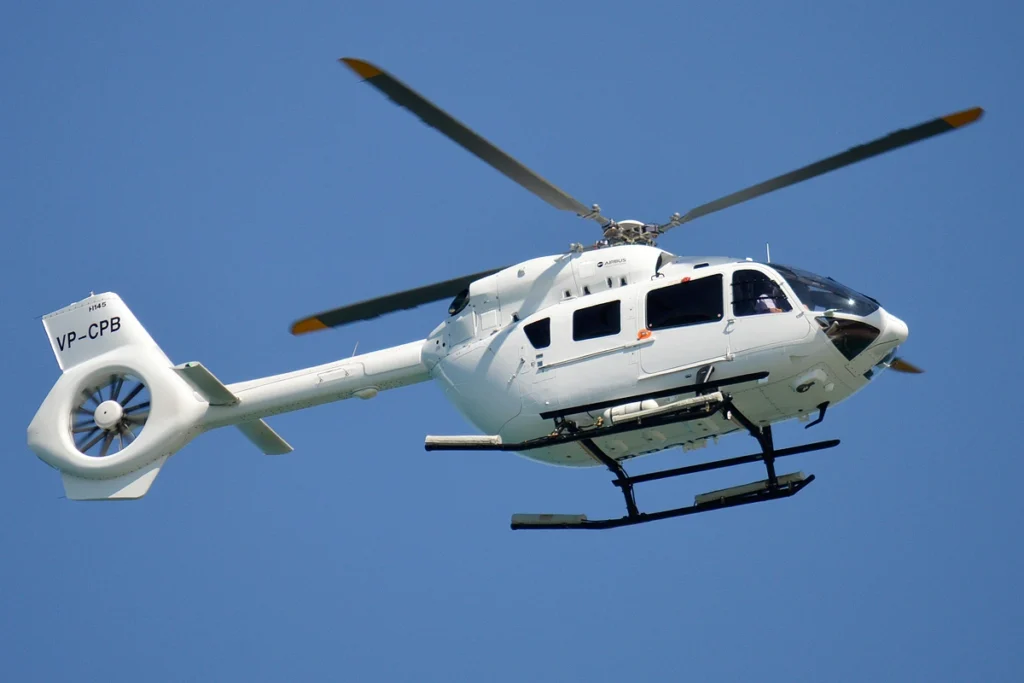
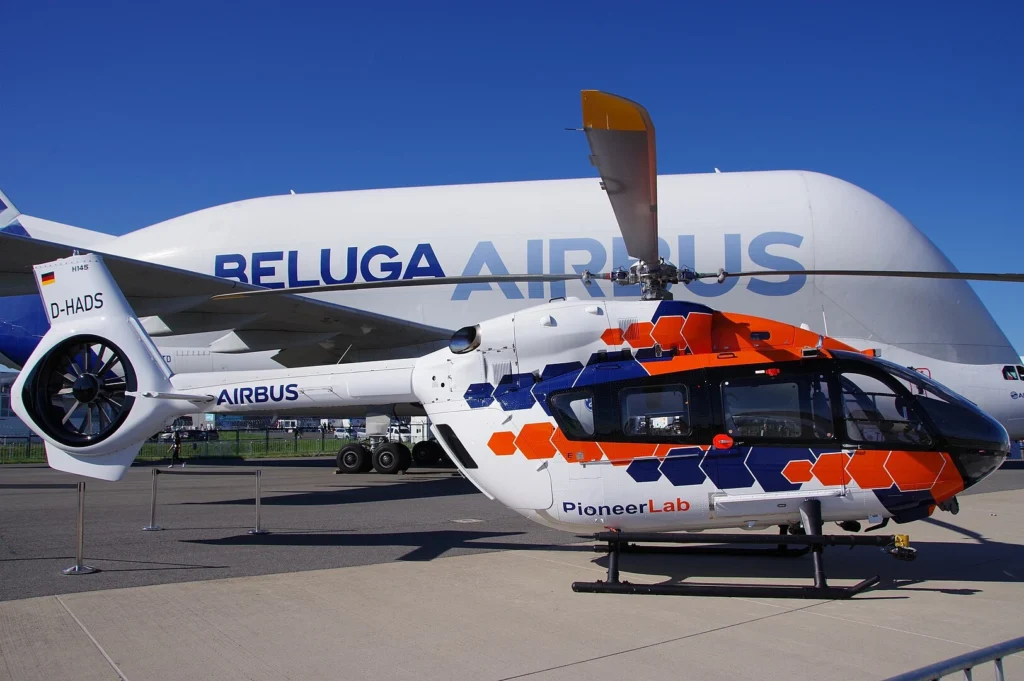
The H145 is known for strong performance, large cabin volume, and mission flexibility. Operators use it for emergency medical services, law enforcement, aerial work, passenger transport, and offshore roles. The aircraft supports more than 400 interchangeable equipment options, which lets operators adapt the platform quickly.
A major upgrade arrived in 2020 with the five-bladed main rotor, increasing useful load by 150 kg and improving agility. The compact footprint allows landings in confined spaces, which is essential for EMS, police, and public service missions.
The H145 runs on two Safran Arriel 2E engines with dual FADEC and upgraded rotor systems. It is capable of taking off and landing at 20,000 ft. A proven demonstration includes its 2019 flight over Mount Aconcagua at 22,840 ft with solid power reserves.
Key safety features include redundant hydraulic and electrical systems, crash-resistant fuel cells, and an energy-absorbing fuselage. Helionix avionics, a 4-axis autopilot, and a wireless airborne communication server support flight envelope protection, data management, and consistent situational awareness.
Maintenance is streamlined through a bearingless main rotor, simplified airframe components, high TBO times, and optional health and usage monitoring systems.
H175: Long Range and Super-Medium Versatility
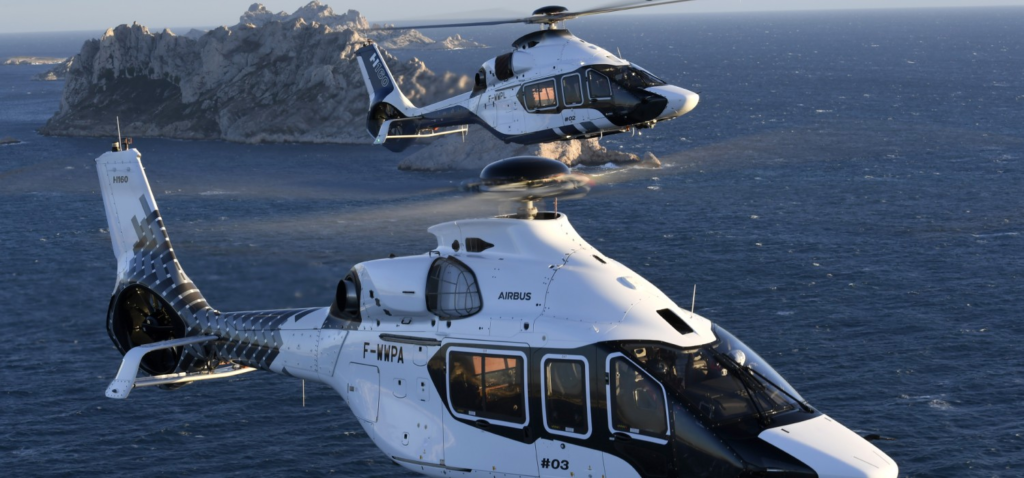
The H175 entered service in 2015 as a super-medium helicopter, offering long range, fast cruise capability, and strong payload performance. It holds time-to-climb records to 3,000 and 6,000 metres and operates efficiently in both hot climates and offshore environments.
The helicopter carries a large fuel load, enabling flexible range and endurance. Its Pratt & Whitney PT6C-67E engines deliver strong output even in one-engine-inoperative scenarios, supporting safe approaches, hoisting, and landing operations. The H175 is frequently selected for offshore energy missions and demanding search and rescue work, including major typhoon rescue operations in Asia.
Helionix avionics support intuitive operation, cockpit awareness, and automated recovery functions. The helicopter meets or exceeds CS29 standards and incorporates IOGP safety recommendations for offshore work. Redundant systems, floatation gear certified for Sea State 6, and crashworthy structure reinforce mission survivability.
The cabin provides high comfort levels with low vibration, large windows, climate control, and space for up to four passengers per row.
NH90: A Fully Modern Military Rotorcraft
The NH90 is a twin-engine, multi-role helicopter developed for NATO standards. Available in TTH and NFH variants, it serves land forces and naval operators for transport, maritime surveillance, anti-submarine warfare, and anti-surface missions. More than 500 helicopters have been delivered, accumulating over 400,000 flight hours.
A composite fuselage reduces structural weight and increases endurance and damage tolerance. The aircraft features a fly-by-wire system with a 4-axis autopilot, meeting modern military handling and safety expectations. The large cabin, sliding doors, and rear ramp support troop transport, cargo lift, and mission equipment integration.
Survivability measures include a low radar signature, infrared suppression, redundant systems, and armour protection for crew and troops. The crashworthy airframe prevents heavy components from entering the cabin and includes highly effective flotation gear for maritime operations.
The NH90’s integrated avionics suite supports data fusion, sensor management, and intuitive interaction with mission systems. Workload is reduced enough for naval warfare missions to be flown with a three-person crew. Commonality between TTH and NFH variants simplifies training and lifecycle costs.
Germany’s NH90 Sea Tiger version adds advanced sonar, surveillance equipment, and guided weapons for modern ASW and maritime strike missions.
Stay tuned with us. Further, follow us on social media for the latest updates.
Join us on Telegram Group for the Latest Aviation Updates. Subsequently, follow us on Google News
