

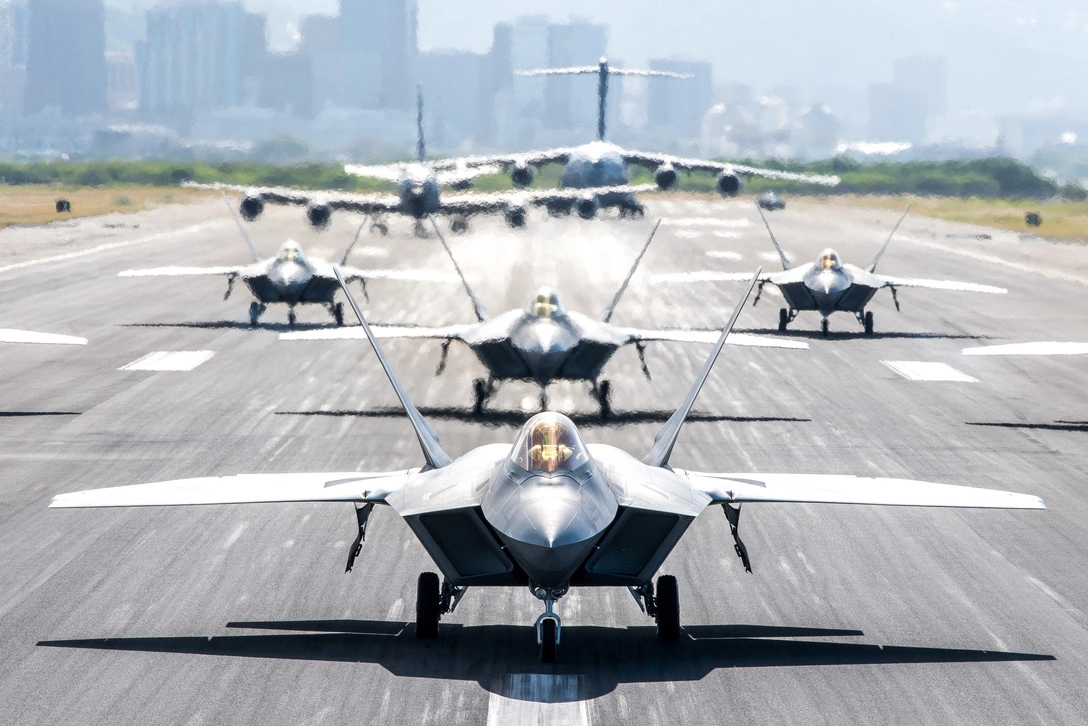
WASHINGTON, D.C.— A new unclassified wargame conducted by the Mitchell Institute for Aerospace Studies warns that the U.S. Air Force (USAF), on its current modernization path, would struggle to repel a Chinese invasion of Taiwan by 2035.
The April 9 report, based on insights from around 60 participants including active Airmen, industry officials, and allied representatives, compared two future force mixes to assess which could more effectively counter Chinese military action in the Pacific.
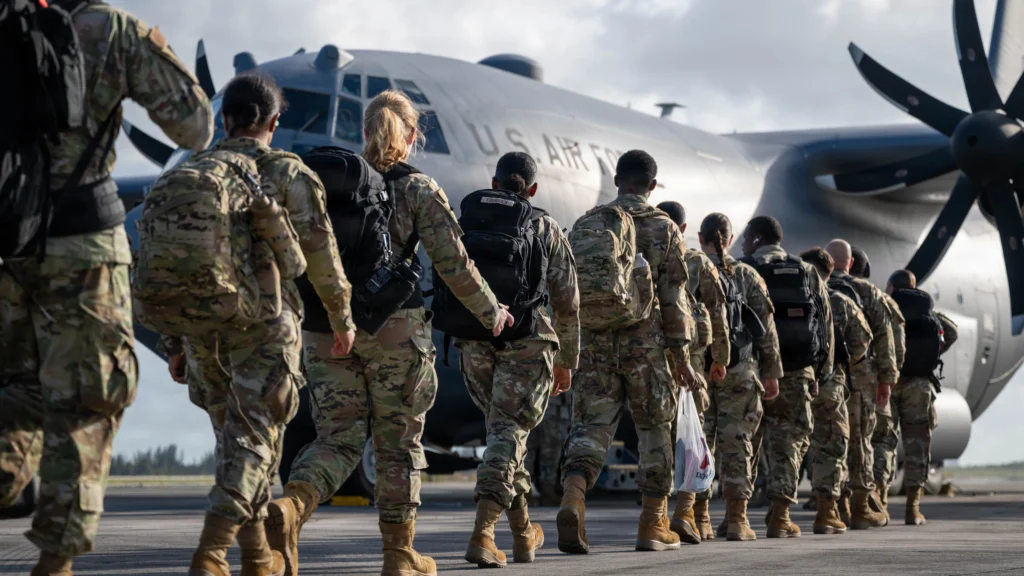
USAF Wargame Reveals Critical Gaps
The exercise divided the blue force participants into two teams. “Team Doolittle” represented the Air Force’s current modernization trajectory over the next decade, while “Team Mitchell” reflected a more aggressive modernization push.
Team Mitchell fielded fewer total fighters but more bombers, Collaborative Combat Aircraft (CCA) drones, E-7 battle management aircraft, and the new sixth-generation F-47 stealth fighter.
The wargame unfolded across three phases set in 2035: deterring a Chinese invasion of Taiwan, actively countering that invasion while striking mainland targets, and sustaining operations through a protracted conflict.
Both teams immediately faced a core dilemma — positioning forces close to Taiwan within the first island chain exposed aircraft to China’s long-range missile strikes, while basing further back significantly reduced sortie generation capacity.
Ground attrition from Chinese missile attacks proved to be the single biggest operational constraint for both teams, outweighing losses from direct air engagements.
Both teams ultimately adopted a split-basing approach, sending forces forward while keeping others at safer distances and delivering attacks in pulses rather than continuous pressure, Air and Space Forces reported.
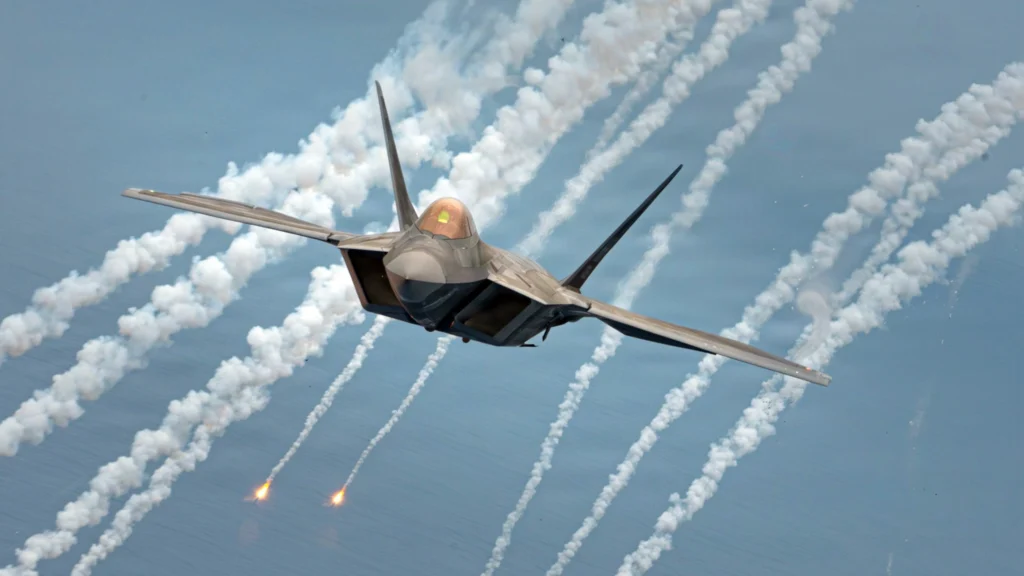
Team Doolittle vs. Team Mitchell
The two teams diverged sharply in capability once active conflict began. Team Doolittle, more reliant on non-stealthy aircraft and standoff munitions, concentrated entirely on defeating the Taiwan invasion force.
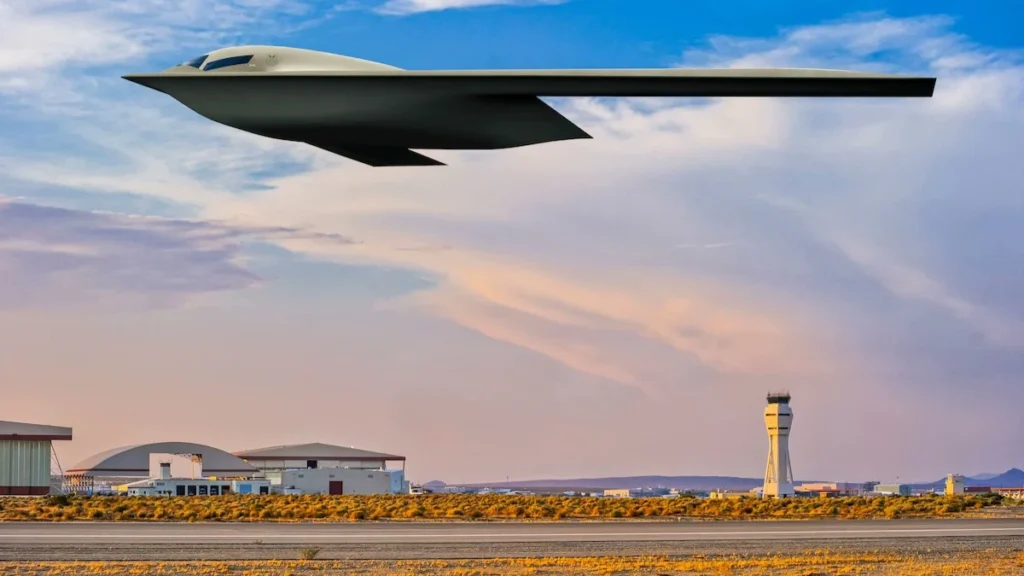
Team Mitchell, equipped with F-47s and B-21 Raider bombers, was able to simultaneously contest the invasion and conduct deep strategic strikes into mainland China.
Retired Col. Mark Gunzinger, project leader and co-author of the report, stated that Team Doolittle’s inability to generate sufficient long-range penetrating strike and counter-air sorties was the defining limitation of that force.
Wargame analysts concluded that Team Doolittle’s approach would ultimately fail because China could continuously reinforce its invasion from within its own borders, which the blue force had no means to interdict at depth.
Team Mitchell’s strategic strike capability, enabled by penetrating platforms with organic kill chains less dependent on external command-and-control systems, gave it a meaningful chance to disrupt the invasion.
Lt. Gen. Jason Armagost, Deputy Commander of Air Force Global Strike Command, described strategic attack as the mechanism to “compel an adversary to change their strategy” and force systemic failure in their operational approach.
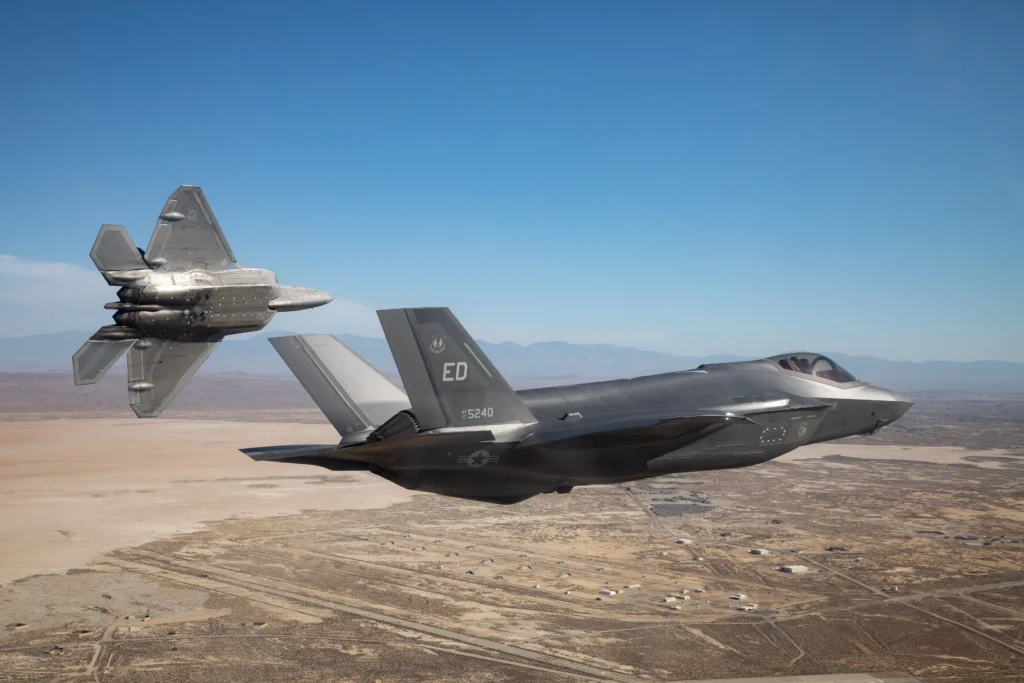
Protracted Conflict Exposes Inventory Depth Problem
Neither team could sustain operations across an extended conflict. Attrition rates exceeded what both forces could absorb given their available aircraft inventories, pointing directly to the consequences of three decades of continuous reductions in USAF combat aircraft numbers.
Gunzinger attributed this to a structural problem: the Air Force has downsized its combat inventories year after year for 30 years, leaving no force large enough to absorb high-intensity Pacific attrition rates over time.
Key Recommendations from the Mitchell Institute Report
The report issued 12 specific recommendations to rebuild what it described as a “balanced Air Force with the capacity to win.” Core recommendations included:
- Procuring more B-21 Raiders and F-47 fighters
- Strengthening air base defenses across the Pacific first and second island chains
- Rebalancing long-range standoff and organic kill chain capabilities
- Fielding a combined space-based and air-based ISR architecture
- Shifting Pentagon resources from the U.S. Army toward the Air Force and Navy, given the Army’s reduced relevance in a Western Pacific conflict
The report called on Congress and the Department of Defense to redirect funding accordingly, including additional resources to defend Pacific basing locations against Chinese missile threats.
Stay tuned with us. Further, follow us on social media for the latest updates.
Join us on Telegram Group for the Latest Aviation Updates. Subsequently, follow us on Google News
