


DUBAI- Emirates (EK) has suspended all flights to and from Dubai International Airport (DXB) after Israel and the United States launched coordinated strikes on Iran, triggering widespread airspace closures across the Middle East.
Qatar Airways (QR) halted operations to and from Hamad International Airport in Doha (DOH), while multiple global carriers suspended services to Tel Aviv (TLV), Beirut (BEY), and other regional hubs amid escalating security risks.
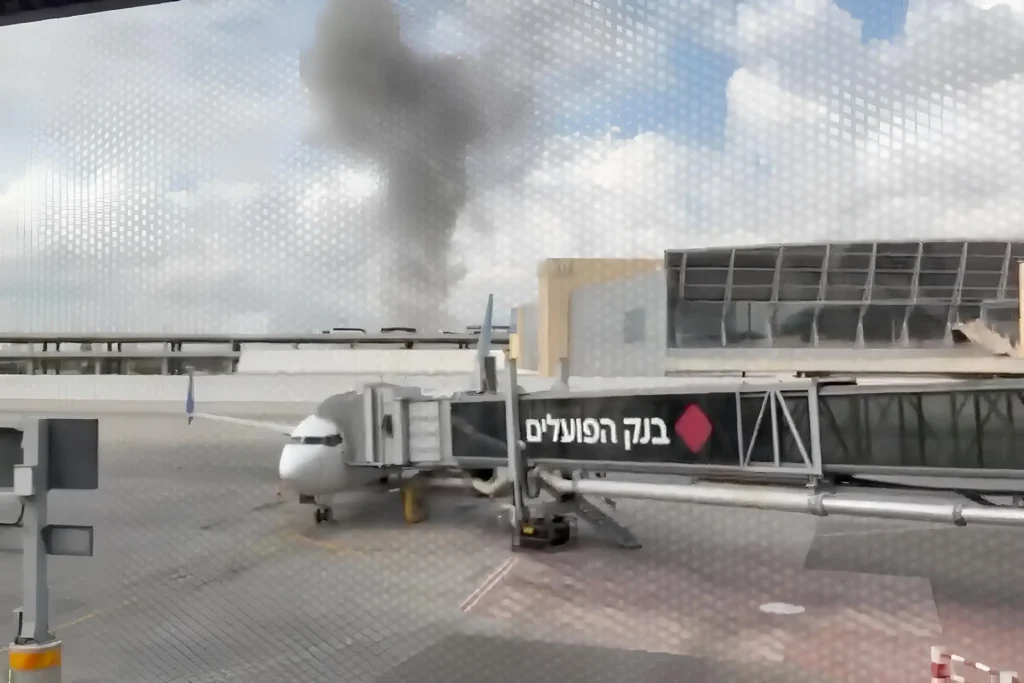
U.S.-Iran War Disrupts Middle East Air Ops
A large-scale military campaign targeting Tehran and other Iranian installations late Friday led to immediate retaliatory missile launches by Iran toward Gulf states hosting US military assets. Bahrain, Kuwait, Qatar, and the United Arab Emirates (UAE) reported heightened air defense activity.
In response, civil aviation authorities across the region closed key sections of airspace. The UAE General Civil Aviation Authority confirmed the suspension of national airspace operations due to rapidly escalating security developments.
Flight tracking data from Flightradar24 showed near-empty skies over Iran, Iraq, Kuwait, Israel, and Bahrain on Saturday.
The European Union Aviation Safety Agency (EASA) advised European carriers to avoid affected airspace zones. The closures created one of the most extensive aviation disruptions in the region in recent years.
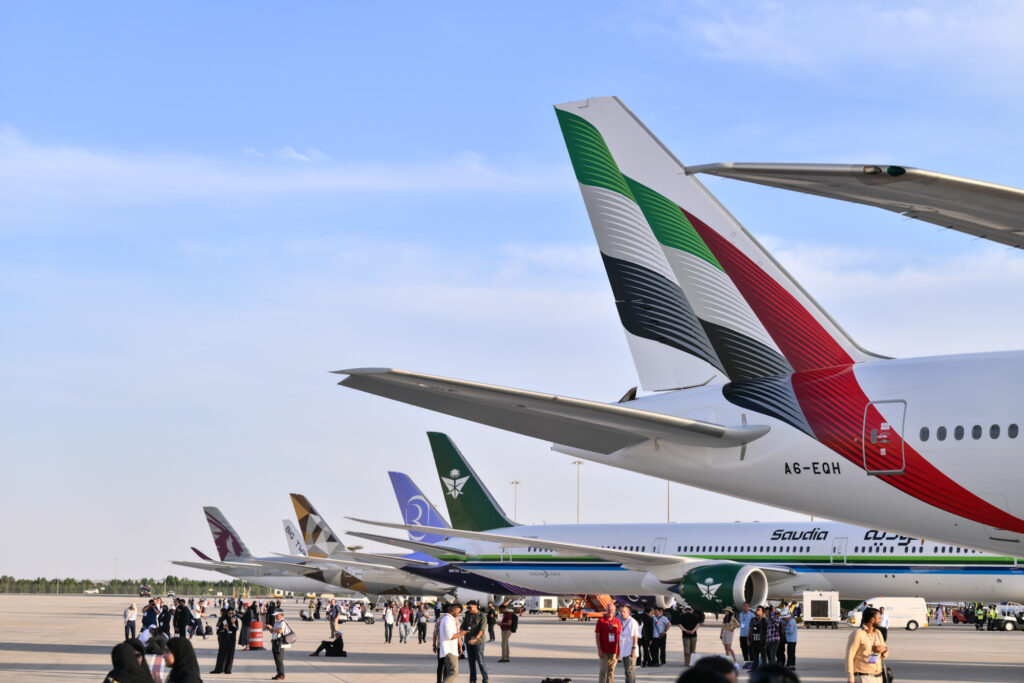
Emirates and Gulf Carriers Suspend Operations
Emirates (EK) confirmed that all flights to and from Dubai (DXB) were suspended until at least 11:00 pm local time on Saturday.
Qatar Airways (QR) temporarily suspended flights to and from Doha (DOH) following the Qatari airspace closure.
Virgin Atlantic (VS) cancelled its London Heathrow (LHR) to Dubai (DXB) service and began rerouting aircraft to avoid Iraqi airspace.
LOT Polish Airlines (LO) returned flight LO121 from Warsaw (WAW) to Dubai (DXB) back to Warsaw mid-route.
Norwegian Air (DY) suspended Dubai services until March 4, while Lufthansa (LH) halted flights to Dubai and Tel Aviv (TLV) and committed to avoiding Israeli, Lebanese, Jordanian, Iraqi, and Iranian airspace until March 7.

European Airlines Halt Tel Aviv and Beirut Routes
Air France (AF) and KLM (KL) cancelled flights to and from Tel Aviv (TLV) and Beirut (BEY). KLM advanced its suspension of Amsterdam (AMS) to Tel Aviv services, cancelling its only scheduled Saturday flight.
British Airways (BA) cancelled flights to Tel Aviv (TLV) and Bahrain (BAH) until March 3, along with its Amman (AMM) service.
Aegean Airlines (A3) suspended routes to Tel Aviv (TLV), Beirut (BEY), and Erbil (EBL) until March 2.
Scandinavian Airlines (SK) halted its Copenhagen (CPH) to Tel Aviv service, with further decisions pending.
Wizz Air (W6) suspended operations to Israel, Dubai (DXB), Abu Dhabi (AUH), and Amman (AMM) until March 7.
Iberia Express (I2) cancelled its scheduled Madrid to Tel Aviv flight on Saturday evening.

Asian and Middle Eastern Carriers Adjust Schedules
Japan Airlines (JL) cancelled its Tokyo Haneda (HND) to Doha (DOH) service and a return flight scheduled for March 1.
Turkish Airlines (TK) cancelled flights to Qatar, Kuwait, Bahrain, the United Arab Emirates, and Oman for Saturday, and suspended routes to Lebanon, Syria, Iraq, Iran, and Jordan until March 2.
ITA Airways (AZ) suspended flights to Tel Aviv (TLV) and halted operations through Israeli, Lebanese, Jordanian, Iraqi, and Iranian airspace until March 7. Dubai services were paused until March 1.
IndiGo (6E) cancelled multiple Middle East services for Saturday, citing operational and safety considerations.

Government Advisories and Security Measures
The British Foreign Office advised nationals in Dubai, Bahrain, Kuwait, Qatar, and the wider UAE to shelter in place, avoid travel, and follow local authority guidance.
Air defense systems were activated across several Gulf states, though reports indicated that some incoming missiles penetrated defensive shields.
The situation remains fluid. Airlines continue to review operational risk assessments, and further cancellations or rerouting decisions are expected if regional tensions persist.
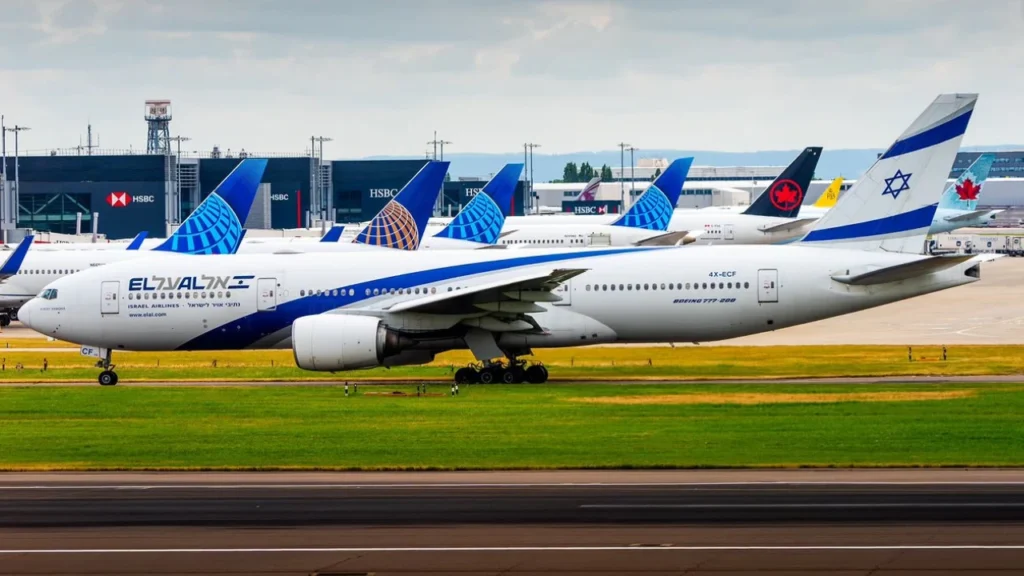
More Details on War
Israel has launched what it calls a preemptive strike against Iran, triggering immediate retaliation across the Middle East. The United States confirmed participation in coordinated military operations targeting Iranian military infrastructure.
Airspace closures, missile exchanges, and maritime security threats now stretch from the Persian Gulf to the Red Sea, signaling a rapidly widening regional conflict.
Israel Launches Operation Roaring Lion Against Iran
The Israel Defense Forces confirmed the start of a large-scale operation, referred to as Operation Roaring Lion, aimed at degrading what Israeli officials describe as existential threats from Iran. According to official statements, the strikes targeted military, missile, and nuclear-related infrastructure, along with command and control nodes linked to Iran’s leadership and security apparatus.
Satellite imagery and released footage indicate significant strikes in Tehran and other strategic locations. Reports suggest damage to facilities associated with the Supreme Leader’s compound, though his status remains unclear. Israeli officials have stated that leadership targets are within scope of the campaign.
The United States confirmed it is conducting parallel operations under the name Operation Epic Fury. A U.S. official stated American forces are focusing on military and missile related targets rather than regime leadership. Pentagon sources described the campaign as a coordinated effort developed through months of joint planning.
Israeli officials also issued evacuation warnings to civilians located near military industrial complexes inside Iran, citing risks from ongoing strikes.
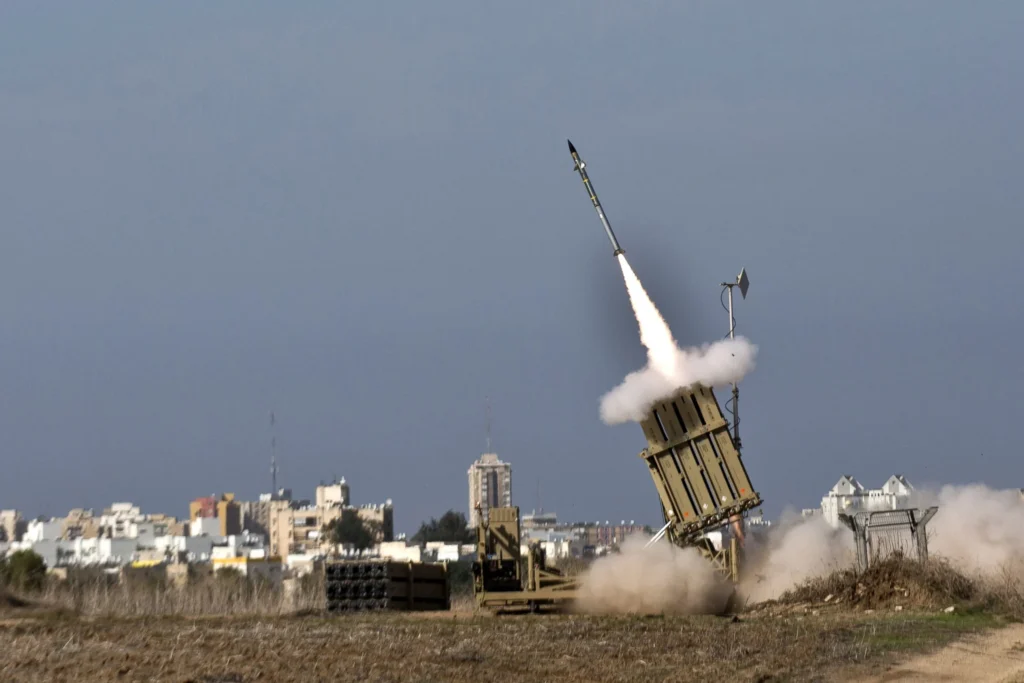
Iranian Retaliation Expands Across the Region
Iran responded with ballistic missile and drone attacks targeting Israel and U.S.-aligned assets across the Gulf. Missile impacts and interceptions were reported in Israel, Bahrain, Qatar, and the United Arab Emirates. Video footage circulating online shows intercepts over Dubai and debris falling in multiple countries.
Iran’s Islamic Revolutionary Guard Corps announced the beginning of what it called extensive missile and drone operations toward Israeli territory. Iranian state media confirmed strikes were in response to what it described as hostile aggression.
Unconfirmed reports indicate impacts near the U.S. Navy’s Fifth Fleet headquarters in Bahrain. U.S. embassies in Bahrain, the UAE, and Jordan issued shelter-in-place alerts. Qatar also activated protective measures near major military installations.
Saudi Arabia condemned Iranian strikes on Gulf states and reaffirmed support for regional allies, warning of serious consequences if sovereignty violations continue.
Airspace Closures and Aviation Disruption
Civil aviation across the Middle East faced immediate disruption. Flight tracking data showed full airspace closures over Iran, Iraq, Kuwait, Bahrain, and Qatar. Commercial carriers diverted routes to avoid conflict zones.
Military air traffic also increased sharply. U.S. tanker aircraft and transport planes were observed repositioning. Israeli aerial refueling aircraft were reportedly operating over Syria in support of strike packages.
Given the scope of airspace restrictions and ongoing missile activity, regional aviation networks are likely to experience extended operational challenges.
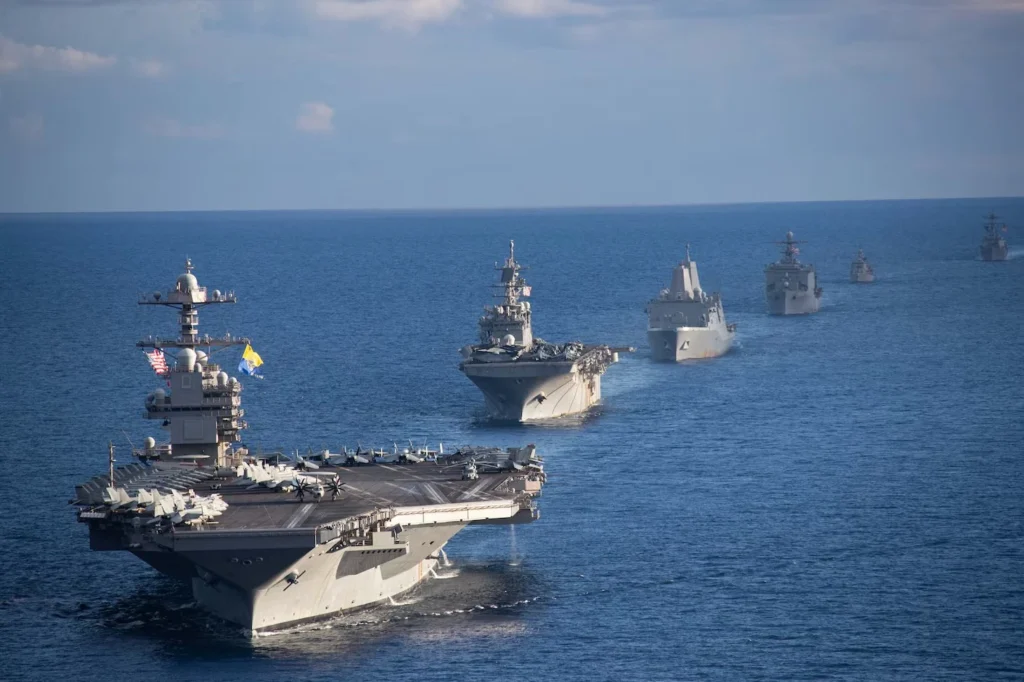
Maritime Security Risks in the Red Sea and Gulf
Maritime security concerns escalated following threats from Yemen’s Houthi movement, which warned of potential attacks on Israeli and U.S.-linked shipping in the Red Sea and Gulf of Aden.
The European Union-led naval mission Operation Aspides urged commercial shipping to remain vigilant, stating that attacks against vessels cannot be excluded. The mission confirmed its assets remain on high alert to safeguard freedom of navigation in one of the world’s most critical trade corridors.
There were also indications that Iranian naval facilities along the Persian Gulf and Arabian Sea were struck, potentially to preempt mining operations or attempts to disrupt the Strait of Hormuz.
Political and Strategic Fallout
Israeli Prime Minister Benjamin Netanyahu stated the joint campaign seeks to eliminate long-term nuclear and missile threats. He credited U.S. leadership for cooperation in the operation.
Former U.S. President Donald Trump described the action as a major combat operation and declared that Iran would not be permitted to develop nuclear weapons. Iranian officials condemned the strikes as violations of international law and warned of continued retaliation.
Oman’s foreign minister expressed concern that ongoing negotiations had been undermined. Oman had been mediating discussions aimed at reducing tensions between Washington and Tehran.
The situation remains fluid. Military operations are ongoing, and further escalation across multiple domains, including cyber, maritime, and air, remains possible.
Stay tuned with us. Further, follow us on social media for the latest updates.
Join us on Telegram Group for the Latest Aviation Updates. Subsequently, follow us on Google News
