


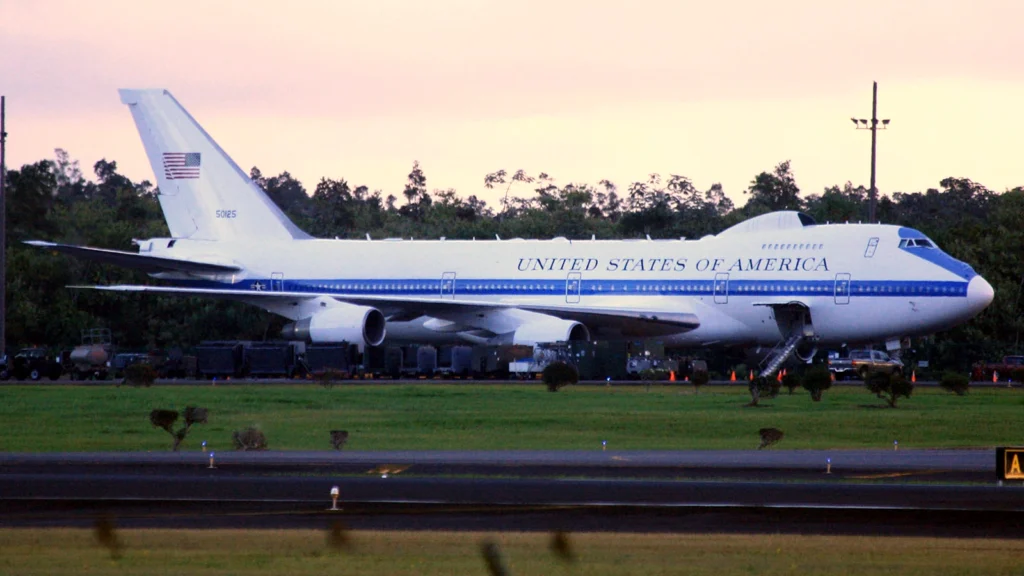
WASHINGTON- The US Air Force’s E-4B Nightwatch, widely known as the Doomsday Plane, has flown into the Washington, DC region as global tensions remain elevated.
The move has drawn attention due to the aircraft’s role in nuclear and national emergency scenarios, even though officials have not indicated any active crisis.

Trump E-4B Moves to Washington
The Boeing E-4B Nightwatch is one of the most secure and specialized aircraft in the U.S. military fleet. Its sole purpose is to ensure continuity of government during catastrophic events that could disable ground-based command centers.
Unlike Air Force One, which focuses on presidential transport, the E-4B serves as the National Airborne Operations Center.
Built on a Boeing 747-200 platform, it allows the President, Secretary of Defense, and senior commanders to direct U.S. forces even if fixed facilities are compromised or destroyed.
The aircraft can remain airborne for extended periods through aerial refueling. This capability ensures uninterrupted command authority during prolonged emergencies, including nuclear or large-scale military scenarios, Live and Let’s Fly reported.

Designed for the Most Extreme Conditions
The E-4B is engineered to operate in environments where conventional systems would fail. While many technical details remain classified, the aircraft is believed to be hardened against electromagnetic pulse effects and designed to withstand nearby nuclear detonations.
Its communications suite is extensive and highly redundant. The aircraft carries dozens of satellite links and specialized antennas, enabling secure contact with military units, ballistic missile submarines, and strategic forces worldwide. This makes the E-4B a central node for national defense decision-making during the most severe events.
On January 6, 2026, the E-4B flew from Offutt Air Force Base in Omaha to Joint Base Andrews in Camp Springs, Maryland. Such flights are not unusual and are typically conducted to maintain crew readiness, test onboard systems, and ensure continuous operational capability.
However, the aircraft’s presence near Washington carries symbolic significance. During periods of heightened geopolitical tension, any movement of the Nightwatch tends to attract scrutiny due to its association with national emergencies.

Readiness Does Not Equal Crisis
The recent flight does not indicate an imminent conflict or emergency. The E-4B is routinely repositioned as part of standard preparedness operations, not as a reaction to specific threats.
Still, its visibility serves as a reminder of how the United States prepares for scenarios that leaders hope never occur.
The aircraft exists to ensure that command and control remain intact under the most severe conditions imaginable.

E-4B Doomsday
E-4B Nightwatch, the United States Air Force aircraft, is designed to function as a flying command center during national emergencies.
Built to ensure continuity of leadership, the E-4B supports the President, Secretary of Defense, and Joint Chiefs of Staff when ground-based command systems are compromised.
The Role of the E-4B in National Defense
The E-4B Nightwatch serves as the National Airborne Operations Center and is a core element of the National Military Command System. Its primary mission is to provide a survivable airborne platform for command, control, and communications during crises ranging from conventional conflict to nuclear scenarios.
If fixed command centers are destroyed or rendered unusable, the aircraft enables senior leaders to direct U.S. forces, execute emergency war orders, and coordinate with civil authorities. The mission scope covers the full threat spectrum, ensuring uninterrupted decision-making capability at all times.
At least one E-4B remains on alert around the clock, supported by a global watch team positioned at selected bases worldwide. This constant readiness ensures immediate response capability for national leadership.
Aircraft Design and Operational Capabilities
The E-4B is a heavily modified version of the Boeing 747-200, engineered for long-range, high-altitude operations. It features four General Electric CF6-50E2 turbofan engines and is capable of aerial refueling, allowing extended endurance during sustained operations.
The aircraft’s main deck is divided into six functional areas, including command workspaces, conference and briefing rooms, an operations team area, a communications center, and crew rest facilities. It can accommodate up to 111 personnel, including flight crew, joint-service operators, communications specialists, security teams, and mission support staff.
Advanced satellite communications systems provide secure, worldwide connectivity for senior leaders. The aircraft is hardened against electromagnetic pulse effects and protected from nuclear and thermal hazards, ensuring functionality in extreme environments.
Strategic Readiness and Emergency Support
Beyond its nuclear command and control mission, the E-4B also supports domestic emergency response efforts. The aircraft has provided command and communications capabilities to the Federal Emergency Management Agency during major natural disasters such as hurricanes and earthquakes.
Air Force Global Strike Command acts as the single-resource manager for the E-4B fleet, supplying aircrew, maintenance, security, and communications support. Operational direction comes from the Joint Chiefs of Staff and is executed through U.S. Strategic Command, which also assigns personnel to the onboard battle staff.
Program History and Assignment
The E-4B evolved from the earlier E-4A variant, which entered service in the mid-1970s. The first E-4B was delivered in January 1980, and all aircraft were converted to the B configuration by 1985.
All four active E-4B aircraft are assigned to the 595th Command and Control Group at Offutt Air Force Base.
The unit has been aligned under Eighth Air Force since October 2016, maintaining responsibility for one of the most critical airborne assets in U.S. defense.

Bottom Line
The E-4B Doomsday Plane is a constant fixture of U.S. national security planning. Its move to the Washington, DC area underscores the military’s focus on readiness rather than signaling an unfolding crisis.
In an uncertain global environment, the Nightwatch remains a critical but rarely seen safeguard of government continuity.
Stay tuned with us. Further, follow us on social media for the latest updates.
Join us on Telegram Group for the Latest Aviation Updates. Subsequently, follow us on Google News
