

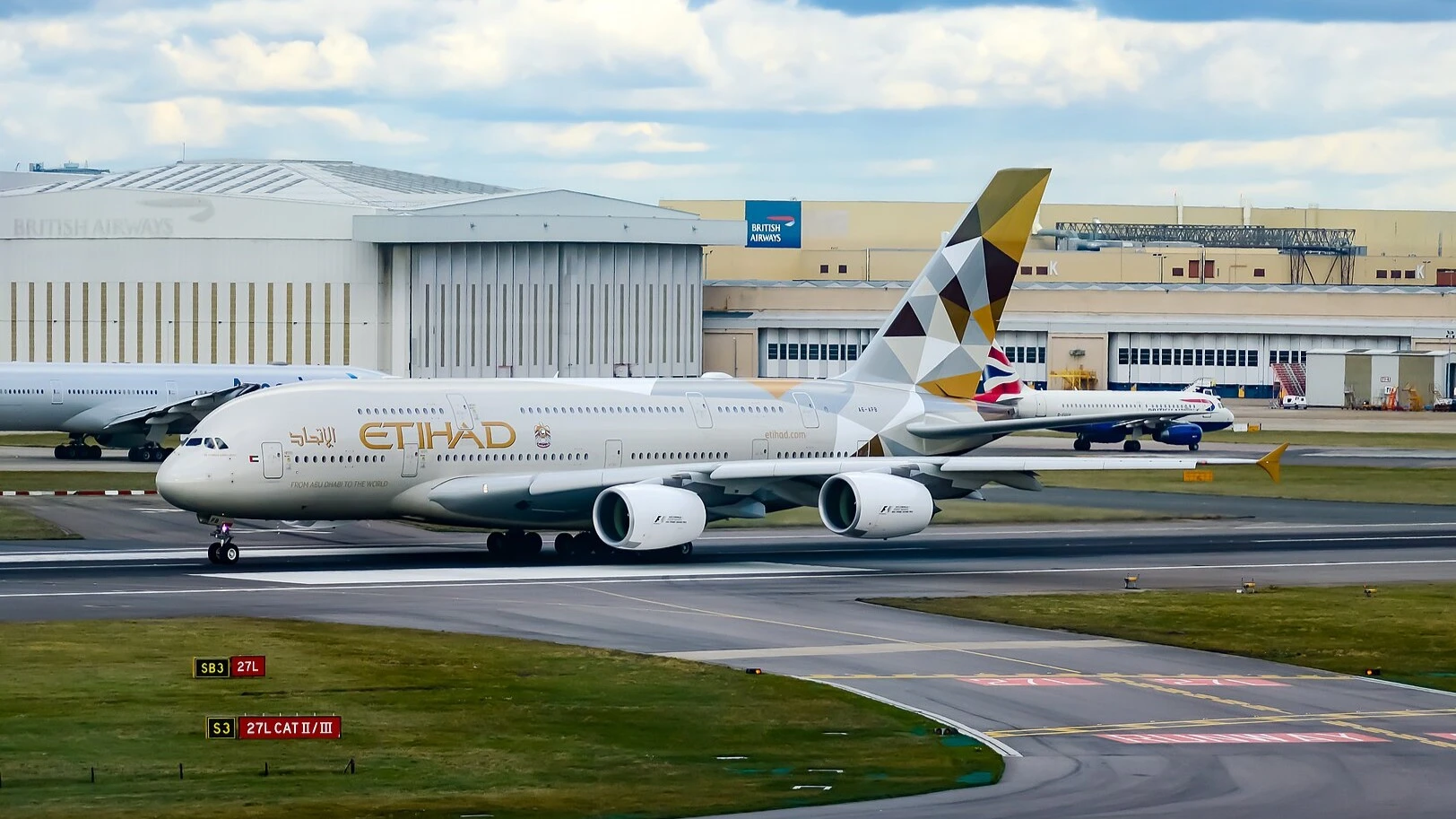
TOKYO- Etihad Airways (EY) flight EY800 from Abu Dhabi (AUH) to Tokyo Narita International Airport (NRT) has recorded repeated delays, with several recent departures leaving more than two hours behind schedule.
Restrictions on Iranian airspace and congestion across alternative flight corridors near Oman offer a plausible explanation for the disruption. However, Etihad has not publicly confirmed the specific cause of the route’s persistent delays.
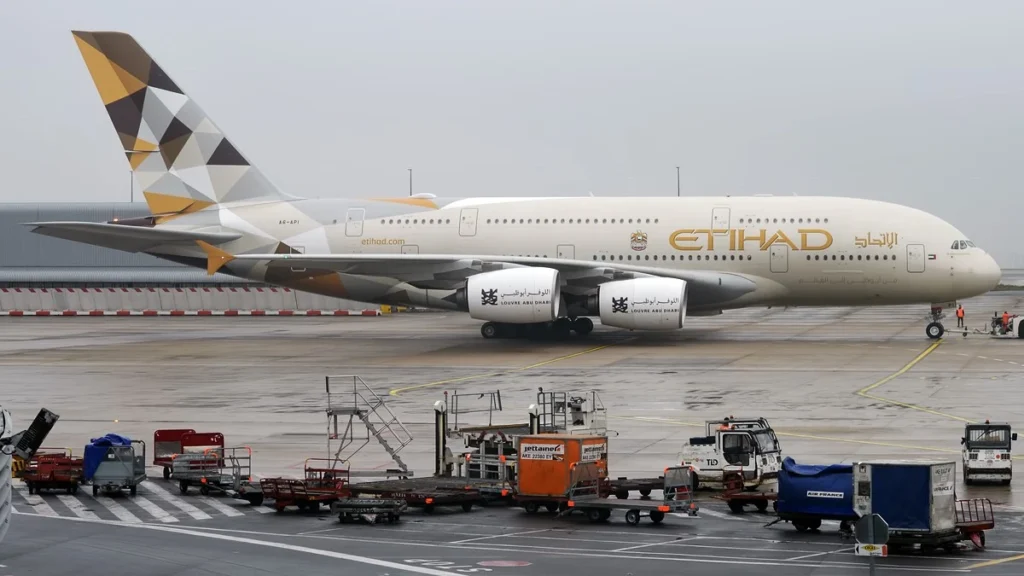
Etihad EY800 Continues to Face Major Delays
Etihad Airways operates flight EY800 between Abu Dhabi and Tokyo Narita using an Airbus A380-800. The route covers approximately 5,035 miles (8,088 kilometres), with a scheduled journey of around 10 hours.
Despite the planned journey time, the flight has struggled to depart and arrive according to schedule. FlightStats data cited in the original report showed that EY800 operated on time approximately 7% of the time, with an average delay exceeding 90 minutes.
Recent flight-tracking records also show a consistent pattern of late departures. According to Flightradar24’s flight history, EY800 departed Abu Dhabi at 12:53 a.m. local time on October 21, 2026, against a scheduled departure of approximately 10:10 p.m. the previous evening. The aircraft subsequently arrived in Tokyo at around 3:19 p.m., compared with its scheduled arrival at 1:30 p.m.
The October 25 service showed a similar pattern. Airportia’s flight tracker recorded an actual departure at 12:22 a.m. on October 26, compared with the scheduled departure at 10:20 p.m. on October 25. Its estimated arrival was 2:17 p.m., approximately 62 minutes behind the scheduled time of 1:15 p.m.
These examples indicate that the delays are not limited to occasional schedule disruptions. However, punctuality percentages and average delays can vary between tracking services depending on the reporting period and measurement method, OMAAT flagged

Iranian Airspace Restrictions May Be Driving the Delays
Air traffic control restrictions and alternative flight routings offer a credible explanation for EY800’s persistent departure delays.
Airlines operating between the United Arab Emirates and destinations across Asia normally plan their routes around available airspace, air traffic control capacity, weather conditions, and security requirements. When a major airspace closes, airlines must adjust their flight plans and share the remaining available routes with other operators.
Iranian airspace has been a significant factor in these changes. A September 30, 2026, operational update from logistics company Expeditors listed Iran as closed to civil operations and warned that affected parts of the region faced tactical routing, air traffic flow controls and short-notice operational changes.
The European Union Aviation Safety Agency (EASA) also maintained an active conflict-zone advisory for Iranian airspace, with the advisory extended through November 16, 2026. These restrictions narrow the available routing options for affected operators and can place additional pressure on neighbouring air traffic control sectors.
For flights travelling east from the UAE towards destinations such as Japan, the loss of conventional routings can increase demand for alternative corridors. Air traffic control authorities must coordinate the movement of flights through these corridors to maintain safe separation and manage traffic volumes.
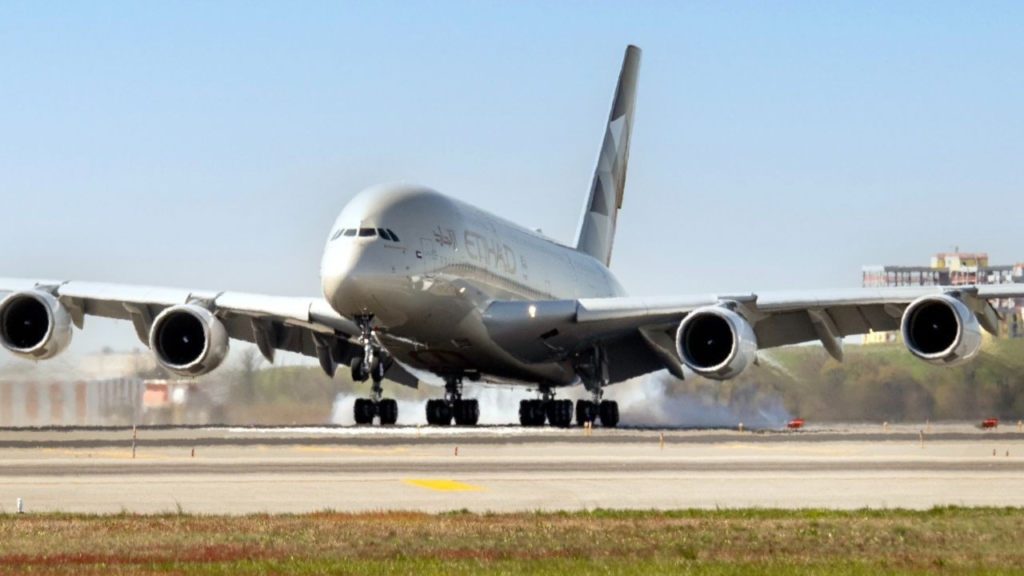
Why Oman Airspace Could Be the Bottleneck
One likely explanation is congestion on routes that connect UAE departures with airspace managed by Oman. Under this scenario, Etihad needs an available departure and air traffic control slot to move EY800 onto its intended eastbound routing.
When demand exceeds the capacity available on a particular route or at a particular time, a flight may have to wait on the ground until the required clearance or slot becomes available. The aircraft can be ready for departure, yet remain delayed because its planned route cannot accommodate it at the preferred time.
This issue may affect Japan-bound flights more severely than some other Asian services. According to the route analysis offered by observers, flights heading towards Japan and other northeastern Asian destinations can compete for limited northern routing options. Flights to destinations such as Singapore and Bali may have access to different routing options, depending on the airspace restrictions and traffic conditions on a given day.
Some observers have also suggested that flights could take more southerly routes through Oman before turning east farther along their journey. Such routings may increase flight distance but could be preferable to waiting several hours on the ground for a more direct route.
The continuing restrictions on Pakistani airspace for Indian aircraft may add further pressure to some regional traffic flows. Pakistan extended its ban on Indian aircraft until November 24, 2026, forcing affected carriers to plan alternative routes. The effect on any particular flight depends on its planned trajectory and the air traffic control capacity available at the time.
Although these factors make congestion a plausible explanation for EY800’s delays, the available information does not establish that Omani air traffic control has specifically caused each late departure.

Why EY800 Appears More Affected Than Other Etihad Flights
The pattern is particularly notable because several potential causes do not fully explain the delays.
The original analysis found that the Airbus A380 assigned to EY800 typically reached Abu Dhabi hours before the scheduled departure. That suggests the problem is not simply the aircraft arriving late from its previous flight.
The return service, EY801 from Tokyo Narita to Abu Dhabi, has also generally operated closer to its scheduled timings, according to the flight-performance information cited in the original report. This difference points towards a possible issue specific to the eastbound service rather than a problem affecting both directions equally.
Connecting passengers have also been suggested as a possible reason for the delay. Etihad could theoretically hold a departing aircraft to accommodate passengers arriving on connecting flights. However, the original analysis noted that services to destinations such as Singapore and Bali around the same period often departed on time.
That comparison makes connecting passengers a less complete explanation, although it does not rule out individual operational decisions.
The long ground turnaround at Tokyo Narita could also influence how the airline manages its departure slot. If a flight has a lengthy period on the ground at its destination, operations planners may have more flexibility to accept a later departure than they would for a service that needs to return quickly to the network.
This remains a possible operational factor, not a confirmed explanation from Etihad. The airline has not publicly established why EY800 experiences delays more frequently than the other services discussed.

What Passengers Should Expect on the Abu Dhabi-Tokyo Route
Passengers booked on Etihad flight EY800 should allow flexibility in their arrival-day plans while the pattern continues.
A delay of 60 to 90 minutes can affect airport transfers, hotel check-in arrangements, onward transport and afternoon activities. The delays reported in recent tracking data have sometimes started with departures more than two hours behind schedule.
Travellers should monitor their booking through Etihad’s official channels and check the latest estimated arrival time before making time-sensitive arrangements in Tokyo. Passengers with connecting flights or fixed transport bookings should review the applicable connection requirements and contact the airline if a disruption affects their itinerary.
The pattern does not mean every EY800 service will experience the same delay. Airspace restrictions, departure slots, and traffic conditions can change, so the performance of an individual flight may differ from the historical average.

Bottom Line
Etihad Airways flight EY800 has experienced repeated delays between Abu Dhabi and Tokyo Narita, with historical performance data showing poor punctuality and recent tracking records confirming late departures.
Congestion on alternative routes, including possible restrictions affecting traffic through Oman, is a credible explanation. Iranian airspace restrictions and the resulting pressure on regional flight corridors provide wider operational context for the problem.
However, the specific cause of EY800’s delays remains unconfirmed. Until its performance improves, passengers should monitor the flight closely and avoid making inflexible plans around its scheduled arrival time.
Stay tuned with us. Further, follow us on social media for the latest updates.
Join us on Telegram Group for the Latest Aviation Updates. Subsequently, follow us on Google News
