

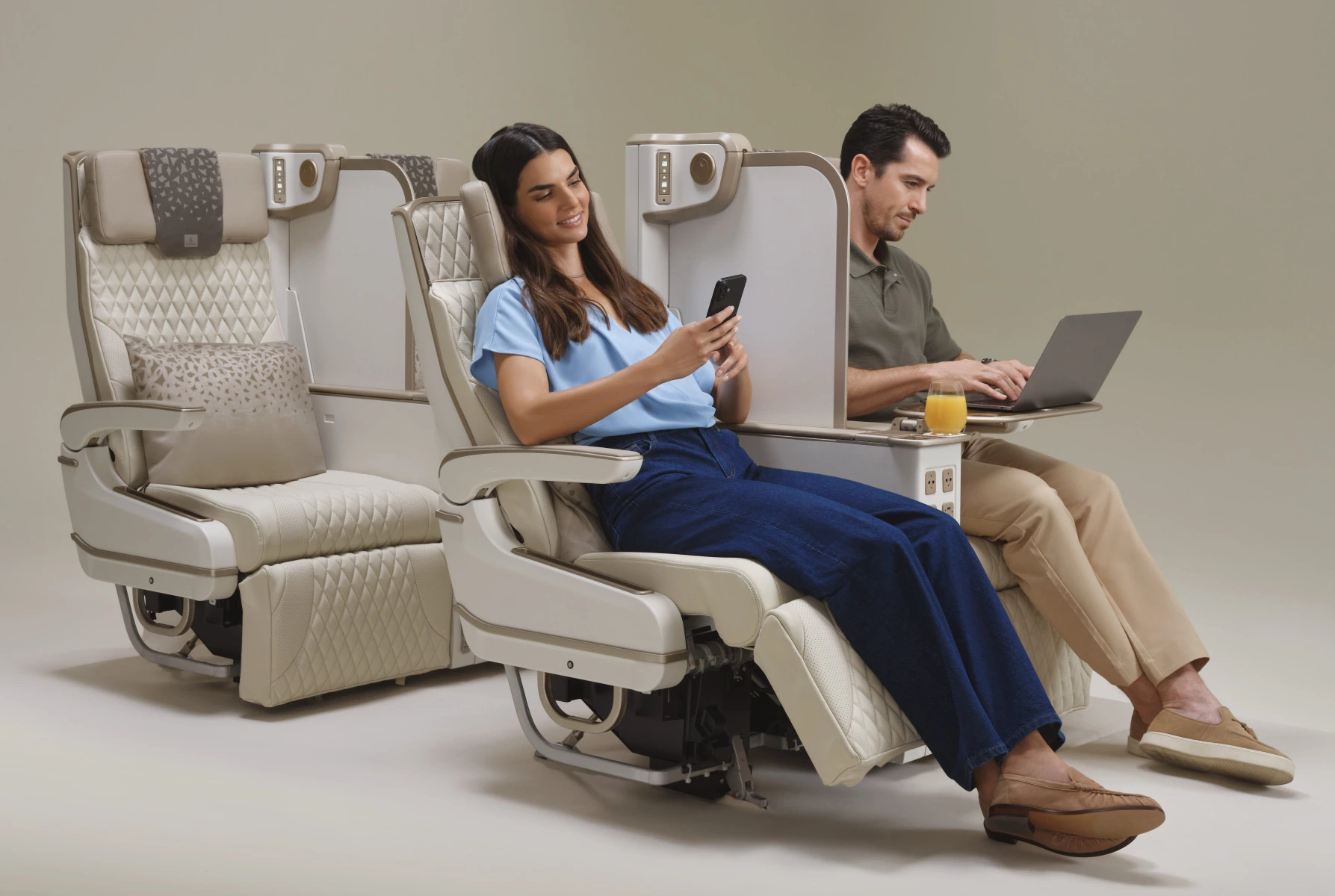
DOHA— Emirates (EK) has strengthened its position in the premium travel market with a new Premium Economy seat, raising fresh questions about why Qatar Airways (QR) continues to operate without a dedicated cabin between Economy and Business Class.
The development is particularly notable because the two Gulf carriers compete directly for long-haul passengers across many of the same markets.
Emirates unveiled its latest electrically powered Premium Economy seat on September 3, featuring a full-height adjustable privacy screen, leather footrest and Safran Seats’ U-Dream headrest.
The seat will debut on new Airbus A350 aircraft in a 2-3-2 configuration with only 28 Premium Economy seats, giving Emirates another product advantage over Qatar Airways.
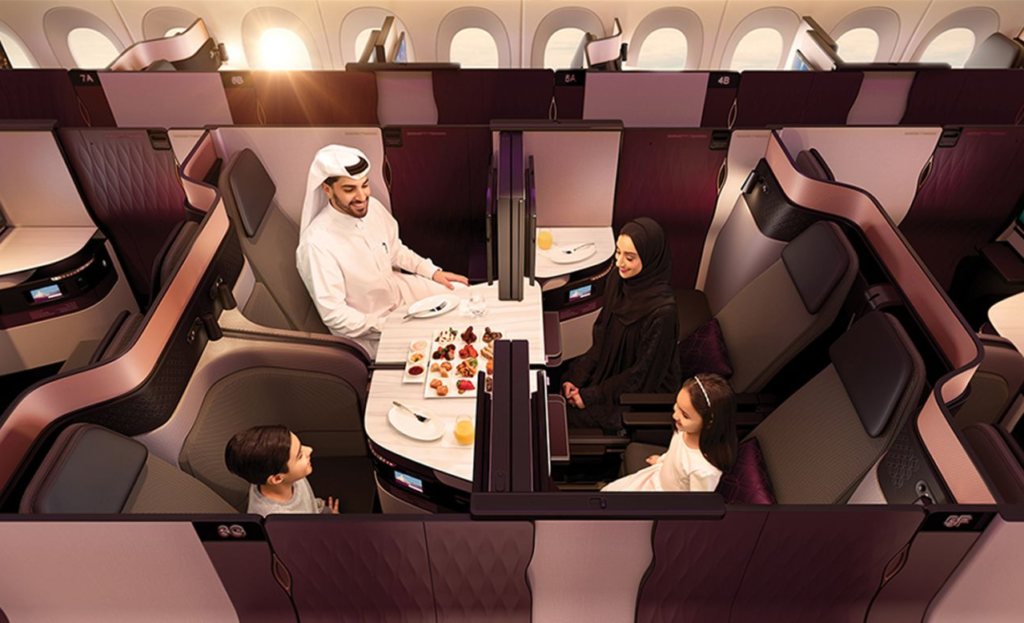
Qatar Airways Premium Economy Policy
Qatar Airways has historically rejected the idea of Premium Economy. Former chief executive Akbar Al Baker repeatedly argued that the airline’s Economy product was already superior to Premium
Economy offered by competitors, and in 2016 said the carrier had no plans to introduce a separate cabin.
That position has become harder to maintain as Premium Economy has evolved into a distinct product rather than simply an Economy seat with additional legroom.
Emirates now offers a dedicated cabin with upgraded seating, privacy and a more refined onboard experience, while Qatar Airways continues to concentrate its long-haul cabin strategy around Economy, Business and First Class.
The difference also creates complications for passengers booking connecting journeys.
A traveler flying with a partner such as British Airways (BA) from London Heathrow Airport (LHR) to Australia through Hamad International Airport (DOH) may be able to book Premium Economy on the first sector, but the Qatar-operated long-haul portion can remain in Economy because Qatar Airways does not operate a standard Premium Economy cabin.
Qatar Airways and British Airways continue to promote enhanced connectivity between the United Kingdom and Australia through their partnership.
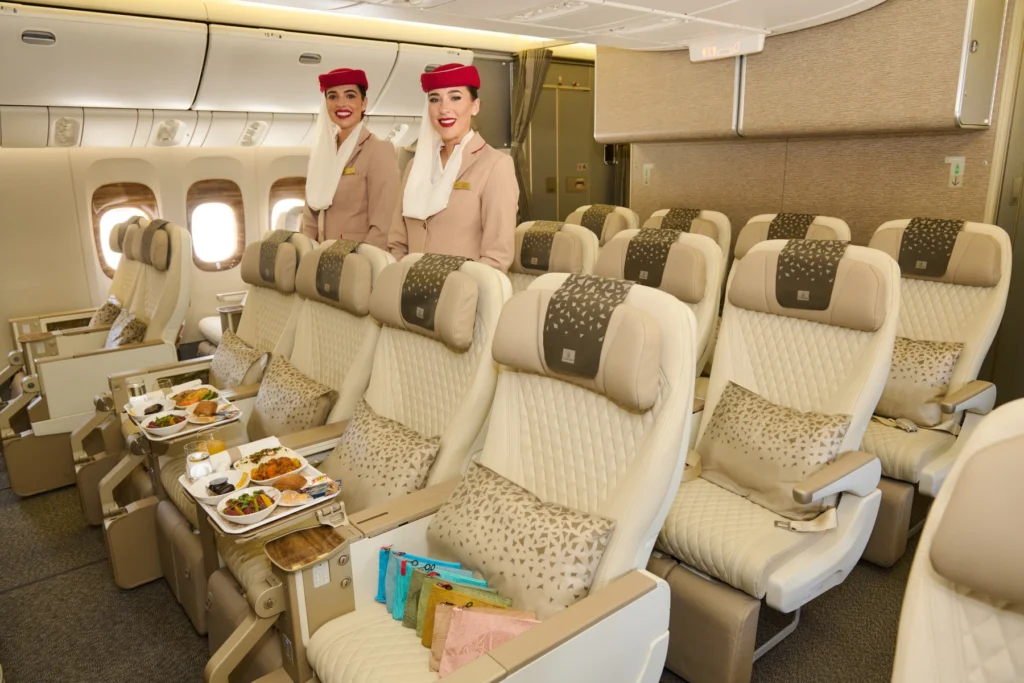
Emirates Raises The Stakes
Emirates’ latest investment suggests the airline sees Premium Economy as more than a temporary upgrade cycle.
Its new A350 seat adds electric adjustment and privacy features while retaining the spacious 2-3-2 layout, giving passengers a clearer step up from Economy without the considerably higher cost of Business Class, PYOK flagged.
Qatar Airways has also had more immediate priorities. Its 2025/26 financial year produced a QAR 7.08 billion ($1.94 billion) profit and 41.8 million passengers, but the final quarter was heavily affected by geopolitical disruption and airspace closures.
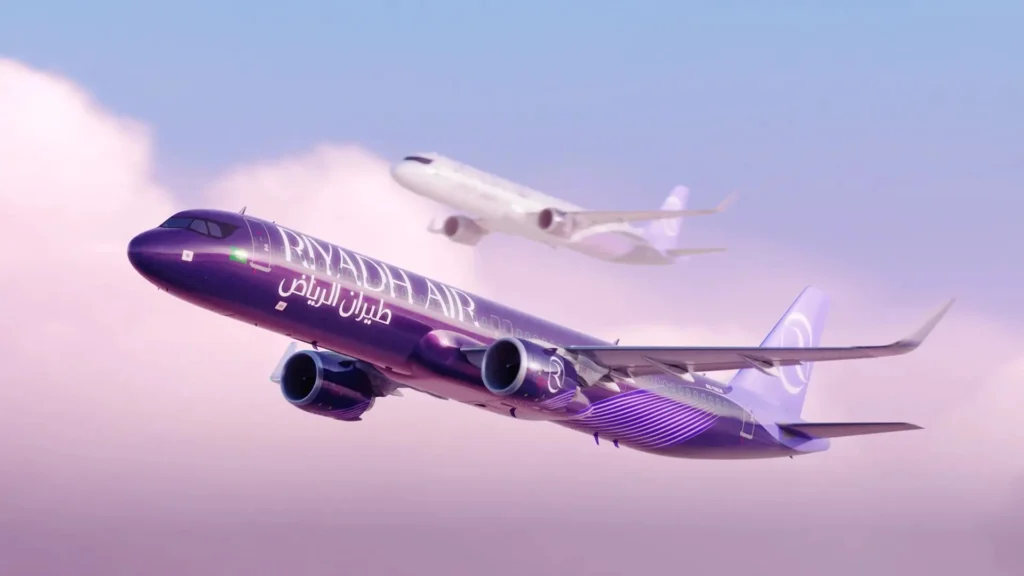
Riyadh Air Changes Competition
The competitive pressure could increase as Riyadh Air develops its network. The new Saudi carrier has designed its Boeing 787 fleet around four cabins, including Premium Economy, with added storage, privacy features and four USB-C charging ports at each Premium Economy seat.
That strategy puts Qatar Airways in an unusual position. Its Economy cabin remains highly regarded, but Premium Economy gives airlines another way to capture passengers who want greater comfort without paying Business Class fares.
For Qatar Airways, introducing Premium Economy would require investment in seats, catering, crew training and aircraft layouts.
Yet Emirates’ latest product demonstrates that the cabin can become a meaningful part of a modern long-haul strategy, leaving Qatar Airways to decide whether its long-standing resistance still makes commercial sense.
Stay tuned with us. Further, follow us on social media for the latest updates.
Join us on Telegram Group for the Latest Aviation Updates. Subsequently, follow us on Google News
