

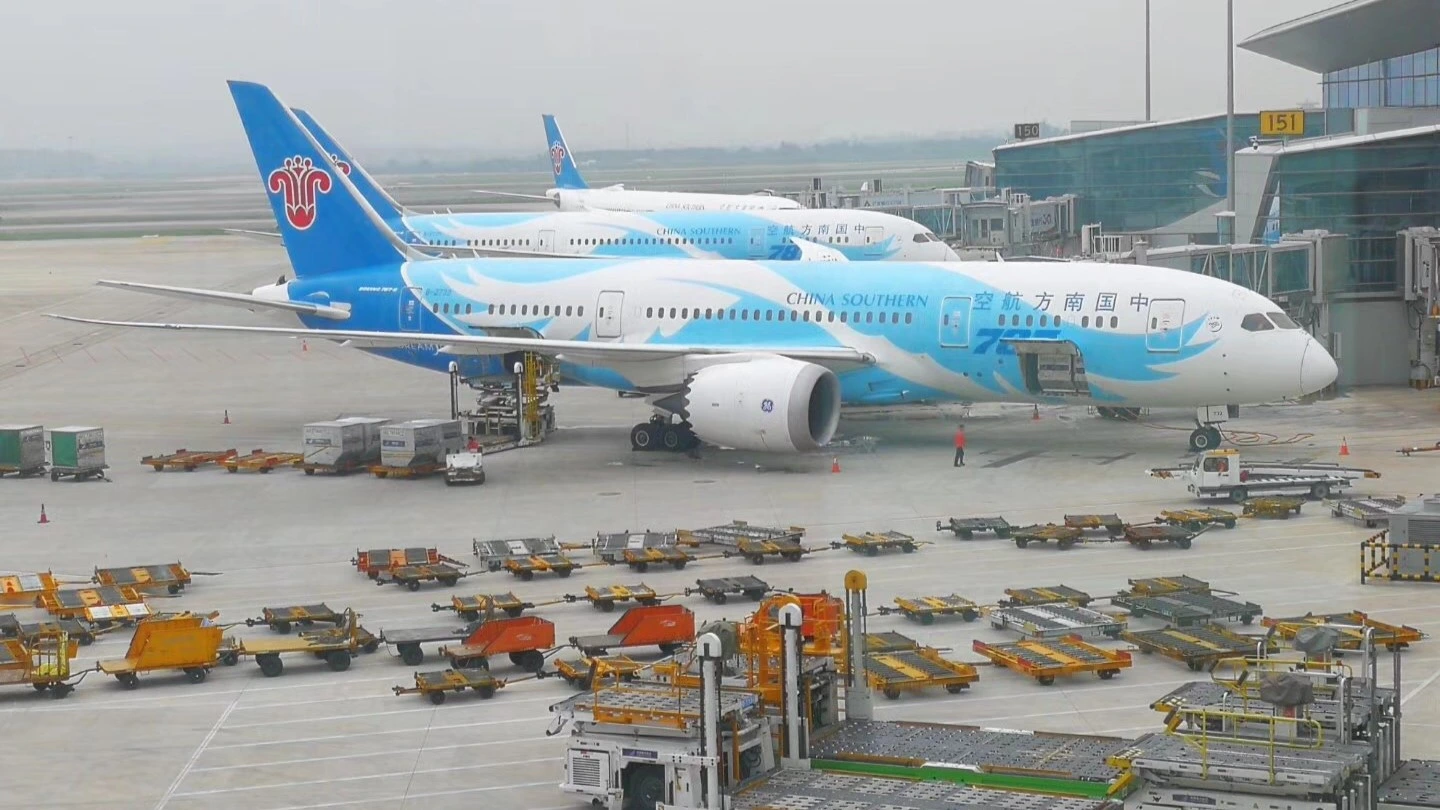
GUANGZHOU— China Southern Airlines (CZ) terminated a veteran flight attendant in 2019 after she posted lingerie selfies from the aircraft lavatory during a delayed flight, sparking a multi-year legal battle over workplace conduct, proportionality of punishment, and the limits of airline authority over crew behavior.
The incident occurred on October 12, 2019, aboard flight CZ3547 departing from Guangzhou Baiyun International Airport (CAN) to Shanghai (SHA), before passengers had boarded. What initially appeared to be a straightforward disciplinary case quickly evolved into a complex legal dispute that reached multiple levels of China’s court system.
China Southern’s Flight Attendant Lingerie Post
Chief flight attendant Guo, who had been with China Southern (CZ) since 2005, posted two lingerie photos to her WeChat Moments during a ground delay caused by air traffic control. Her caption referenced trying a “naked-feel” product and included her bra size.
She deleted the post roughly ten minutes later, but not before a contact screenshotted and reported it. The flight, originally scheduled to depart at 6:55 p.m., eventually left at 8:06 p.m.
The airline terminated Guo on October 18, 2019, citing use of work time for private business, violations of its online conduct rules, and posting content deemed indecent and damaging to the company’s image and public morals.
Guo contested the dismissal, arguing it was disproportionate. Her defense rested on several points: the lingerie was a gift from a friend she was helping promote, she had no financial motive, fewer than 1,000 contacts could view the post, and other crew members were also using their phones, given that no passengers were on board at the time.
Legal Proceedings Expose Gaps in Airlines’ Conduct Rules
Guo filed for labor arbitration on June 3, 2020. The Guangzhou Labor and Personnel Dispute Arbitration Commission ruled the dismissal unlawful on July 22, 2020, ordering China Southern (CZ) to pay RMB 212,735.63 (approximately US$30,909) in back wages.
China Southern appealed to the Baiyun District Court, which upheld the finding against the airline. The court acknowledged the post was inappropriate but determined the airline had failed to establish “serious circumstances” justifying termination.
Crucially, it found the airline’s conduct rules were vague and overbroad, lacking a clear definition of what constituted a “serious” violation. The court also noted the post occurred during staff rest time, caused no safety impact, and resulted in no documented reputational harm to the airline.
The airline escalated the matter to the Guangzhou Intermediate People’s Court, which reversed the lower court’s decision and ruled the termination lawful.
This court found that under Ministry of Transportation regulations, the period in question was classified as a duty period, not rest time, making her actions a conduct violation during active service.
It also noted that one of the airline’s cited rules had not yet taken effect in 2019, though this did not alter its overall conclusion.
The court further determined that the promotional nature of the post, the visibility of her airline identity to contacts, and the presence of the aircraft in the photos combined to create reputational and safety concerns sufficient to justify dismissal.

Case Reaches Guangdong High Court With No Final Ruling Yet
As of the latest available reporting, Guo’s case has been accepted for further appeal by the Guangdong High Court, but no final ruling has been issued. The case continues to generate coverage in Chinese media precisely because it remains unresolved.
The case draws a parallel to that of Delta Air Lines (DL) flight attendant Ellen Simonetti, who was fired in the early days of blogging after posting mildly suggestive photos of herself in uniform aboard aircraft and writing an anonymous blog titled “Queen of Sky: Diary of a Dysfunctional Flight Attendant,” launched in September 2003.
Simonetti was suspended and later terminated, becoming an early example of personal online activity colliding with airline conduct standards at a time when such expectations were largely undefined.
The Guo case reflects an ongoing tension airlines face globally: how far employer authority extends into crew behavior during ambiguous on-duty moments, particularly as social media continues to blur the lines between personal expression and professional conduct.
Stay tuned with us. Further, follow us on social media for the latest updates.
Join us on Telegram Group for the Latest Aviation Updates. Subsequently, follow us on Google News
