

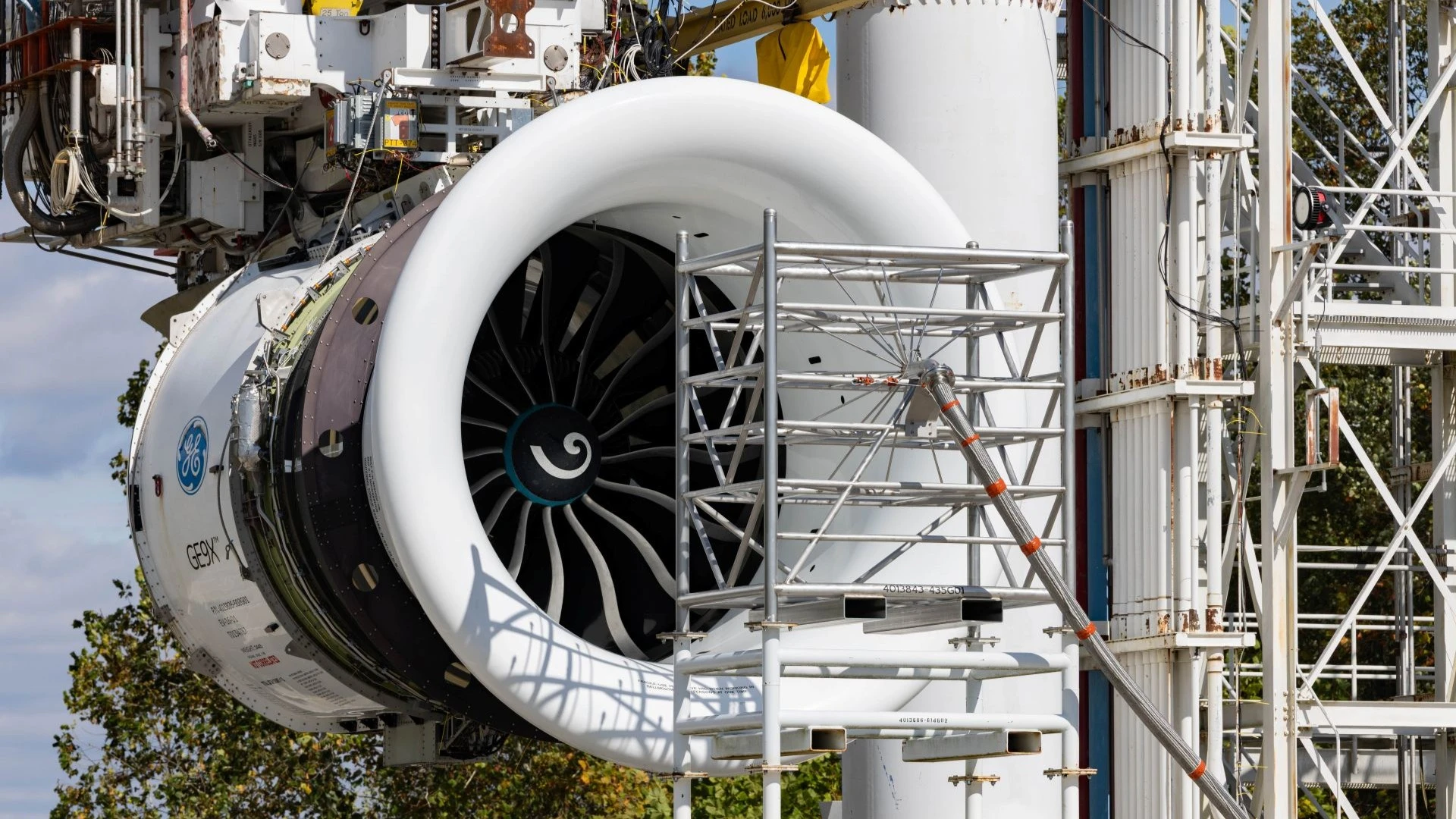
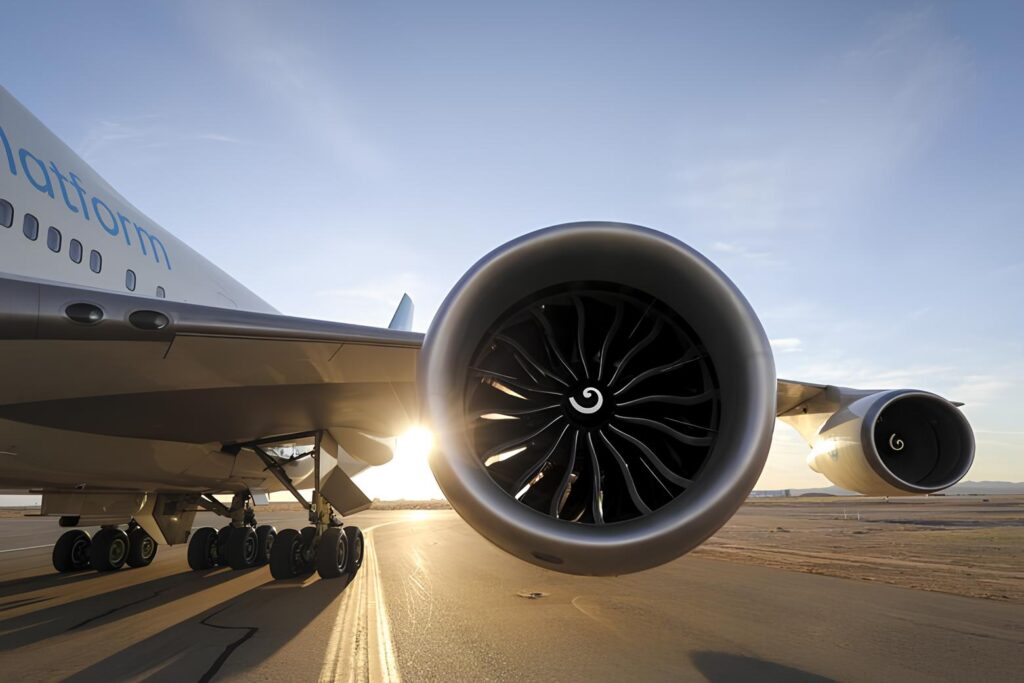
OHIO- GE Aerospace engineers push the boundaries of engine durability by simulating Middle Eastern desert dust in Ohio test cells, targeting the GE9X, the world’s largest commercial jet engine, for Boeing 777X aircraft.
This effort directly addresses demands from Emirates (EK), the Dubai-based carrier, with over 200 firm orders for the twin-engine widebody.
The GE9X delivers a record 134,300 pounds of thrust and 10% better fuel efficiency than the GE90 predecessor, but GE Aerospace prioritizes resilience against fine sand particles in routes from Dubai International Airport (DXB).
Multiple test campaigns, including a second round underway as of late 2024, validate upgrades before the 777X’s entry into service in 2027.
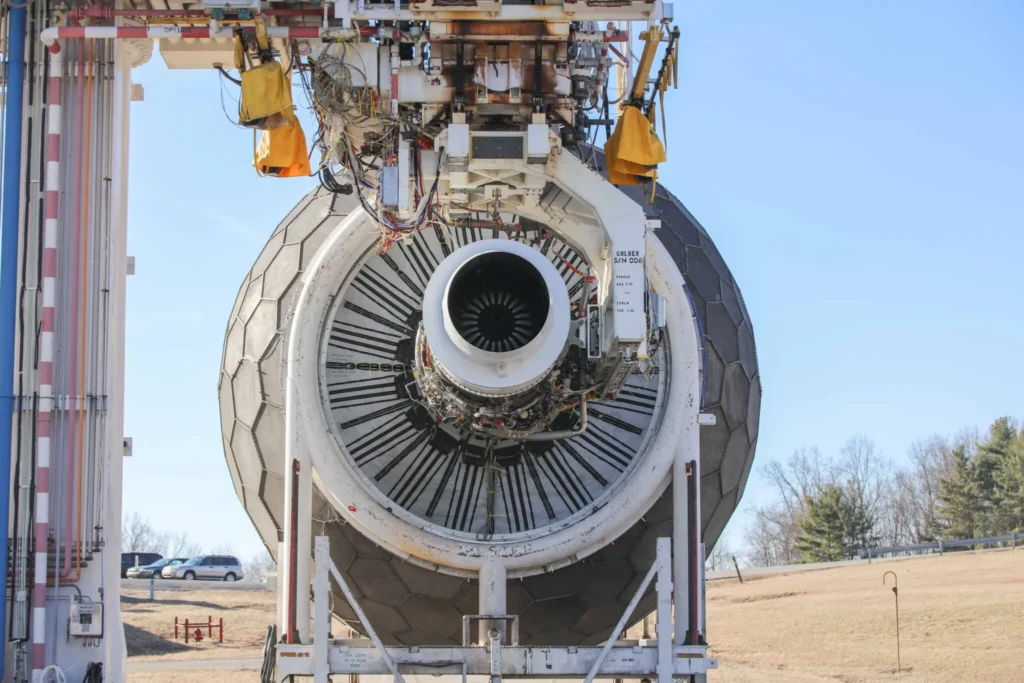
GE Aerospace Test GE9X Dust Durability
GE Aerospace replicates Arabian Desert conditions at its Peebles, Ohio, facility, engineering custom dust mixtures to match the chemistry and particle size encountered during takeoffs from DXB.
Engineers spray these particles onto GE9X components at simulated velocities, accumulating over 1,600 cycles in the initial 2022 campaign and planning a third series in 2025.
This early testing, conducted years before certification, builds on 15 years of lab data and millions of field hours from prior engines like the GEnx and CFM LEAP.
Carlos Perez, vice president of commercial engine systems engineering, notes the precision stems from GE Aerospace’s 2.3 billion global flight hours, enabling predictive modeling of dust erosion on turbine blades and combustors.
These trials have doubled time-on-wing metrics for similar engines in hot, dusty environments, with fixes targeting high-pressure turbine airfoils and coatings to prevent buildup.
For the GE9X, lightweight ceramic matrix composites and 3D-printed parts undergo validation under escalating heat and debris loads, ensuring compliance with Emirates’ (EK) stringent reliability standards for long-haul operations.
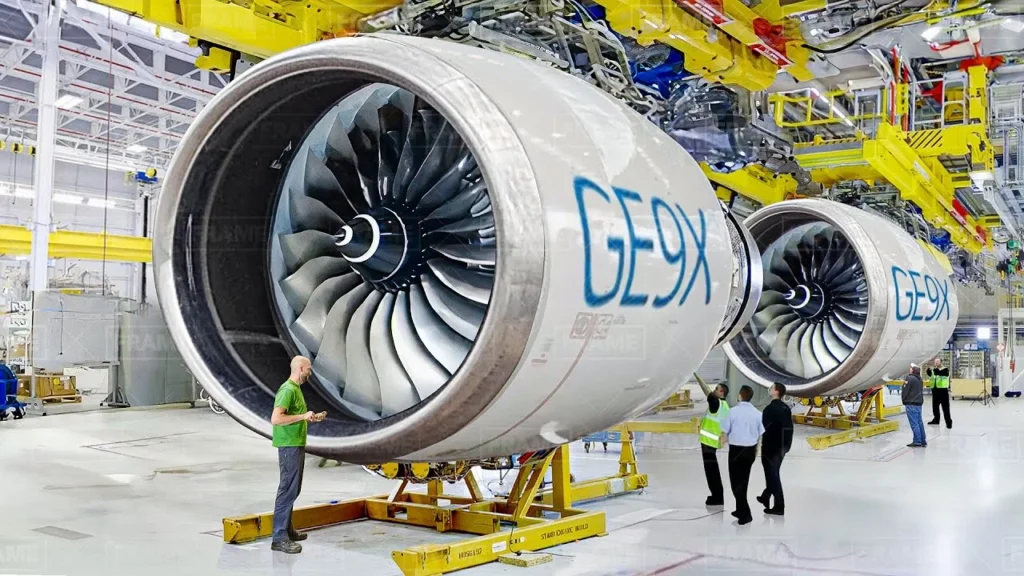
Upgrades from Proven Platforms
Lessons from the GEnx engine, which powers Boeing 787 Dreamliners and entered service in 2011 with 15% fuel savings over the CF6, inform GE9X enhancements.
Engineers repositioned cooling holes on GEnx high-pressure turbine blades by mere micrometers and applied resilient coatings to combustors, boosting durability in Middle Eastern fleets.
A GEnx unit operating since 2021 recently exceeded 4,000 cycles without a major overhaul, thanks to these tweaks and the 360 Foam Wash system that clears internal debris.
Similarly, CFM International’s LEAP engine, used on Boeing 737 MAX and Airbus A320neo, benefits from “turn on, turn off” cycling tests in Cincinnati, Ohio, comparing dusty versus clean runs.
These yield over twofold increases in on-wing time for LEAP-1B variants by 2026, with hardware like improved seals directly transferable to GE9X.
Alisha Kalb, commercial engine systems engineering leader, emphasizes that 30,000+ total cycles on the GE9X, including 9,000 endurance runs, accelerate maturity and reduce post-service disruptions for operators like Qatar Airways (QR) and Etihad Airways (EY).
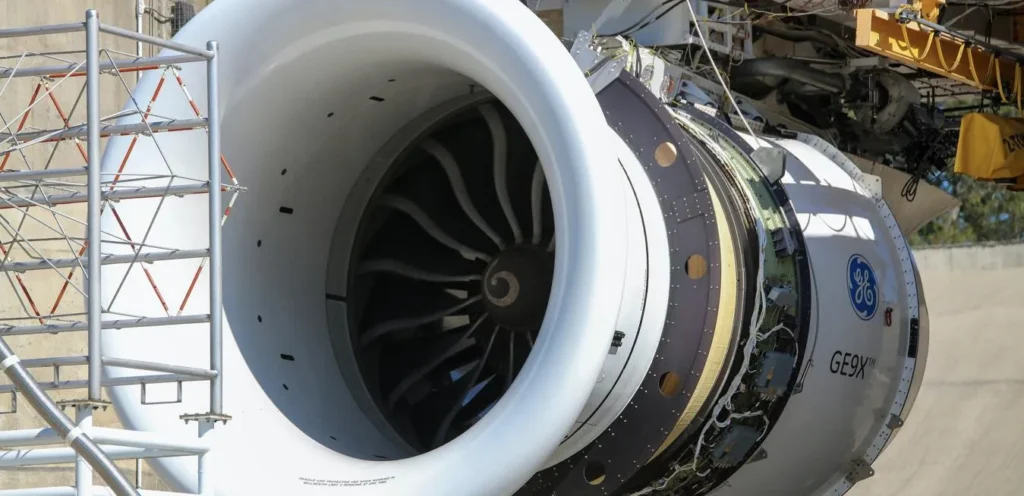
Future-Proofing with RISE
GE Aerospace integrates durability into next-generation programs like the CFM RISE demonstrator, which has logged 3,000+ endurance cycles on hot-section blades while testing Open Fan architecture for 20% fuel savings.
Early dust trials on RISE turbine airfoils, the soonest ever in development, balance efficiency with sand resistance using advanced cooling and composites, as explained by Arjan Hegeman, vice president of future flight technologies.
To support Middle Eastern growth, GE Aerospace invests $50 million in a new 120,000 sq.ft. maintenance, repair, and overhaul facility at Dubai South’s Mohammed Bin Rashid Aerospace Hub, set for completion in Q1 2027.
This expansion from the existing 29,000 sq.ft. site will service GE9X and LEAP engines on-site, minimizing downtime for Emirates (EK) and others. Cristina Seda-Hoelle, GE9X general manager, affirms confidence in meeting Emirates’ feedback, with Federal Aviation Administration approval for extended twin operations targeted for early 2026.
Defense and Legacy Engine Advances
GE Aerospace’s Defense & Systems unit applies similar rigor to military platforms. The F110 engine, powering F-16 fighters, features 92% upgraded parts since 1984, including LEAP derived cooling that extends time-on-wing to 750 hours in sandy theaters.
The T700 helicopter engine surpasses 100 million flight hours with inlet particle separators and doubled hot-section life in the T700-GE-701D variant, enduring extreme temperatures.
These innovations align with GE Aerospace’s FLIGHT DECK model, which drives continuous improvements customer-first.
As Mohamed Ali, senior vice president and chief technology officer, states, simplicity in design, like fewer parts for easier maintenance, underpins long-term reliability, ensuring safe returns for passengers on routes from DXB to global hubs.
Stay tuned with us. Further, follow us on social media for the latest updates.
Join us on Telegram Group for the Latest Aviation Updates. Subsequently, follow us on Google News
