


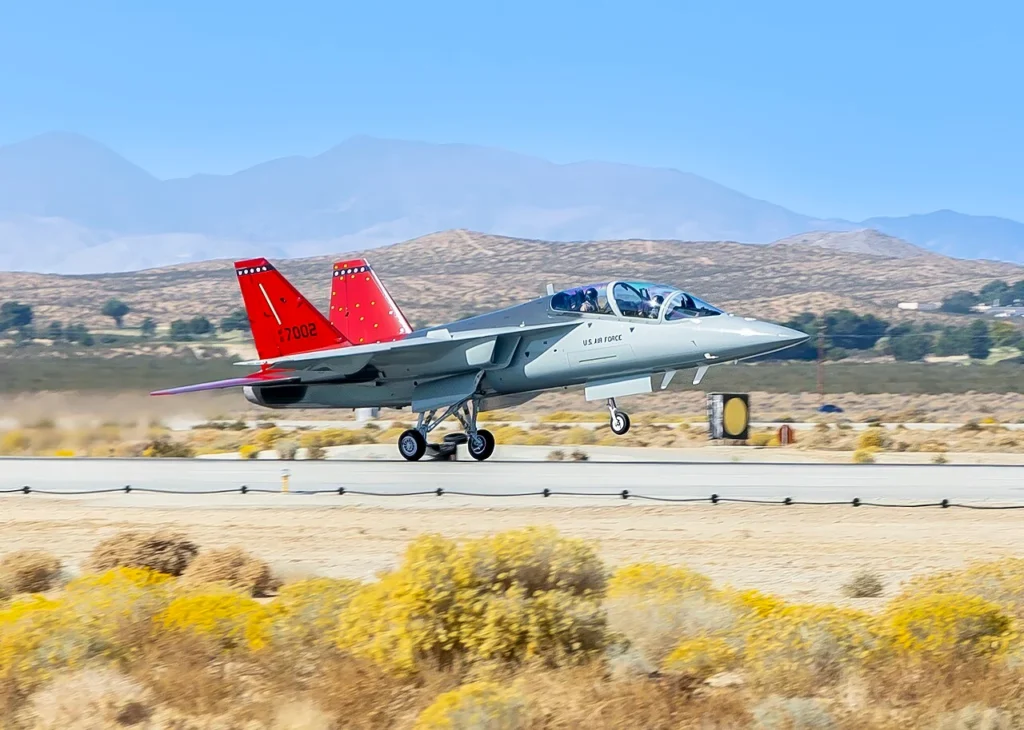
WASHINGTON, D.C.— The United States Air Force (USAF) has approved the T-7A Red Hawk advanced trainer aircraft to enter production, awarding a $219 million contract to Boeing to build the first batch of jets.
The approval follows the program achieving a key acquisition milestone, allowing Boeing to begin low-rate initial production. The contract includes 14 aircraft along with support systems, spare parts, and training infrastructure.
The T-7A Red Hawk is being developed by Boeing to replace the aging Northrop T-38 Talon fleet, which has been in service for more than six decades.
The new trainer is expected to prepare pilots for advanced aircraft such as the F-35 and F-22, which demand significantly higher levels of system awareness and flight control precision.

Boeing Wins $219 Million Deal from USAF
The approval, known as Milestone C in defense acquisition terms, clears the program to begin manufacturing its first operational units. This stage confirms that the aircraft has met key testing and design benchmarks required for production readiness.
The initial contract focuses on a limited batch of jets, allowing the Air Force to gradually scale production while continuing evaluation. This phased approach is intended to reduce risk and incorporate lessons learned during ongoing testing.
The Air Force plans to monitor each production lot carefully before approving larger orders. This method ensures that any technical issues identified during early production can be addressed without disrupting the broader program timeline.

Training Capability
The T-7A Red Hawk is designed to transform how pilots are trained for modern air combat.
Unlike older trainers, it integrates advanced avionics, digital systems, and high-performance flight characteristics that closely match frontline fighter jets.
This capability allows trainee pilots to transition more smoothly into aircraft such as the F-15EX, F-35, and future platforms like the B-21 Raider. The aircraft also reduces the need for early training on operational fighters, which are expensive to operate and maintain.
In addition to the aircraft itself, the program includes 46 ground-based simulators that will support pilot instruction across multiple training bases.
These simulators will play a key role in building skills in a controlled environment before pilots move to live flight operations.
T-7 Program Challenges
The T-7 program has faced multiple delays since its initial contract award in 2018, when Boeing secured a deal valued at approximately $9.2 billion.
Early expectations aimed for operational deployment by 2023, but technical issues pushed timelines back several times, Air and Space Forces flagged.
Challenges included problems with the ejection seat system, flight control software, and supply chain disruptions. These issues required redesign efforts and additional testing, which extended the development phase.
In response, the Air Force adopted a revised management approach that increased collaboration with Boeing and expanded the test fleet. This strategy helped stabilize the program and enabled it to reach the production stage.
The service now plans a gradual ramp-up in procurement, with future orders expected to increase significantly through the late 2020s. Initial operational capability is currently targeted for 2027.
Stay tuned with us. Further, follow us on social media for the latest updates.
Join us on Telegram Group for the Latest Aviation Updates. Subsequently, follow us on Google News
