


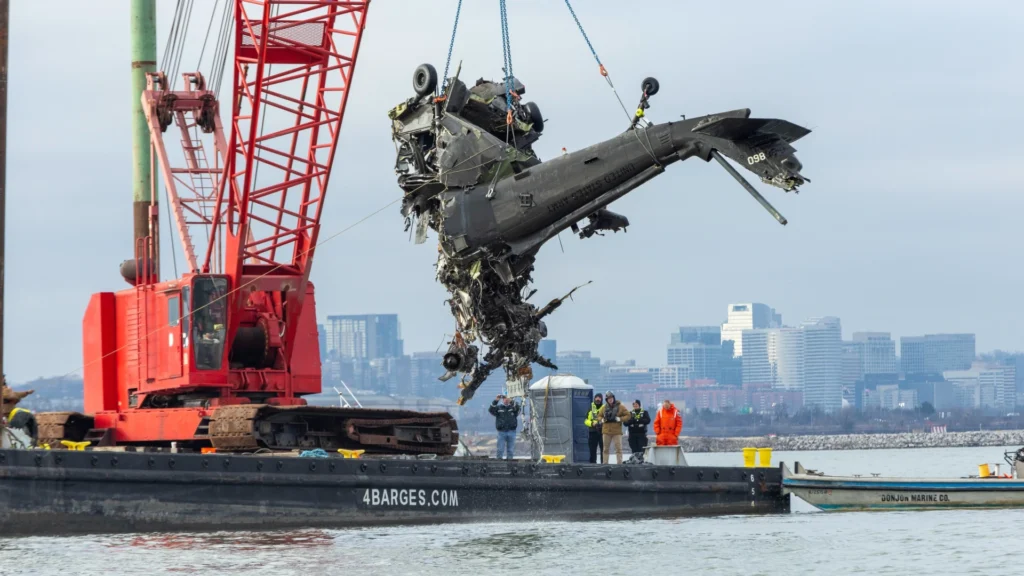
FORT WORTH- American Airlines (AA) Flight 5342, operated by regional partner PSA Airlines, crashed into the Potomac River on January 29, 2025, after colliding mid-air with a US Army Black Hawk helicopter while on approach to Ronald Reagan Washington National Airport (DCA) from Wichita Dwight D. Eisenhower National Airport (ICT).
The tragedy killed all 64 passengers and crew onboard the regional jet and three soldiers aboard the helicopter.
In the aftermath of the crash, Jo Ellis, a transgender Virginia Army National Guard Black Hawk pilot, became the target of a viral defamation campaign on the social media platform X.
Ellis was approximately 100 miles away from Washington, D.C. (DCA) at the time of the incident and had no affiliation with the Fort Belvoir unit operating the helicopter involved.
A federal court has now ruled that her defamation lawsuit against social media influencer Matt Wallace can move forward after denying his anti-SLAPP motion on appeal.
American Airlines Crash Falsely Blames Trans Pilot
Shortly after the American Airlines (AA) Flight 5342 collision, Matt Wallace posted to his 2.3 million followers on X, claiming his brother @JackWallace888 had identified the helicopter pilot as transgender.
Wallace then singled out Ellis as the pilot responsible for the crash, as reported by View from the Wing.
Wallace posted that the “transgender helicopter pilot who allegedly crashed into the plane” was converting to Judaism.
He also claimed a “transgender Black Hawk helicopter pilot” had written about gender dysphoria and depression one day before the crash.
He then suggested that what happened “may have been another trans terror attack.” That post alone accumulated 4.8 million views.
Ellis was not in the US Army. She served as a Virginia Army National Guard Black Hawk pilot for 15 years and had no connection to the Fort Belvoir military unit involved in the crash.
She was very much alive and located roughly 100 miles from the crash site at the time of the collision.

Online Harassment and Amplification
Ellis became the second-most trending topic on X following the crash. More than 90,000 posts on the platform mentioned her name or likeness.
According to her lawsuit, Wallace’s campaign reached over 18 million people and triggered direct threats against her safety.
Other accounts rapidly amplified the false narrative. An account called Project Constitution (@ProjectConstitu) posted a thread labeled “BREAKING,” framing the crash as potentially intentional and claiming Ellis had appeared on a podcast the day before the collision.
Multiple accounts posted that Ellis had been “confirmed” as the crash pilot. This misinformation spread widely before the National Transportation Safety Board (NTSB) released any substantive findings about the accident.
Wallace later posted what he called an “important update,” acknowledging that Ellis was not piloting the helicopter and was still alive.
However, he misgendered Ellis in the correction itself, using “he” and “his” throughout the post, even while acknowledging the error.

Court Denies Anti-SLAPP Motion
Wallace attempted to dismiss Ellis’s defamation lawsuit through an anti-SLAPP motion, arguing his posts constituted protected speech on a matter of public concern. The court denied his motion.
He appealed, and the appellate court also denied his motion, allowing the case to proceed.
Because the crash qualifies as a matter of public concern, Ellis must demonstrate “actual malice” by clear and convincing evidence. This means she must prove Wallace either knew his statements were false or acted with reckless disregard for the truth.
Ellis’s legal team argues several factors support an actual malice finding. Wallace had no firsthand knowledge or reliable source identifying Ellis as the pilot. He relied on information from his brother and other unverified posts.
He used her photograph without verification. He failed to conduct any investigation before publishing the claims.
He later deleted or modified posts and blamed other users after Ellis posted “proof of life” demonstrating she was alive and uninvolved.

Terror Attack Accusation
Wallace’s claim that Ellis was the crash pilot is false on its face. However, his suggestion that she was engaged in a “terror attack” presents an independently actionable problem in the defamation case.
The false identification alone causes reputational harm, but accusing someone of committing a terror attack carries an additional layer of defamatory weight.
Wallace will likely argue that the phrase “may have been another trans terror attack” was speculation rather than a factual assertion.
He will contend that the qualifying language “may have been” signals opinion and hyperbole, not a statement of fact. He will also argue he was merely repeating what others were saying on the platform.
If the court treats this as pure opinion, it could receive different legal treatment than the factual claim about Ellis being the pilot.

Wallace Files Counterclaim and Amplification Problem
Wallace filed a counterclaim alleging that Ellis defamed him through statements she made about the case during podcast appearances and stand-up comedy performances.
Ellis has responded that her statements were not materially false and were not made with actual malice.
Wallace’s defense rests partly on the argument that he was reacting to chaotic breaking news conditions, relied on posts from other users, including his brother, used qualifying language such as “allegedly” and “may have been,” and corrected his posts once Ellis publicly demonstrated she was uninvolved.
Working against this defense is the documented absence of any reliable source or independent investigation before publication.
Even if liability is established, Wallace may not bear sole responsibility for the reputational harm Ellis suffered.
The broader internet mob played a significant role in amplifying the false narrative beyond Wallace’s initial posts. Thousands of accounts repeated and expanded on the claims independently.
This shared amplification could reduce Wallace’s individual liability in any damages calculation.

Broader Lessons
The rush to assign blame after the Potomac crash exposed how quickly misinformation can cause irreversible harm.
Identifying the pilot as transgender fit a pre-existing political narrative that sought to link diversity and inclusion initiatives to catastrophic operational failures. That narrative proved entirely false.
The actual investigation into the crash has focused on military flight operations over civilian airspace near Ronald Reagan Washington National Airport (DCA) and longstanding concerns about helicopter traffic patterns in the Potomac corridor.
The collision highlighted a known risk involving military air traffic over civilian approaches that had not received adequate attention until the tragedy occurred.
The case ultimately reinforces that facts matter for anyone seeking answers to important questions in good faith. The US military’s history offers relevant context.
Few today would dispute that racial integration made the armed forces a stronger and more effective institution.
What that historical parallel means for current debates about inclusion in the military remains an open question.
But this case makes clear that rushing to conclusions based on identity rather than evidence can destroy reputations and undermine the search for truth.
Stay tuned with us. Further, follow us on social media for the latest updates.
Join us on Telegram Group for the Latest Aviation Updates. Subsequently, follow us on Google News
