

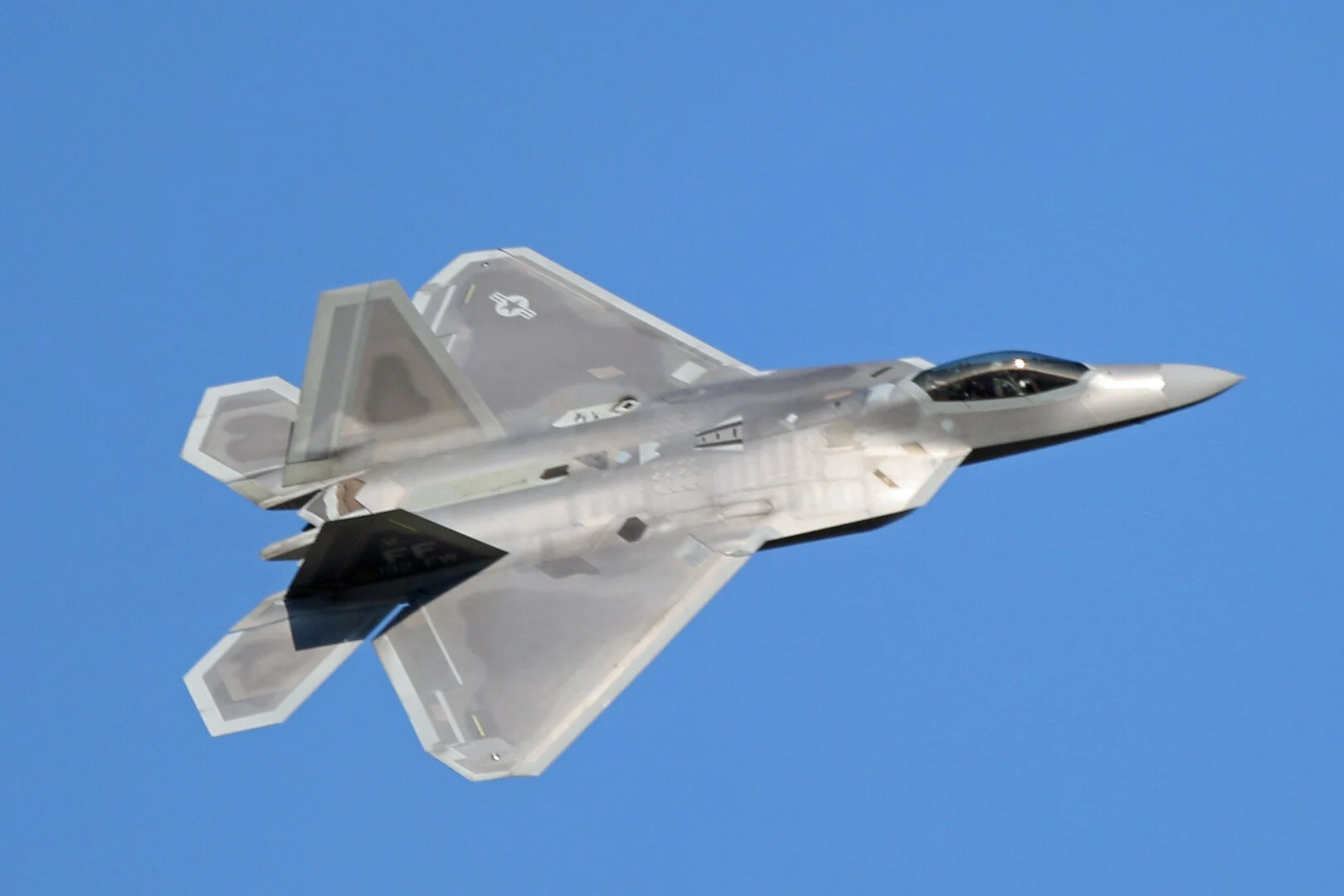
CALIFORNIA— The U.S. Air Force (USAF) has been conducting expanded flight testing over the Mojave Desert, with new photographs capturing the F-22 Raptor in its upgraded “Raptor 2.0” configuration.
The images show the aircraft equipped with stealthy external fuel tanks and infrared sensor pods, marking a significant step in the jet’s modernization program.
Separately, a Boeing B-52H Stratofortress was photographed carrying a pair of AGM-181A Long-Range Standoff (LRSO) nuclear-armed cruise missile prototypes under its wing.
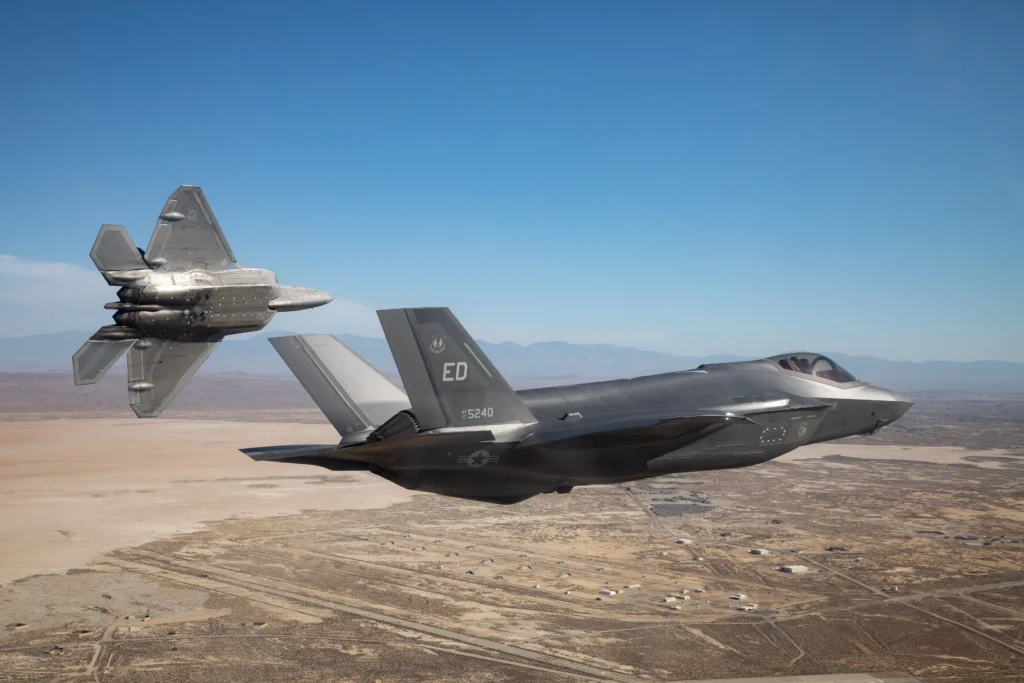
Aviation photographer Jarod Hamilton captured both aircraft during flight tests out of Edwards Air Force Base (EDW), also photographing them linking up with a KC-135 tanker for aerial refueling, TWZ reported.
F-22 Raptor Modernization
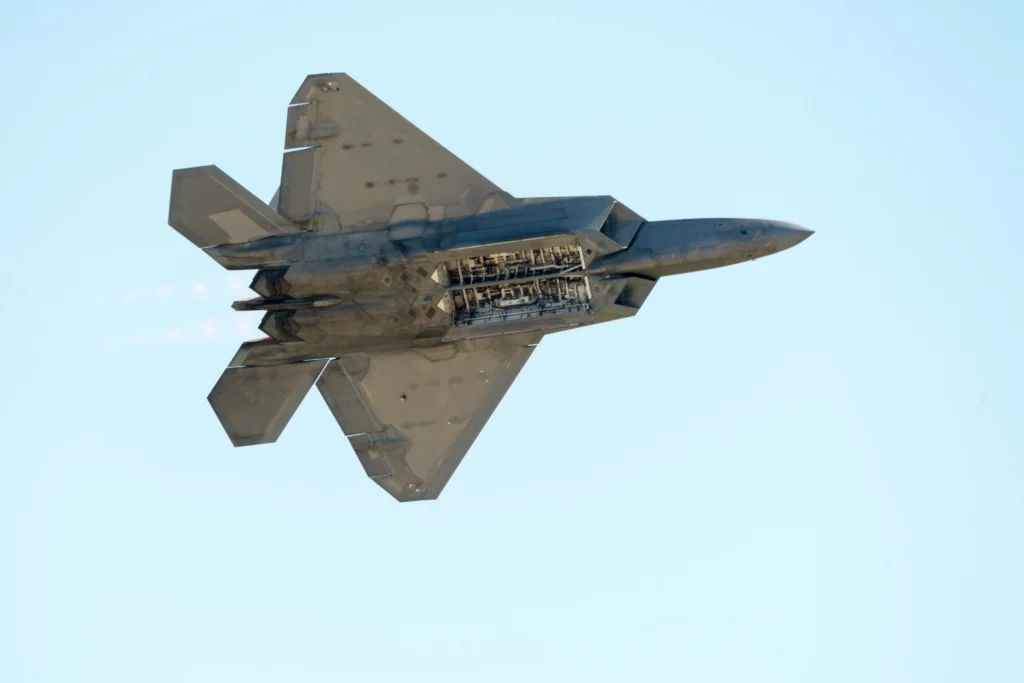
F-22 Raptor 2.0: New Fuel Tanks and Sensor Pods
Lockheed Martin’s “Raptor 2.0” upgrade package addresses one of the F-22’s most significant operational limitations: its short combat range. The new stealthy low-drag external fuel tanks are designed to extend the Raptor’s reach across the vast distances of the Indo-Pacific theater without compromising its survivability against modern air defenses.
Unlike the older non-stealthy 600-gallon tanks currently used by F-22s on alert duty in Alaska, the new tanks are designed to remain attached during combat operations.
Katie Ciccarino, Vice President of the F-22 Program at Lockheed Martin, confirmed that the tanks are engineered to avoid the need for jettison in combat. “They are low-drag tanks. The idea would be that you don’t have to [jettison them], and you can perform any of the same maneuvers that you would on a clean wing,” she stated at the 2026 Warfare Symposium.
The upgrade package also includes Advanced Sensor Pods housing Infrared Search and Track (IRST) systems. These pods improve the F-22’s ability to detect stealth aircraft, a growing concern in the Pacific region.
IRST-equipped Raptors can also share sensor data with other F-22s operating in a “clean” configuration, expanding fleet-wide situational awareness. The full Raptor 2.0 package further includes a new Infrared Defensive System (IRDS), enhanced radar, and upgraded electronic warfare capabilities.
Testing Status and Delivery Timeline
The Air Force originally targeted deliveries of the stealthy fuel tanks to operational F-22 squadrons for March 2025. However, the program encountered technical discrepancies during the Engineering and Manufacturing Development (EMD) phase, delaying the schedule.
Operational testing of the tanks was subsequently projected for the fourth quarter of Fiscal Year 2025, which ended September 30, 2025.
Qualification testing of the infrared sensor pods is ongoing and scheduled to run through the third quarter of Fiscal Year 2026, ending June 30, 2026. The exact date for either system entering operational service has not been publicly confirmed.
AGM-181A LRSO: America’s Next Nuclear Cruise Missile
The AGM-181A Long-Range Standoff missile is being developed as a direct replacement for the aging AGM-86B Air Launched Cruise Missile (ALCM), which has been in service for decades. The new photographs provide the clearest public view of the missile to date, confirming that the official rendering released by the Air Force last June was largely accurate to the actual design.
The LRSO features an inverted tail arrangement similar to the AGM-158 JASSM stealthy cruise missile, a trapezoidal fuselage cross-section, and a wedge-shaped nose. The images also offer a clear view of the missile’s pop-out main wings in their stowed configuration. No air inlet is visible in the available imagery, a detail likely withheld for security reasons.
The AGM-181A will be armed with a W80-4 thermonuclear warhead, developed through a Life Extension Program (LEP) that refurbishes and modernizes older W80-1 warheads.
The existing AGM-86Bs carry W80-1 warheads with reported yield settings of five kilotons or 150 kilotons. According to the National Nuclear Security Administration (NNSA), the W80-4 LEP incorporates modern components, updated safety features, and an insensitive high-explosive design.
Production and Deployment Plans
The Air Force is targeting low-rate initial production of the AGM-181A in Fiscal Year 2027, ahead of a full-rate production decision in Fiscal Year 2029.
The planned launch platforms are the B-52H Stratofortress and the B-21 Raider stealth bomber.
The previously stated Initial Operational Capability (IOC) target of 2030 has since been reclassified as controlled unclassified information and is no longer publicly disclosed.

Broader Air Force Modernization Push
The flight testing activity over the Mojave Desert reflects a wider acceleration of U.S. Air Force capability development. Earlier this month, a B-21 Raider was observed conducting air-to-air related flight testing for the first time.
The service is also pushing forward with the F-47 sixth-generation fighter, multiple Collaborative Combat Aircraft (CCA) drone programs, and new operational tactics to support next-generation platforms. These developments are expected to define U.S. air power for the next 15 to 20 years.
Stay tuned with us. Further, follow us on social media for the latest updates.
Join us on Telegram Group for the Latest Aviation Updates. Subsequently, follow us on Google News
