

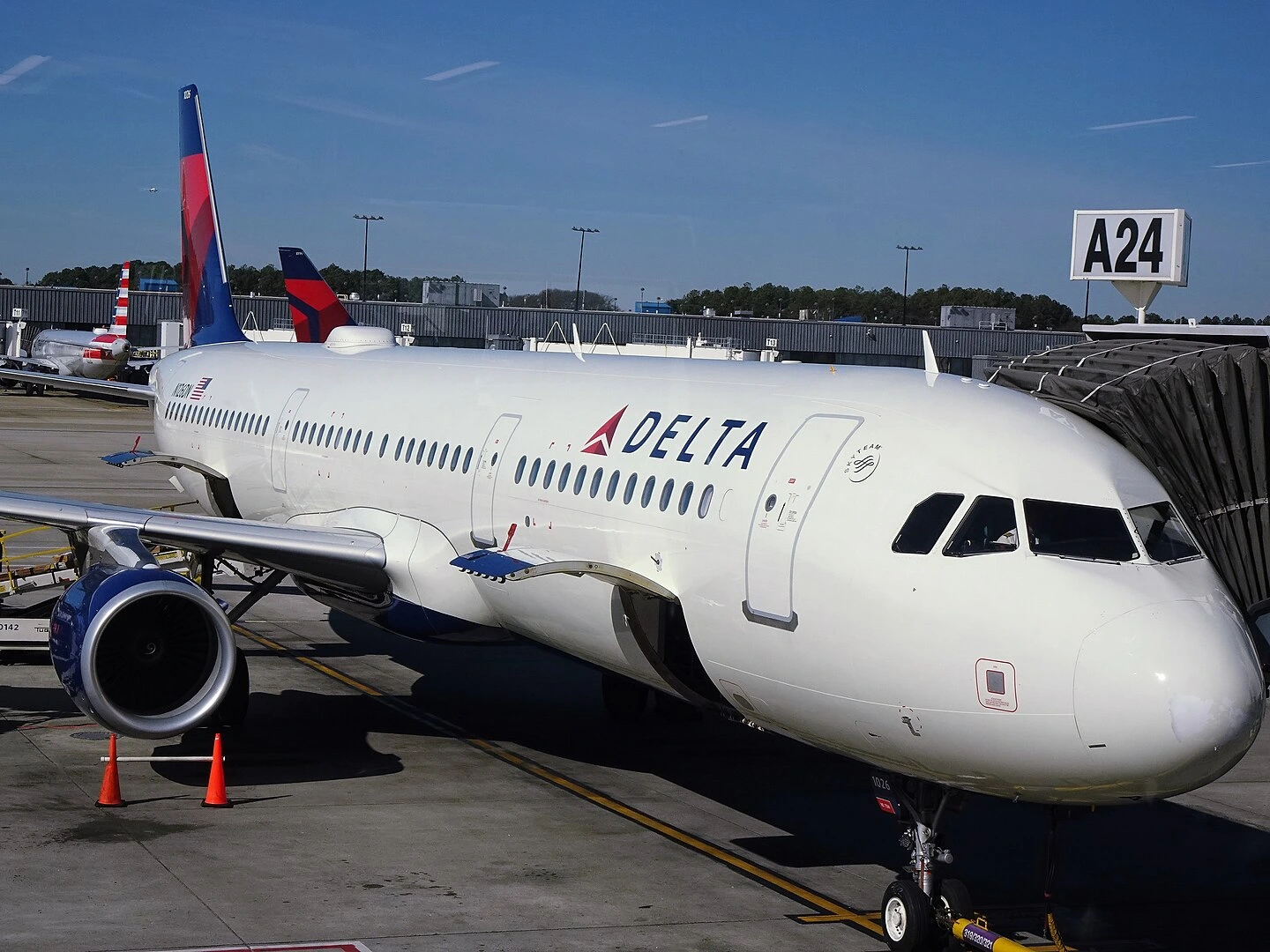
ATLANTA- Delta Air Lines (DL) could face a significant financial penalty after severe weather disruptions left hundreds of passengers trapped inside aircraft at Atlanta Hartsfield-Jackson International Airport (ATL).
A sudden hailstorm forced the evacuation of the airport’s control tower and triggered a complete ground stop.
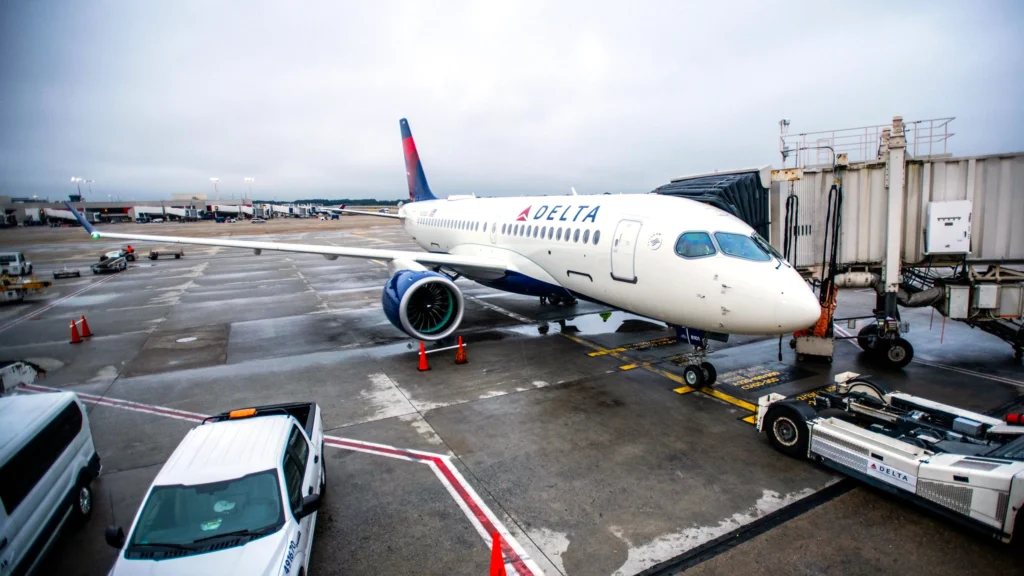
The operational breakdown at Delta Air Lines’ primary hub, Atlanta Hartsfield-Jackson International Airport, caused aircraft to remain on the tarmac for hours.
Some passengers reported being confined onboard aircraft for as long as 11 hours during the disruption.
Severe Storm Forces Control Tower Evacuation
A powerful storm system moved across the Atlanta metropolitan area on Friday evening, bringing nickel-sized hail, lightning, and strong gusty winds.
The severe conditions forced air traffic controllers to temporarily evacuate the control tower at Atlanta Hartsfield-Jackson International Airport (ATL).
The Federal Aviation Administration immediately issued a full ground stop at the airport, which is typically the busiest airport in the United States by passenger traffic.
Earlier forecasts from the National Weather Service had predicted isolated showers and thunderstorms across the Atlanta region.
The National Airspace System also indicated that severe weather was not expected. Despite these predictions, the storm intensified quickly and produced hazardous conditions that disrupted airport operations.
Even after the storm passed, Delta Air Lines (DL) continued to request a ground stop as its operational network at Atlanta struggled to recover.
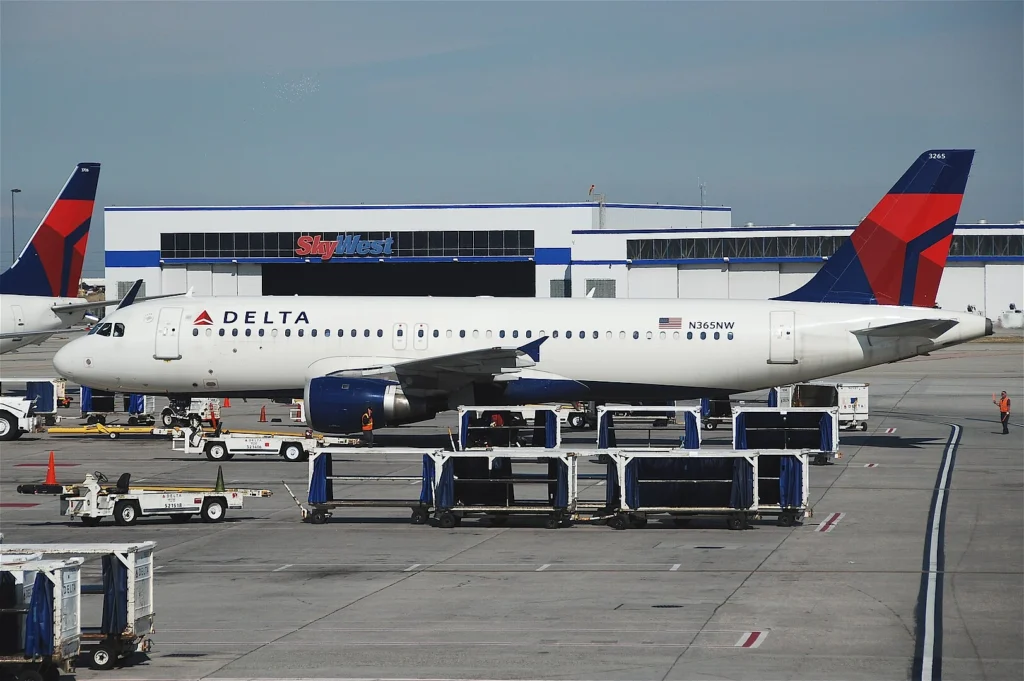
According to PYOK, aircraft quickly accumulated across taxiways and ramps while ground operations struggled to manage the sudden disruption.
Passengers Report Extended Tarmac Delays
Passengers across several flights reported being stuck inside the aircraft for long periods while waiting for gates to become available.
Many travelers described delays between three and five hours on the tarmac. In one extreme case, passengers reported remaining onboard an aircraft for nearly eleven hours.
One passenger on a 2-hour flight to Atlanta departed at approximately 5 PM on Friday. By 6 AM on Saturday morning, the aircraft had still not reached a gate, leaving passengers confined onboard overnight.
Another passenger flying from New York JFK departed around midnight and remained stuck on the Atlanta tarmac for roughly 4 hours after landing.
The traveler reported spending a total of 8 hours inside the aircraft and stated that the flight should have been cancelled instead of operating under such conditions.
Several passengers also reported major operational failures after landing. Some claimed there were no ramp workers available to move aircraft, no gate agents at service desks, and no jet bridge operators available to connect aircraft to gates.
Passengers also noted that many gates appeared empty because connecting flights had already been cancelled or delayed.
However, parked aircraft remained in place because there were not enough ramp crews available to reposition them and free gates for incoming flights.
US Tarmac Delay Rules and Potential Penalties
United States aviation regulations require airlines to maintain contingency plans for extended tarmac delays.
These regulations are enforced by the Department of Transportation through the Office of Aviation Consumer Protection.
Under current rules, passengers on domestic flights must be allowed to deplane once a delay reaches 3 hours. For international flights, airlines must allow passengers to leave the aircraft after four hours.
Airlines may exceed these limits only if allowing passengers to deplane would create safety or security risks, or if air traffic control determines that deplaning would significantly disrupt airport operations.
If investigators determine that Delta Air Lines (DL) violated these regulations, the airline could face a substantial financial penalty.
A comparable enforcement action occurred in 2023 when American Airlines received a record 4.1 million dollar fine for trapping passengers on delayed aircraft at Dallas Fort Worth International Airport (DFW).
That case covered 43 separate incidents investigated by regulators between 2018 and 2021.
Aircraft Inspections Required After Hailstorm
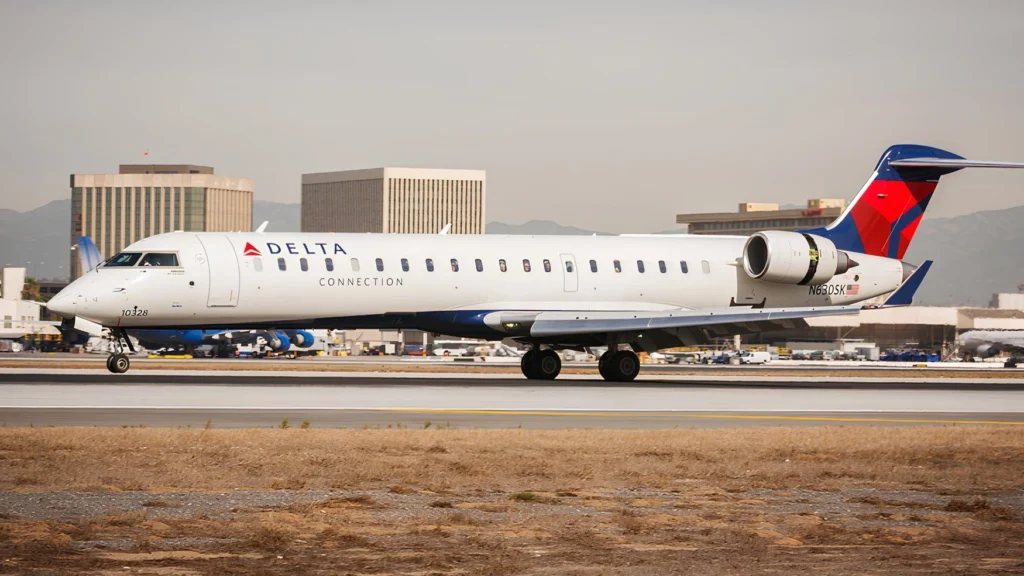
The hailstorm that struck Atlanta also raised concerns about potential aircraft damage. Aircraft exposed to hail must undergo detailed inspections before being cleared for further flights.
Engineers must check critical surfaces such as fuselage panels, radomes, and flight control components to ensure no structural damage occurred during the storm.
Similar weather-related disruptions have affected airlines in recent years. In 2024, Canadian carrier WestJet was forced to ground approximately 10 percent of its fleet after sixteen aircraft sustained significant damage during a severe hailstorm at Calgary International Airport (YYC).
Delta Air Lines (DL) also faced a comparable situation in June 2024 when another hailstorm struck Atlanta. On that occasion, the airline temporarily grounded around 100 aircraft for emergency inspections.
Maintenance teams completed the inspections overnight and returned the fleet to service the following morning.
Operational Recovery Still Ongoing
Despite the scale of disruption, Delta Air Lines (DL) had not immediately issued a formal travel advisory for passengers affected by the incident at Atlanta Hartsfield-Jackson International Airport (ATL).
The situation illustrates how sudden weather events at a major airline hub can rapidly escalate into large scale operational challenges that affect flights across the entire network.
Stay tuned with us. Further, follow us on social media for the latest updates.
Join us on Telegram Group for the Latest Aviation Updates. Subsequently, follow us on Google News
