

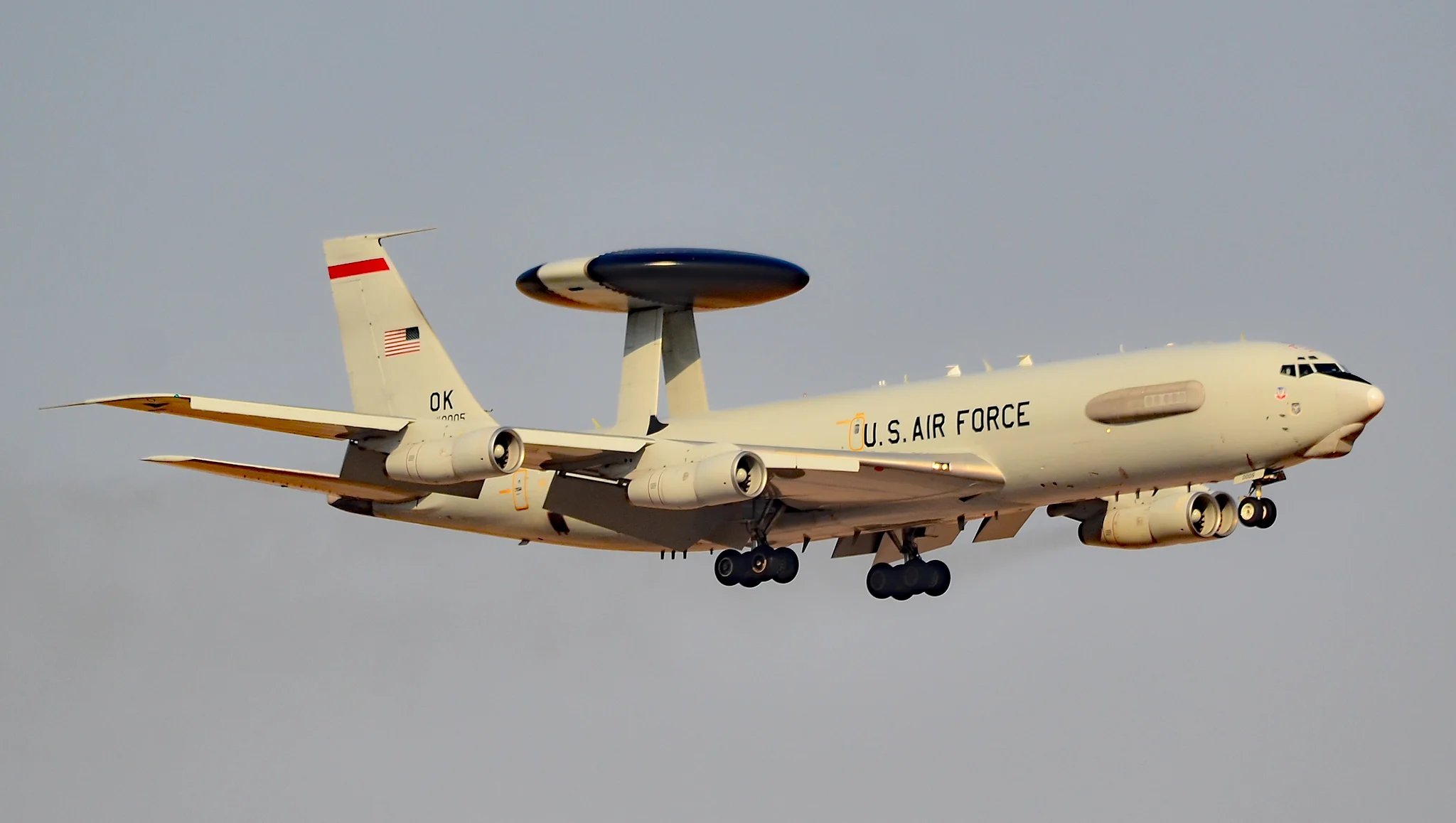
TEHRAN– The United States Air Force (USAF) has deployed six Boeing E-3 Sentry Airborne Warning and Control System aircraft to forward locations in Europe, signaling a major airpower buildup linked to rising tensions with Iran.
Two aircraft departed from Elmendorf Air Force Base and arrived at Royal Air Force Mildenhall, while four others launched from Tinker Air Force Base to Ramstein Air Base.
This deployment represents nearly 40% of the USAF’s 16-aircraft E-3 fleet and follows the earlier dispatch of advanced fighters, including F-22 Raptors and F-35 Lightning IIs, to the U.S. Central Command area of responsibility.
Open-source flight tracking data indicates that at least two E-3 aircraft are already moving toward the Middle East, reinforcing America’s airborne command and control capabilities.

USAF E-3 Deployment in the Middle East
The Boeing E-3 Sentry serves as the backbone of U.S. airborne battle management and surveillance operations.
Equipped with a powerful rotating radar dome, the aircraft provides real-time detection and tracking of aircraft, missiles, and maritime threats at ranges of up to 250 miles.
Military planners rely on the E-3 to generate a comprehensive air picture for joint commanders. In a high-threat environment, it coordinates fighters, refueling tankers, electronic warfare platforms, and strategic bombers to maintain operational control.
With multiple fighter squadrons already positioned in the region, the arrival of additional E-3 aircraft enhances situational awareness and strengthens command and control networks.
The aircraft can relay communications, integrate sensor data from satellites and ground radars, and direct strike packages with precision.

https://commons.wikimedia.org/wiki/File:AWACS,_ILA_2024,_Schoenefeld_(ILA43889).jpg
US Prepares to Strike Iran
Defense analysts view the concentration of airborne early warning assets as a critical step before any large-scale air campaign.
The E-3 would act as the central node in managing combat air patrols, escort missions, and suppression of enemy air defenses.
Iran operates advanced air defense systems, including the Russian-built S-300, which require coordinated suppression efforts.
The E-3’s look-down radar capability allows it to detect low-flying cruise missiles and unmanned aerial systems, improving early warning timelines, reported Eurasian Times.
During previous operations such as Operation Desert Storm and Operation Enduring Freedom, the E-3 proved essential in managing complex multinational air operations.
Its ability to synchronize dozens of aircraft in contested airspace remains a core advantage despite evolving threats.
US’ E-3 Fleet Challenges
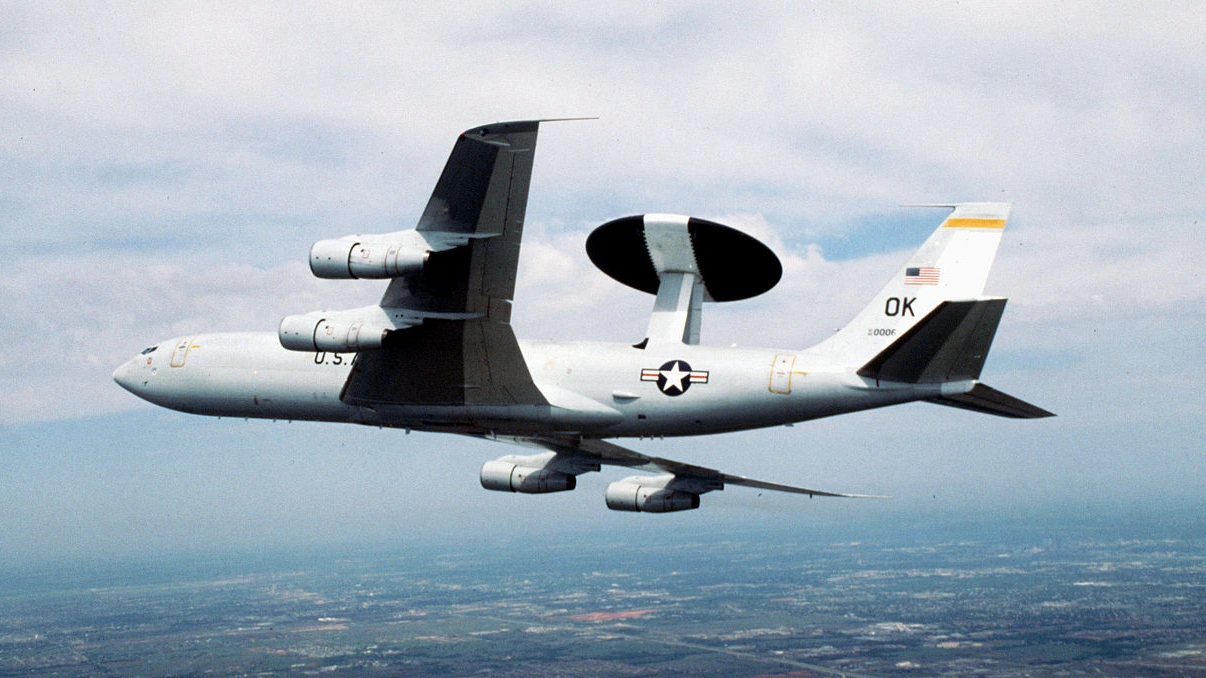
Despite its operational value, the E-3 fleet faces mounting sustainment issues. The aircraft are based on the aging Boeing 707 airframe, with the newest deliveries completed in 1992, and maintenance demands have steadily increased.
Each sortie requires extensive preparation time, and the fleet’s mission-capable rate has hovered near 55%. Aging Pratt & Whitney TF33 engines and diminishing spare parts inventories have forced the Air Force to rely on retired aircraft for components.
The planned successor, the Boeing E-7 Wedgetail, encountered funding and schedule challenges before Congress intervened to preserve limited development funding.
Lawmakers authorized additional resources in the FY2026 National Defense Authorization Act, preventing full program termination and restricting further E-3 retirements.
However, funding currently supports only prototype aircraft rather than a full operational fleet replacement. Until a long-term solution emerges, the USAF must rely on a small and aging E-3 inventory to sustain global airborne command and control missions.
Stay tuned with us. Further, follow us on social media for the latest updates.
Join us on Telegram Group for the Latest Aviation Updates. Subsequently, follow us on Google News
