

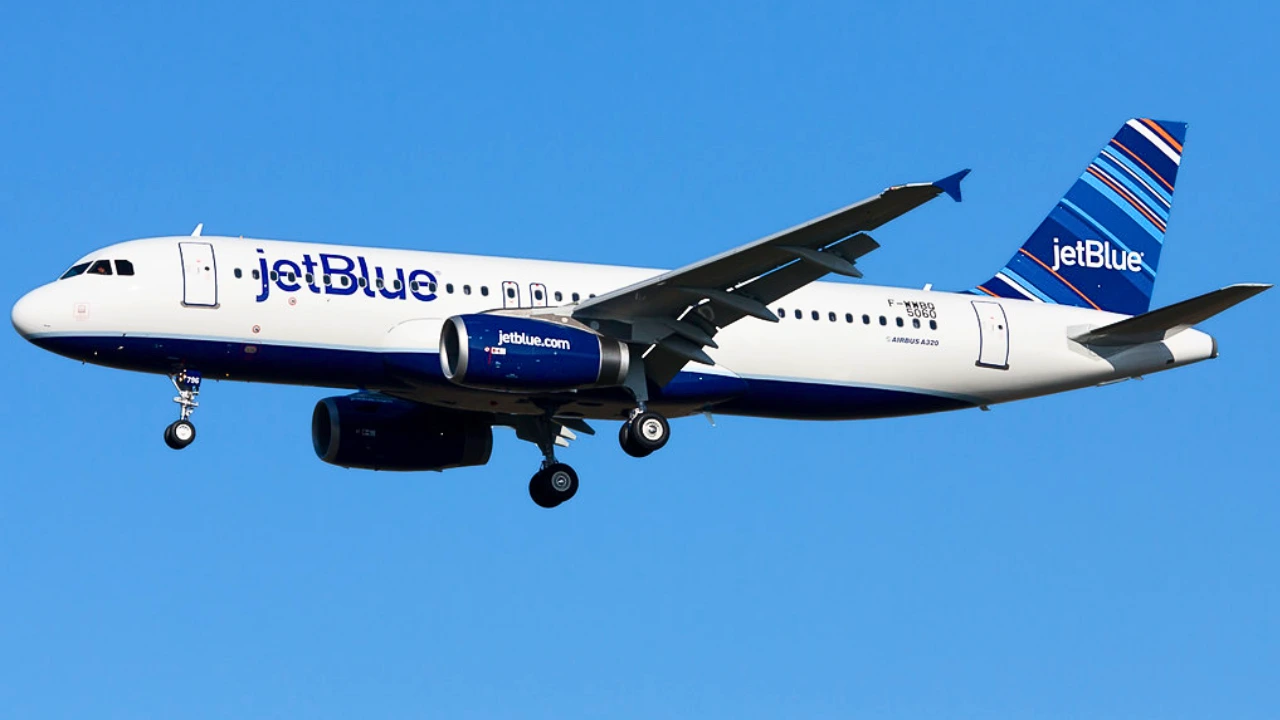
NEW YORK- JetBlue Airways (B6) Flight 1112 from Curaçao Hato International Airport (CUR) to New York John F. Kennedy International Airport (JFK) reported a near midair collision with a United States Air Force tanker aircraft.
The crew of the Airbus A320 halted their climb after spotting the tanker crossing ahead of them without an active transponder. The aircraft had departed Willemstad and was climbing through FL330 when the encounter occurred near Venezuelan airspace.
JetBlue A320 Pilots Avoids Collision
JetBlue 1112 reported the tanker at roughly 2 to 3 miles distance and at a similar altitude. The crew advised air traffic control that the tanker was not transmitting on its transponder, leaving controllers without a radar return.
The A320 stopped its climb near 33300 feet to avoid conflict while the tanker continued northeast and entered Venezuelan airspace.
Controllers later confirmed the military aircraft was estimated at 34000 feet, matching the pilot’s visual assessment.
The incident fit the FAA definition of a near midair collision due to proximity and altitude convergence. JetBlue subsequently filed reports with federal authorities.

Details of the Encounter
The pilots described the aircraft as an air-to-air refueling tanker operated by the United States Air Force. Without a transponder or ADS-B Out, the aircraft appeared as an uncooperative target, meaning civilian ATC systems could not identify or track its altitude. This forced the JetBlue crew to rely solely on visual avoidance.
The crew stated that they were climbing from Curaçao toward cruise altitude of 35000 feet when they detected the tanker at their ten o’clock position passing directly across their path. They briefly descended to increase separation.
The encounter occurred amid heightened US military activity around Venezuela. The FAA had previously advised US carriers to exercise caution near Venezuelan airspace due to geopolitical instability and increased defense operations.
Encounters with non-squawking military aircraft in the region have become more common as surveillance missions intensify.
ATC and JetBlue Pilot Comms
Here’s a detailed transcription of the communication between JetBlue pilots and New York JFK ATC as flagged by YouCanSeeATC and recorded by LiveATC.net:
{ts:17}
Pilot (JetBlue 1112): Curacao, JetBlue 1112.
ATC: Go ahead, sir.
{ts:22}
Pilot: We just had traffic pass directly in front of us within 5 miles of us, maybe 2–3 miles, but it was an air‑to‑air refueler from the United States Air Force, and he was at our altitude. We had to stop our climb.
{ts:37}
ATC: Confirm the traffic was at your altitude?
Pilot: They’re heading off to the northeast right now. They passed directly in our flight path. We had to stop our climb. They are not painting; they don’t have their transponder turned on. It’s outrageous, 1112.
{ts:60}
ATC: Yes, I don’t have anything on my scope. You are totally right here. I apologize.
{ts:69}
Pilot: If you can make a note of it, we almost had a mid‑air collision up here.
{ts:77}
Pilot: They’re heading off into Venezuelan airspace if that helps, but they’re going off to the northeast. I’ll give you some distance here from the VOR.
{ts:94}
Pilot: All right, they’re 340 radial off of Curacao, 150 DME, JetBlue 1112.
{ts:130}
ATC: Just to confirm, the traffic crossed in front of you at level 340?
Pilot: That traffic looked like they were level at 340. We were passing through 33.3–33.4, somewhere in that range, when we caught them at maybe the 10 o’clock position, but they were moving directly in front of us at 34 and we were climbing to 35. So we had to stop our climb and actually descend to avoid hitting them.
{ts:154}
ATC: Copy, for me to make the annotation.
{ts:163}
Pilot: We’ll do a report on our end too, but they did not have the transponder turned on, so there’s no way for you to see them.
{ts:172}
ATC: Yes, please make your report so at least the authorities can investigate.
Pilot: Yep. Sorry about that.
ATC: Okay, thank you.
Bottom Line
JetBlue Flight 1112, operated by Airbus A320 registration N809JB, completed its route and arrived in New York roughly four hours later without further issues.
The precise track of the tanker remains unverified because it was not broadcasting positional or altitude data.
Stay tuned with us. Further, follow us on social media for the latest updates.
Join us on Telegram Group for the Latest Aviation Updates. Subsequently, follow us on Google News
