

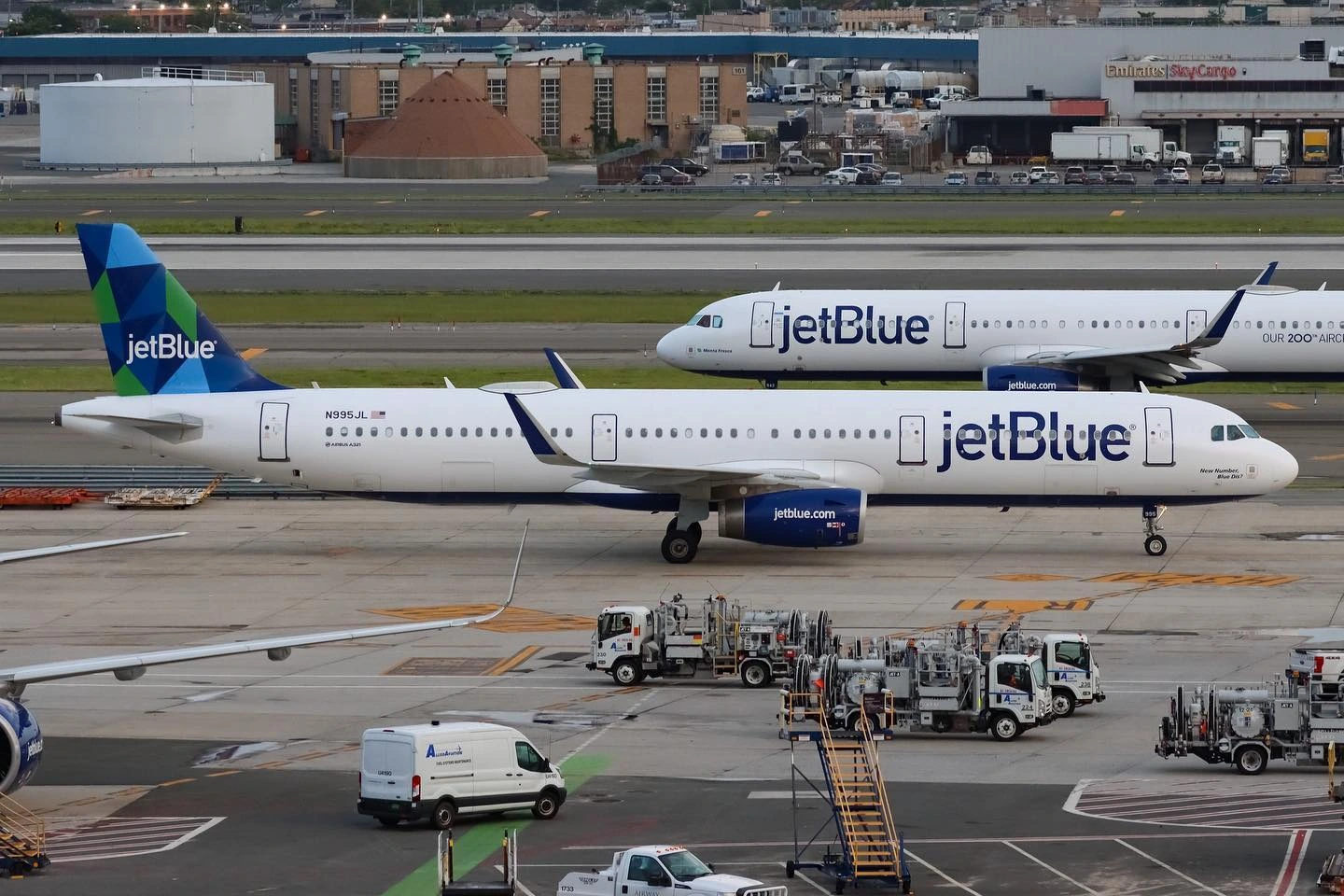
NEW YORK– JetBlue Airways (B6) is facing a $2.5 million lawsuit after a passenger allegedly suffered head and knee injuries when another traveller struck her with a suitcase while rushing to leave an aircraft.
The incident occurred aboard JetBlue Flight B6 2126 from Montego Bay, Jamaica (MBJ), to Fort Lauderdale-Hollywood International Airport (FLL). The plaintiff claims the airline failed to remove a disruptive passenger before departure, raising questions about its responsibility under the Montreal Convention.
JetBlue Flight Attendants Accused of Ignoring Disruptive Passenger
The lawsuit was filed by Tymia Wiggins, who owns a boutique villa resort in Jamaica and regularly travels between the island and her home in Maryland. According to PYOK, the complaint was filed in a New York federal court on November 17, 2026.
Wiggins was traveling from Montego Bay to Ronald Reagan Washington National Airport (DCA), with a connecting stop in Fort Lauderdale. The incident allegedly occurred during the first leg of her journey on June 4.
According to the complaint, Wiggins was seated in 17D when she noticed a male passenger sitting several rows behind her. She described his behaviour as unruly, belligerent, and disruptive.
A JetBlue flight attendant reportedly noticed the passenger’s behaviour, reprimanded him, and warned that he could be removed from the aircraft if his conduct continued.
However, the airline allowed the passenger to remain onboard, and the aircraft subsequently departed for Fort Lauderdale.

Passenger Allegedly Struck Woman With Suitcase During Deplaning
Wiggins claims the passenger continued displaying disruptive behaviour during the flight.
After the aircraft arrived at Fort Lauderdale and parked at the gate, passengers began standing up and retrieving their belongings from the overhead bins.
However, the male passenger allegedly attempted to leave the aircraft without waiting for other travellers.
According to the complaint, he pushed through the crowded aisle while holding his suitcase at approximately head height. Wiggins alleges that flight attendants failed to control the movement of passengers or intervene.
As she stood up to retrieve her carry-on luggage, the man’s suitcase allegedly struck the back of her head.
The passenger continued pushing forward, and his legs reportedly became entangled with hers. The incident caused Wiggins to fall forward, twist her right knee, and aggravate an existing injury.
Wiggins argues that JetBlue’s failure to address the passenger’s behaviour before departure and its lack of intervention during deplaning contributed to the incident.

Montreal Convention Could Determine JetBlue’s Liability
Wiggins is pursuing compensation under Article 17 of the Montreal Convention, which governs airline liability for passenger death or bodily injury resulting from an accident during international air transportation.
The provision covers qualifying incidents occurring onboard an aircraft or during the operations of embarking or disembarking.
For a successful claim, the plaintiff must establish that an accident occurred, that it caused the alleged injury, and that the incident falls within the Convention’s scope.
The definition of an accident generally involves an unexpected or unusual event external to the passenger. In this case, the alleged suitcase collision and the circumstances surrounding the passenger’s behaviour could become central to the legal proceedings.
Importantly, Article 17 does not require passengers to prove airline negligence to establish liability at the initial compensation tier. However, the amount recoverable and the airline’s potential defences are governed by Article 21.
$2.5 Million Claim Exceeds Montreal Convention’s First-Tier Threshold
Wiggins is seeking $2.5 million in compensatory damages, substantially exceeding the Montreal Convention’s current first-tier liability threshold of 151,880 Special Drawing Rights (SDRs) per passenger.
The revised threshold took effect on December 28, 2024, following the International Civil Aviation Organization’s review of liability limits.
The Convention establishes a two-tier liability system.
Under Article 21, airlines are liable for proven bodily injury damages up to 151,880 SDRs without being able to rely on the defence that they were not negligent. Contributory negligence by the passenger can still affect liability.
For damages exceeding 151,880 SDRs, the airline can avoid additional liability if it proves that the damage was not caused by negligence or another wrongful act or omission by the airline or its employees and agents, or that it resulted solely from the negligence or wrongful act of a third party.
This distinction is important for Wiggins’ $2.5 million claim.
She would need to establish the full extent of her damages, while the circumstances surrounding the flight attendants’ response could become significant in determining whether JetBlue can avoid liability beyond the first-tier threshold.
JetBlue Could Challenge the Negligence Allegations
JetBlue could dispute the allegations concerning its flight attendants’ handling of the disruptive passenger.
The airline may argue that its crew members took reasonable action by reprimanding the passenger and warning him about his behaviour. It could also challenge whether the crew had sufficient grounds to remove him before departure.
The conduct of the passenger who allegedly struck Wiggins could also become an important part of the proceedings.
However, proving that the other passenger caused the physical injury would not automatically remove JetBlue’s first-tier liability under the Montreal Convention. The distinction becomes particularly important when determining responsibility for damages exceeding the 151,880 SDR threshold.
A court would ultimately assess the evidence, the alleged injuries, the crew’s actions and the connection between those actions and the incident.
The $2.5 million figure represents the compensation Wiggins is seeking, not an amount awarded by a court. The case has been filed, and the allegations have yet to be established through legal proceedings.
Stay tuned with us. Further, follow us on social media for the latest updates.
Join us on Telegram Group for the Latest Aviation Updates. Subsequently, follow us on Google News
