

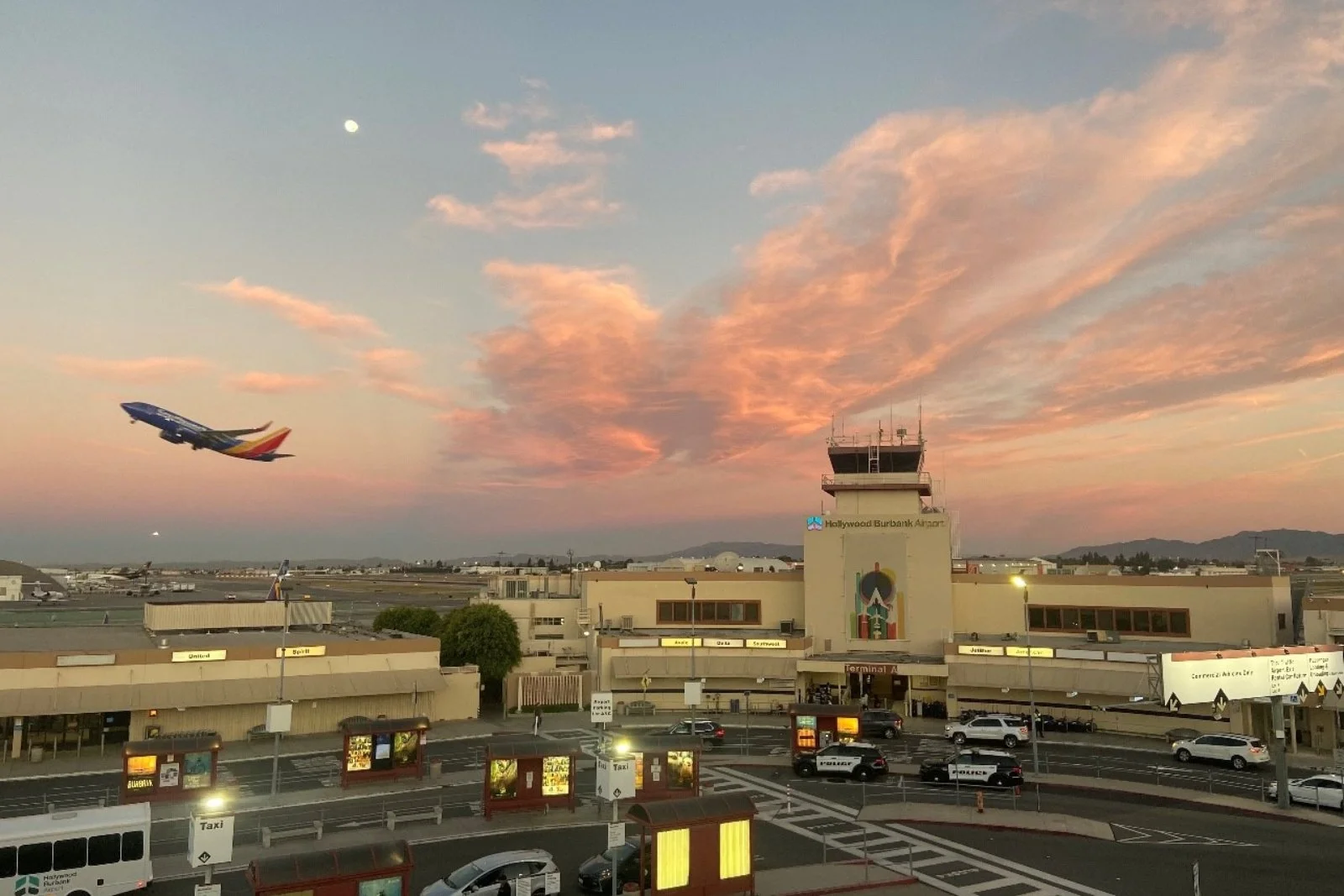
BURBANK, CALIFORNIA — Hollywood Burbank Airport (BUR), long valued as a relaxed alternative to Los Angeles International Airport (LAX), is preparing for its biggest transformation in nearly a century. The mid-sized Southern California airport will open a $1.3 billion replacement terminal in October 2026, replacing a facility that first opened in 1930.
The new terminal sits just north of the current building and is set to open on October 13, 2026. BUR lies about 12 miles north of downtown Los Angeles and remains the closest LA-area airport to Warner Bros. Studio Tour Hollywood and Universal Studios Hollywood. Nine commercial carriers, including low-cost operator Allegiant Air (G4), serve roughly 30 nonstop destinations across North America.
A Century-Old Terminal Reaches Its Limits
The existing terminal carries clear charm but no longer meets modern standards. Patrick Lammerding, the airport’s deputy executive director of operations, security, and safety management systems, said the two-concourse, 14-gate building is cramped and short on current amenities.
It barely satisfies Americans with Disabilities Act requirements and restricts concessions, amenities, and holds room seating.
The structure also fails to meet California’s seismic standards and does not comply with Federal Aviation Administration rules on distance from the main runway.
Repairing the current terminal or rebuilding it on the same footprint was never viable. As a result, the airport committed to a replacement project that Lammerding described as decades in the making. Once the new terminal opens, crews will demolish the old one, TPG reported.
What the New BUR Terminal Will Offer
The replacement terminal keeps 14 gates but adds significant space, growing to 335,000 square feet from the current 232,000 square feet. It pairs with a much larger parking garage and meets current earthquake design, ADA accessibility, and runway-distance requirements.
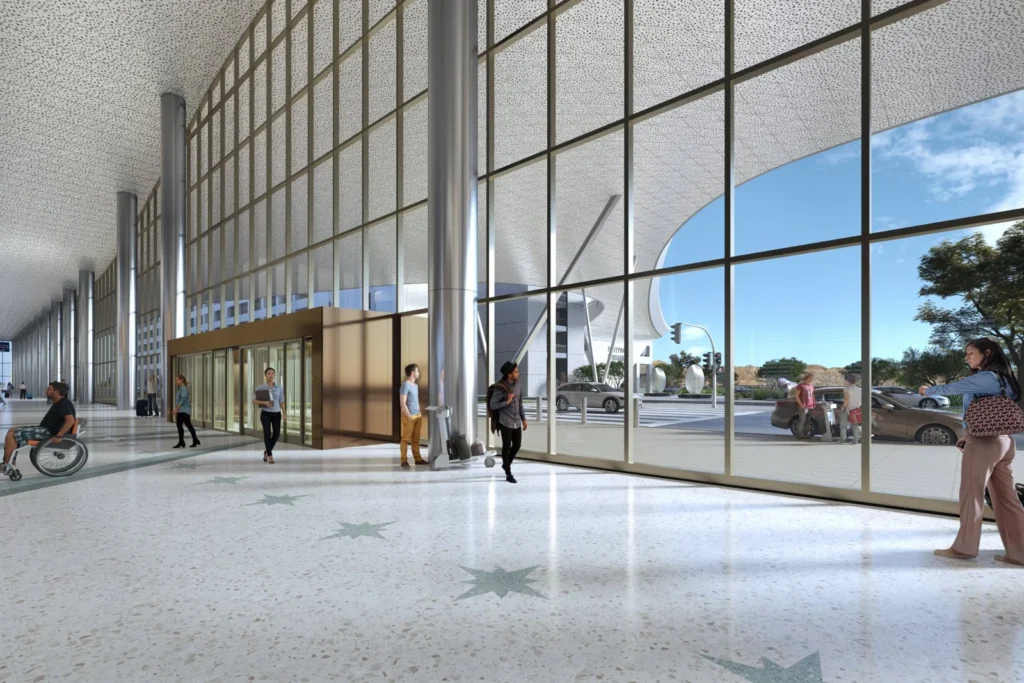
Inside, travelers will find one central eight-lane TSA checkpoint, floor-to-ceiling windows, a new baggage screening system, and a single baggage claim area with three carousels. Additional features include upgraded restrooms, pet relief areas, and expanded shopping and dining.
One signature feature stays in place. The terminal will keep its outdoor, ground-level boarding with no jet bridges, so passengers will continue to walk onto the tarmac and climb airstairs to reach their aircraft. Lammerding said community workshops showed strong public support for outdoor boarding, along with a clear request to keep the airport simple and convenient.
Old Hollywood Glamour Shapes the Design
The design-build team is led by Holder, Pankow, TEC, Joint Venture (HPTJV), with Corgan providing architectural services in association with CannonDesign. Community input pushed planners to draw on Hollywood’s Golden Age and film industry roots.
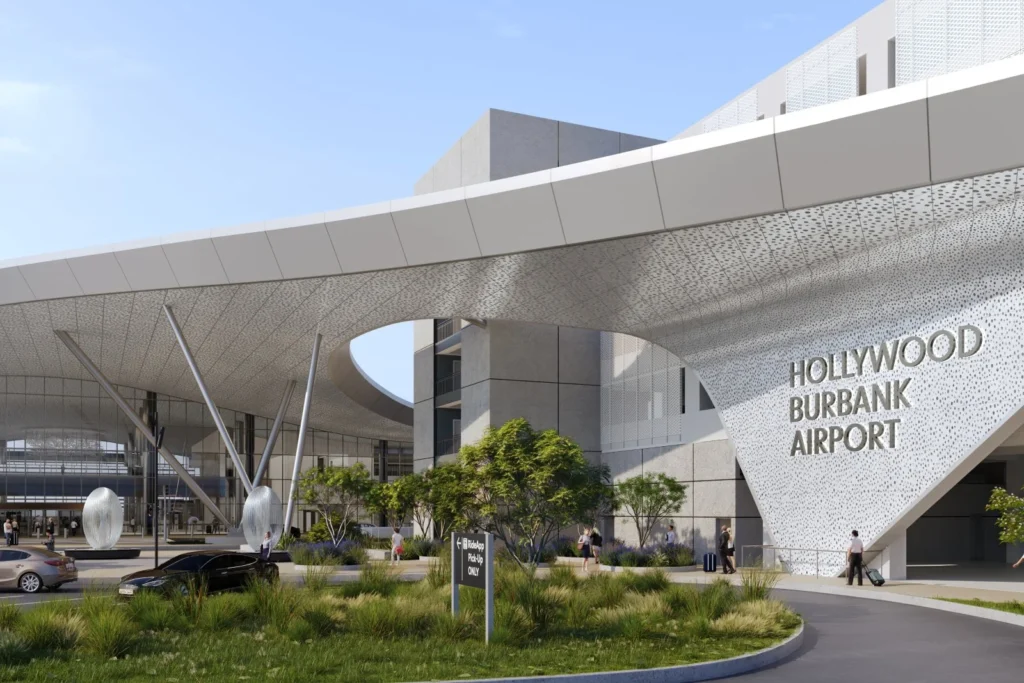
Brent Kelley, managing principal at Corgan, said the team built the project around the glitz and glamour of old Hollywood. A silver metallic canopy shields travelers from the sun, links the terminal to the parking garage, and nods to the silver screen of early cinema.
Canted support columns evoke the searchlights that once marked Hollywood movie premieres. Inside, terrazzo flooring carries spotlight-shaped inlays that double as wayfinding cues, while restrooms feature individual, illuminated, oval mirrors instead of a single large vanity mirror.
Art That Honors Aviation History
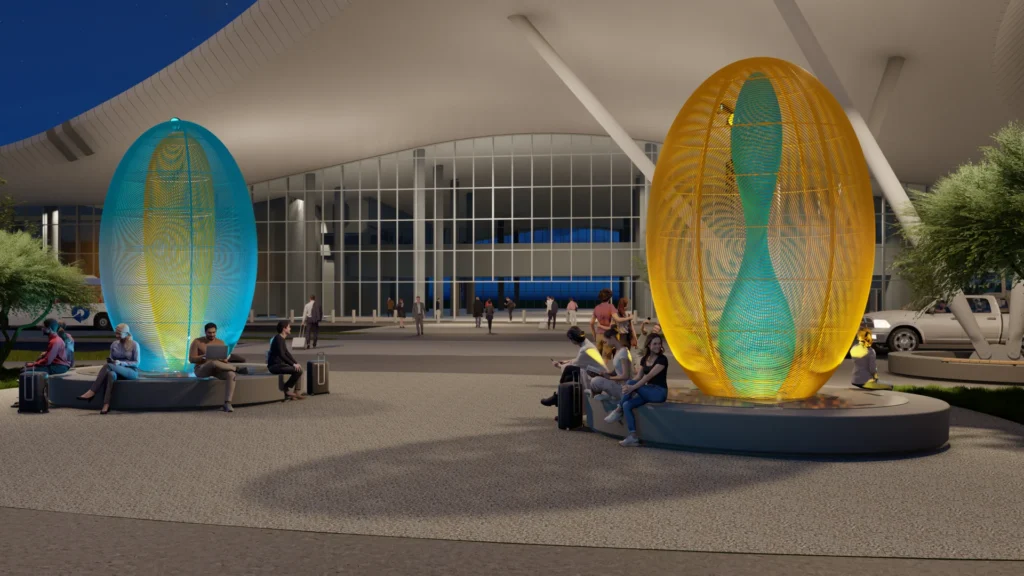
The terminal’s artwork ties the site to its aviation past. Outside, “The Two Electras” by Cliff Garten presents a pair of 16-foot-tall illuminated ellipses inspired by the Lockheed Model 10E Electra Special.
Lockheed engineer Clarence “Kelly” Johnson worked on that aircraft early in his career, and the plane, built at this site in 1936, carried Amelia Earhart during her 1937 attempt to circle the globe.
Inside, artist Glenn Kaino’s 30-by-40-foot steel mesh and mirrored ribbon piece, titled “When We Reflect,” hangs from the ceiling. The site holds a deeper history as well. From 1943 until the early 1990s, Lockheed’s secretive Skunk Works operated nearby and developed aircraft such as the U-2, SR-71 Blackbird, and F-117 Nighthawk.
During World War II, crews disguised the factory as a suburban neighborhood, using camouflage netting made by Japanese Americans incarcerated under Executive Order 9066 at the nearby Santa Anita Assembly Center. Kaino’s family was among those held there, a history reflected in his installation.
Stay tuned with us. Further, follow us on social media for the latest updates.
Join us on Telegram Group for the Latest Aviation Updates. Subsequently, follow us on Google News
