

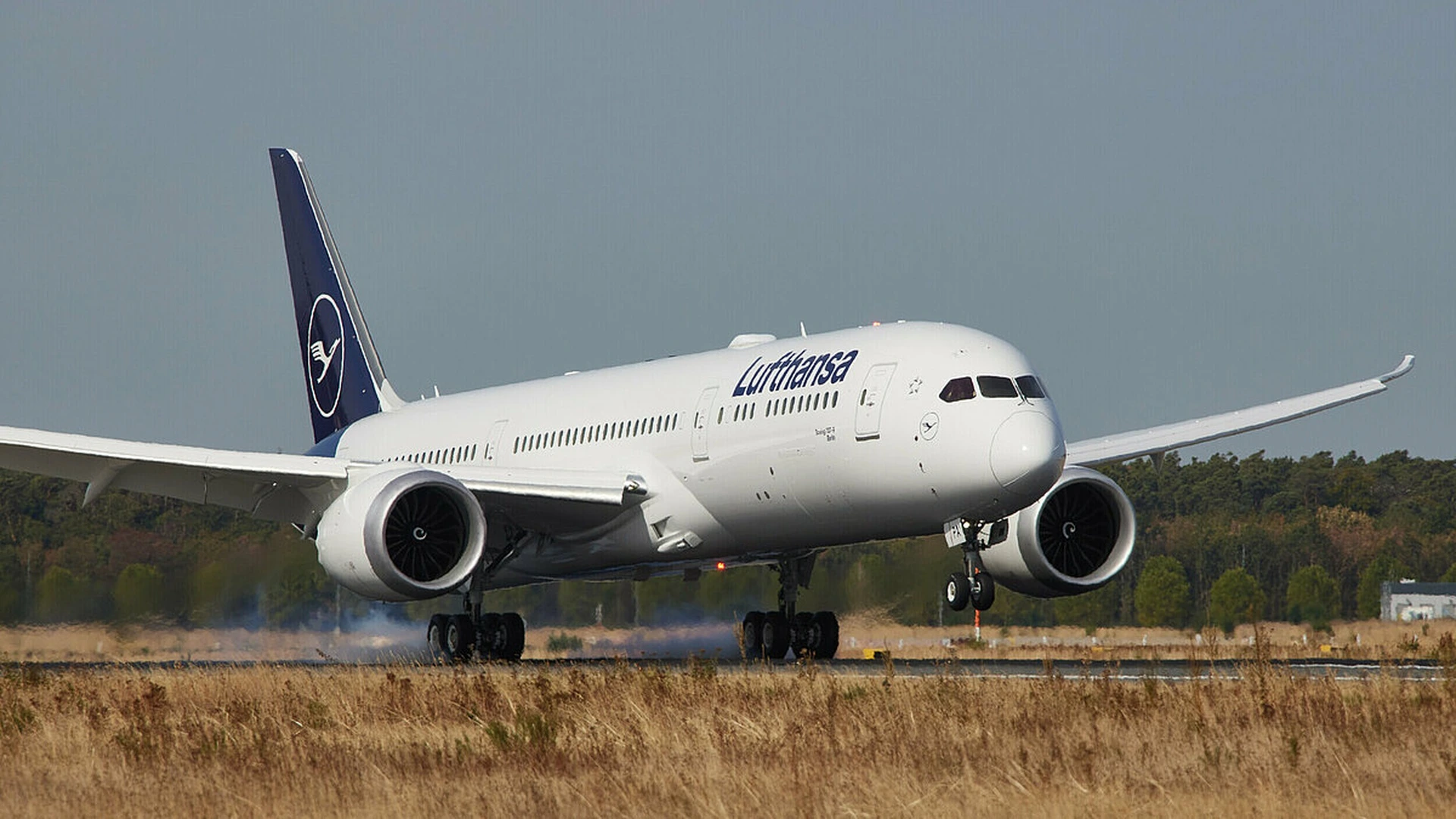
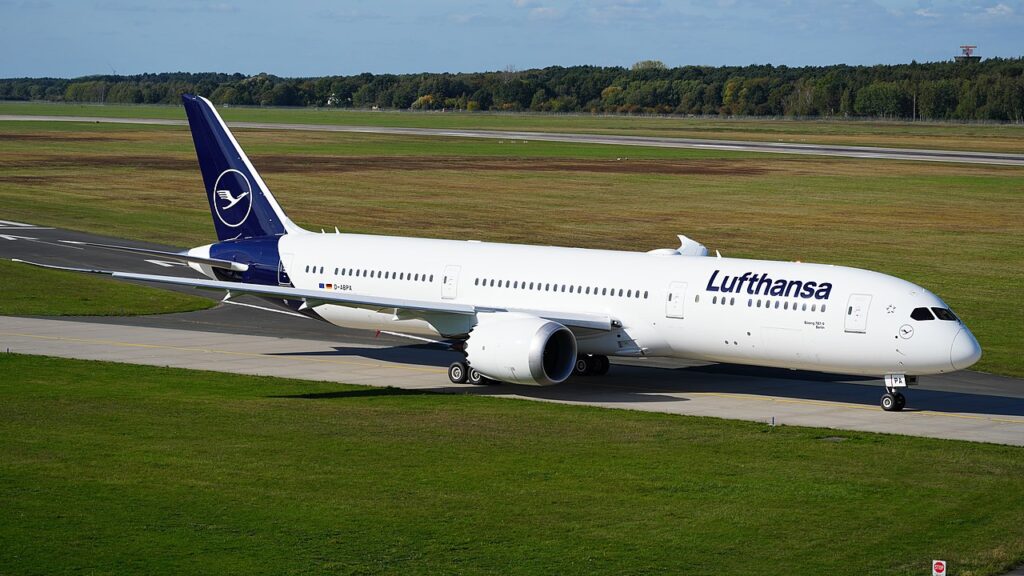
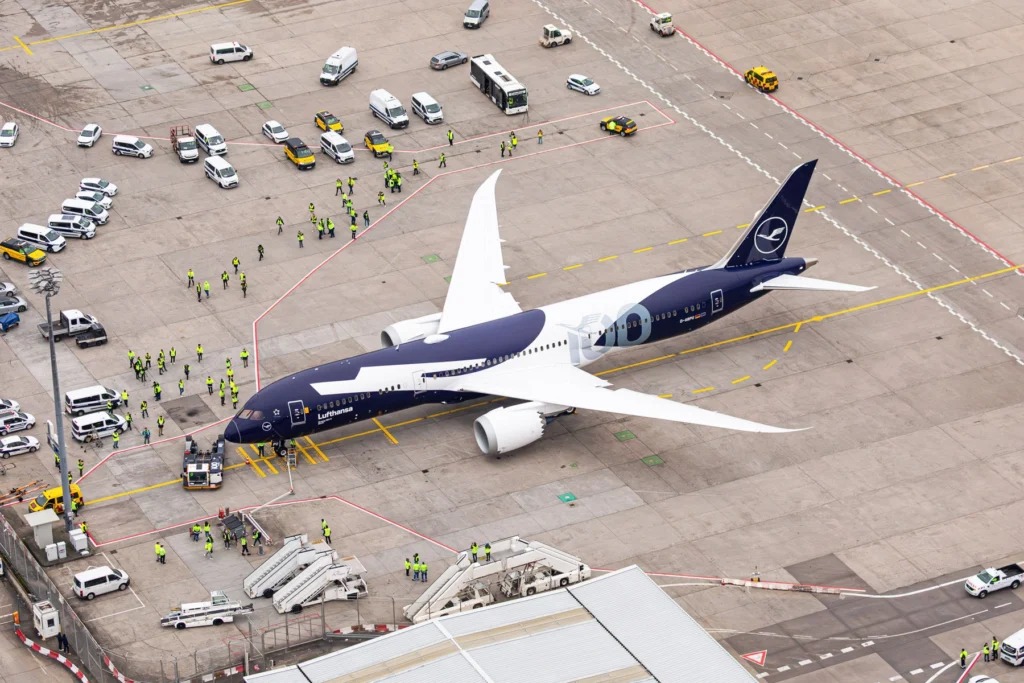
COLOGNE- Lufthansa (LH) has confirmed that its Boeing 787-9 Dreamliner, registration D-ABPQ, will be repaired after investigators complete their work at Frankfurt Airport (FRA). The aircraft dropped nose-first at the gate on June 4th when its nose landing gear collapsed for reasons that remain unclear.
A comparable British Airways (BA) incident at London Heathrow (LHR) in 2021 offers a reference point for the likely damage, repair scope, and downtime the German carrier now faces. That Boeing 787-8 returned to service roughly five months after a similar nose gear failure, AeroTelegraph reported.
Lufthansa 787 Repair Estimate
On June 4th at around 12:45 pm, the nose landing gear of the Boeing 787-9 suddenly collapsed while the aircraft sat at the gate. The fuselage dropped by up to 1.85 meters, leaving the long-haul jet resting nose-first on the ground.
During the night, crews drained the damaged Dreamliner of its fuel. They then lifted the aircraft and towed it on its own wheels to the maintenance depot. The German Federal Bureau of Aircraft Accident Investigation (BFU) is now conducting its investigation there.
Lufthansa stated that the Boeing 787-9 will be repaired once the BFU concludes its work. The airline has declined to comment on the potential damage, citing the ongoing investigation.
The 2021 British Airways Incident Offers Clues
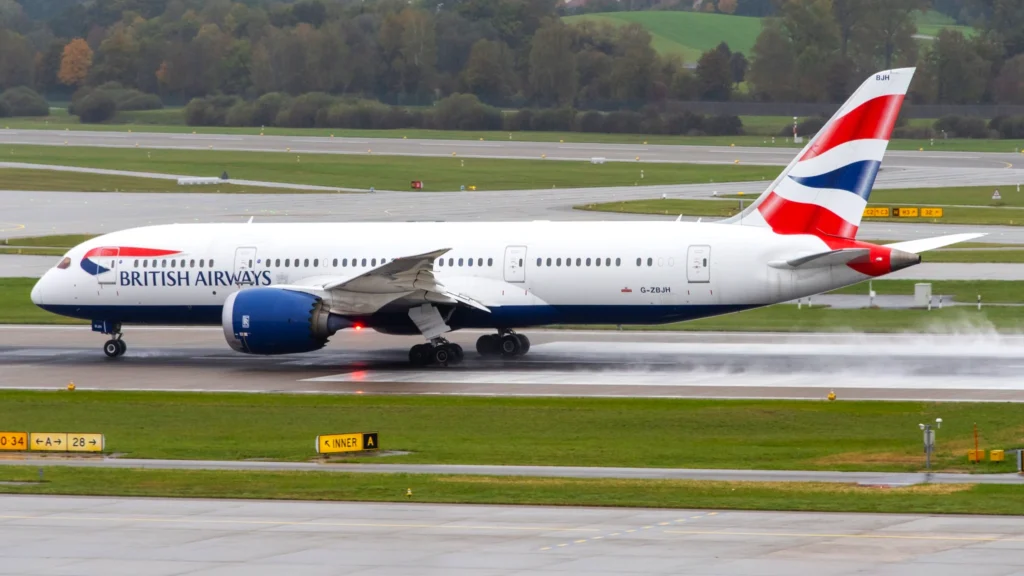
A similar event involving British Airways helps frame the likely downtime and repair work. In June 2021, the nose landing gear of a Boeing 787-8 collapsed at London Heathrow.
The aircraft, registration G-ZBJB, was being prepared for a cargo flight to Frankfurt when the front fuselage section struck the ground.
Investigators later determined the cause. A locking pin for the nose landing gear had been inserted in the wrong place during maintenance work. When the system was tested afterward, the nose landing gear retracted, and the nose dropped to the ground.
Damage Recorded on the British Airways Aircraft
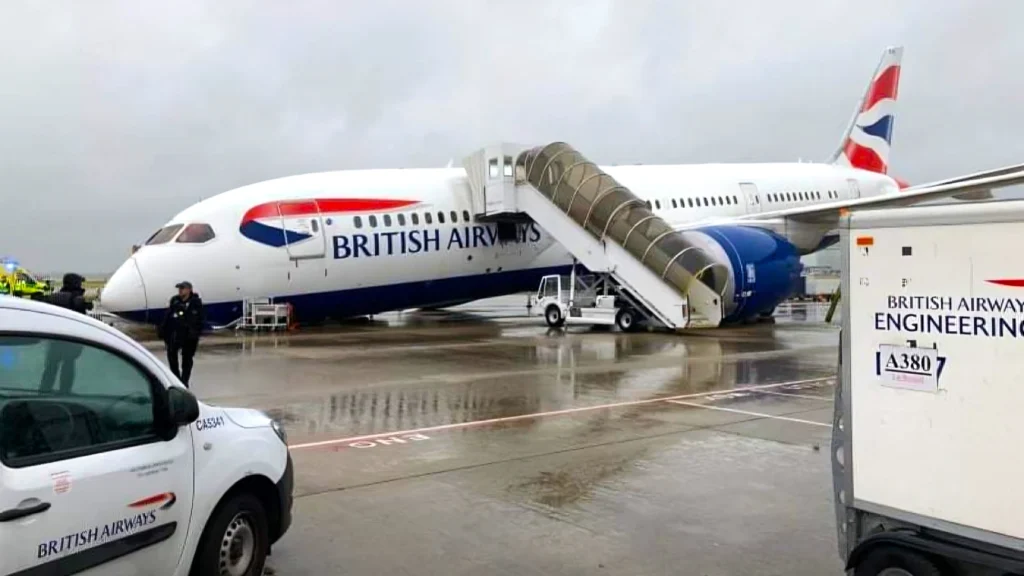
The damage to the British Airways Dreamliner gives a sense of what extensive repairs can involve. The flaps that conceal the retracted nose landing gear were severely damaged and partially torn from their mountings.
A passenger boarding ladder stood next to the second door on the left side of the fuselage. The sudden drop ripped that door from its mounting. The front cowling of both engines was also damaged. Further damage affected a door of the main landing gear and the frame of the front cargo hatch.
British Airways repaired the aircraft at London Heathrow. The G-ZBJB returned to service in November 2021, approximately five months after the incident. No public documents detail the repair work itself.
Why CFRP Fuselages Complicate Repairs
An aircraft structural engineer previously summarized the repair procedure for the Aeropeep portal. As a first step, technicians must use specialized measuring equipment to assess how far the damage extends inside the fuselage. If structural damage has occurred, replacement is not straightforward.
The Dreamliner’s fuselage is made of carbon fiber reinforced plastic, or CFRP. This material makes the fuselage significantly lighter than aluminum and offers a better strength-to-weight ratio.
It also makes the structure considerably harder to repair. Aluminum fuselages consist of individual panels that can be replaced piece by piece along with the underlying structure, which is far more difficult with CFRP.
For minor damage, technicians can sand the material at a very shallow angle before gluing in and curing new layers of carbon fiber. The process resembles repairing a fiberglass boat but demands far greater precision. Slightly larger damage can be addressed with prefabricated CFRP doublers, which act as carbon fiber repair patches. Technicians sometimes use titanium instead, riveting the metal to the hull.
Replacing Entire Fuselage Sections
In cases of more extensive damage, technicians can cut out entire sections of the fuselage and replace them with new components from current production. Boeing manufactures the 787 fuselage in individual segments known as barrels, which are joined together, making section replacement theoretically possible.
The fuselage internally supports a complex framework of transverse and longitudinal stiffeners. This makes such an intervention extremely demanding and runs against the aircraft’s fundamental design philosophy. In cases of severe structural damage, it may still remain the only option.
Boeing Must Approve Each Major Repair
On the British Airways jet, the internal mountings that held the landing gear were also likely damaged and required replacement. The nose landing gear itself, its associated doors, and a cabin door with its wiring also needed replacement.
Damage of this magnitude falls outside the standard procedures in Boeing’s Structural Repair Manual. As a result, the manufacturer must issue individual technical approval for each repair, which can easily extend the work over several months.
It remains unclear whether the damage to the Lufthansa Dreamliner is comparable, and the airline is not commenting. Strong indications suggest the D-ABPQ will be out of service for an extended period.
Stay tuned with us. Further, follow us on social media for the latest updates.
Join us on Telegram Group for the Latest Aviation Updates. Subsequently, follow us on Google News
