

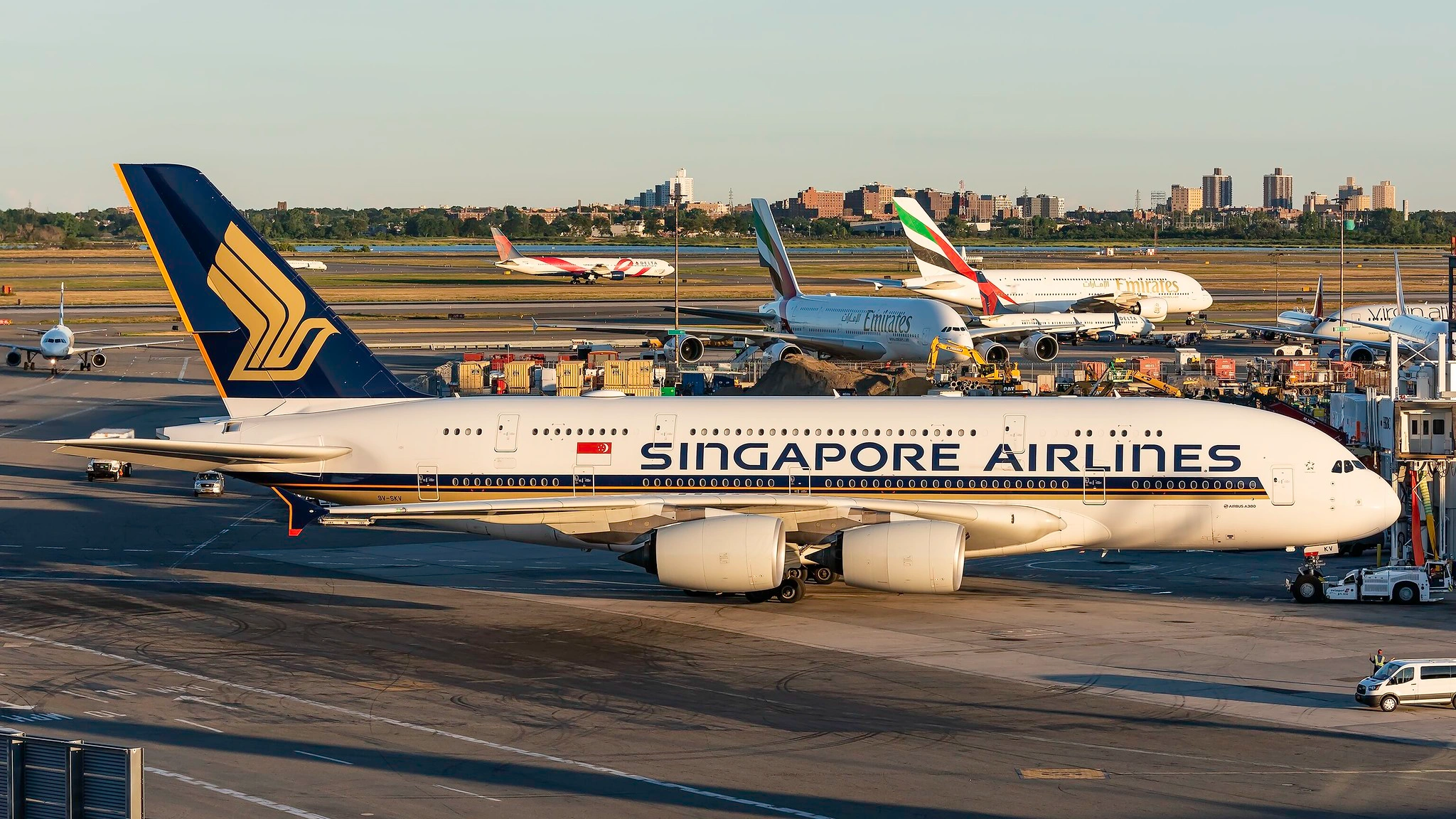
The Airbus A380 remains the flagship of commercial aviation, offering airlines the world’s largest premium cabins and pilots some of the highest salaries in the industry.
Emirates (EK), based at Dubai International Airport (DXB), operates the largest A380 fleet globally and pays its captains industry-leading packages.
A380 pilot pay varies sharply by carrier. Emirates (EK), Qantas (QF) flying out of Sydney (SYD), and British Airways (BA) at London Heathrow (LHR) offer the most competitive salaries, while smaller operators, including Etihad Airways (EY), Qatar Airways (QR), and Singapore Airlines (SQ), round out the global A380 employer market, Simple Flying reported.
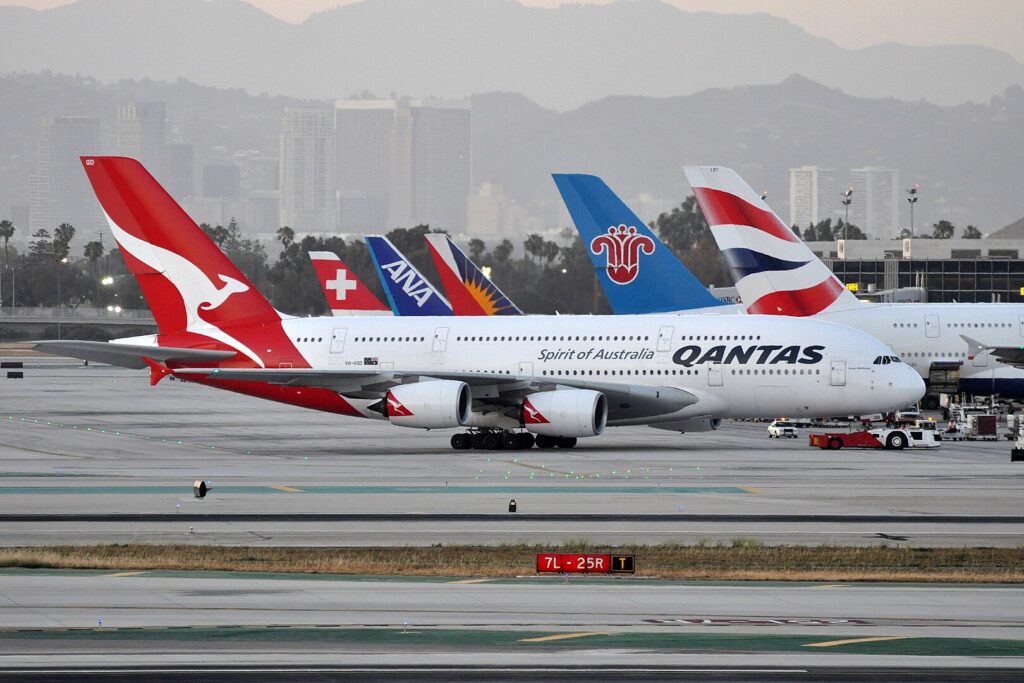
A380 Captain Salaries At The World’s Largest Operators
The A380 sits at the top of most airline fleets, and captain pay reflects that. At Emirates (EK), captains receive a monthly package of roughly AED 44,000 to over AED 98,000, equal to between $11,978 and $26,680.
On an annual basis, this works out to between $143,736 and $320,160. Earnings in the UAE are generally tax-free under local law, which lifts take-home pay further.
Qantas (QF) captains on the type earn between AUD 250,000 and AUD 400,000 per year, equal to between $177,838 and $284,542.
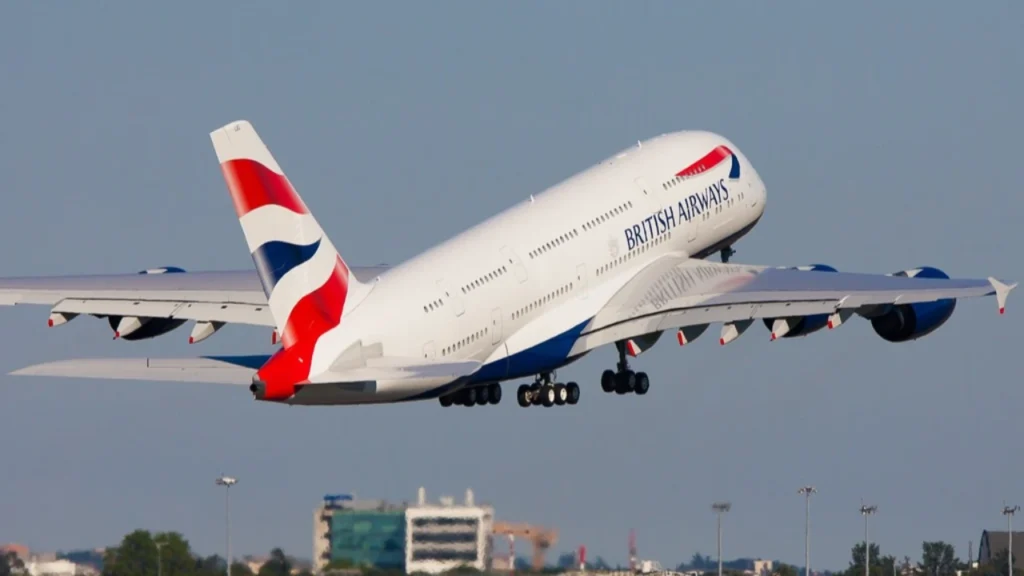
At British Airways (BA), captains receive between £190,000 and £240,000 annually, equal to between $256,025 and $323,400.
Although pay rates technically scale with tenure, the A380 is a senior fleet at most carriers. Most captains, therefore, earn at or near the top of the published bands, and the main source of variation is monthly flight hours rather than seniority.
At some airlines, the A380 pays the same as other large aircraft like the Boeing 777, but A380 pilots still draw the highest combined rates due to their seniority.
Pay structures also differ by region. US airlines pay pilots almost entirely by the hour. Emirates pays a fixed monthly salary plus a variable flying rate. Qantas pays its pilots hourly, similar to the US model, while still guaranteeing a minimum monthly figure calculated on an hourly basis.
First Officer And Second Officer Pay On The A380
The A380 is a two-pilot aircraft, with a first officer always seated as second-in-command. At Emirates (EK), first officers earn between AED 31,000 and AED 45,000 per month, equal to between $8,439 and $12,251.
The annual figure works out to between $101,268 and $147,012. Senior first officers earn close to what junior captains do.
Globally, A380 first officer salaries range from around $140,000 to nearly $250,000. A first officer slot on the A380 still ranks among the most senior positions at any airline.
Carriers differ in how pilots progress through aircraft types. Some give pilots a full choice of equipment and seats. Others use a structured path: narrowbody first officer to widebody first officer, then narrowbody captain, and finally widebody captain.
Emirates (EK) and Singapore Airlines (SQ) also staff long-haul flights with second officers. These pilots act as cruise pilots, taking the controls when other crew rest during extended sectors. Second officers do not perform takeoffs or landings.
As the most junior pilots on the seniority list, they earn the lowest rates, often below $120,000, even on the A380. Airlines without a second officer rank instead add extra first officers or captains to long-haul rotations.
Why Seniority Drives Every Pilot Outcome
Seniority shapes nearly every aspect of an airline pilot’s career. The date of hire determines pay rate, position, aircraft type, and base assignment at carriers with multiple hubs.
Relative seniority on the company-wide list controls those broad factors. Relative seniority within a fleet and seat controls the rest: days off, total hours flown, trip patterns, and specific destinations.
High retirement and hiring rates speed up progression by thinning out senior pilots and adding junior ones. A flat airline with little growth or attrition will see slow movement up the list.
Most carriers offer two schedule types. A line schedule has fixed trips on set days. A reserve schedule places pilots on call with fewer guaranteed days off, and most consider it less desirable.
Many airlines also pay per diem on top of base salary. This is a smaller hourly payment meant to cover living costs during layovers. It is usually paid for the full duration a crew is away from base. In the US, per diem is not taxable for trips that include a layover, but it is taxable for same-day turns. Line pilots can also pick up additional flying, sometimes at premium rates.

Which Airlines Still Operate The A380
Emirates (EK) confirmed plans to keep flying the A380 into the 2040s, but its 116-aircraft fleet will shrink over time. New A380 pilot positions at the carrier will become rarer as Emirates pivots toward the Boeing 777-9.
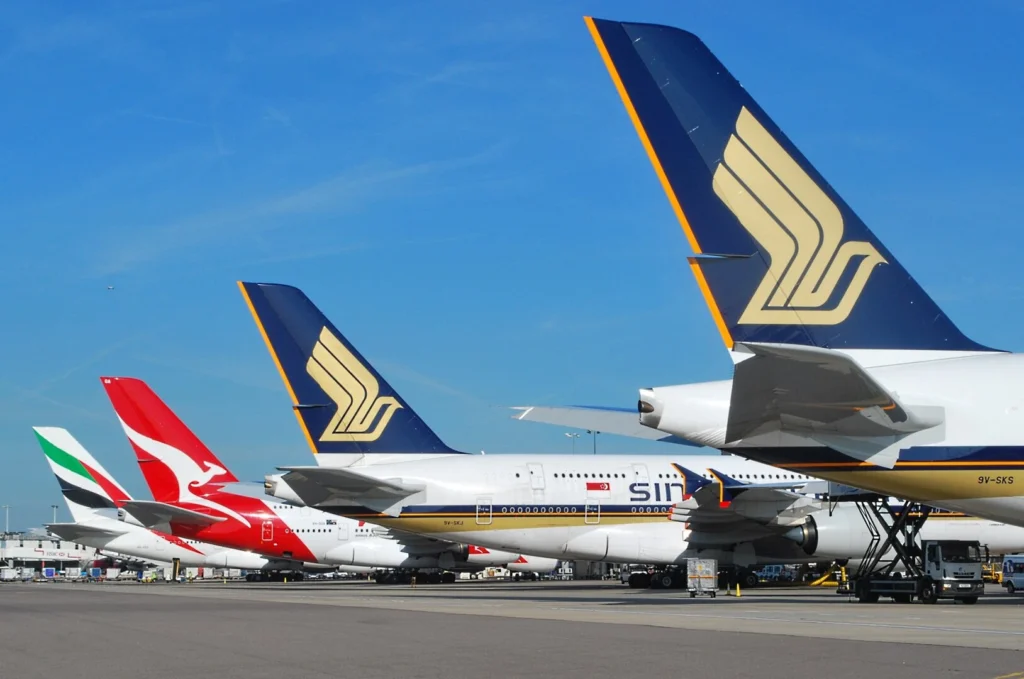
Within the Middle East, the A380 is also operated by Etihad Airways (EY) from Abu Dhabi (AUH) and Qatar Airways (QR) from Doha (DOH). In Asia, the type flies for Singapore Airlines (SQ) out of Singapore Changi (SIN), Korean Air (KE) and Asiana Airlines (OZ) from Seoul Incheon (ICN), and All Nippon Airways (NH) from Tokyo.
Asiana is currently merging with Korean Air. Qantas (QF) is the only Australian operator. In Europe, the type flies for British Airways (BA) from London Heathrow (LHR) and Lufthansa (LH) from Frankfurt (FRA).
Current A380 fleet sizes are as follows:
| Operator | Number In Fleet |
|---|---|
| Emirates (EK) | 116 |
| British Airways (BA) | 12 |
| Singapore Airlines (SQ) | 12 |
| Qantas (QF) | 10 |
| Etihad Airways (EY) | 9 |
| Lufthansa (LH) | 8 |
| Qatar Airways (QR) | 8 |
| Korean Air (KE) | 7 |
| Asiana Airlines (OZ) | 6 |
| All Nippon Airways (NH) | 3 |
Aside from Emirates, no operator flies more than 12 A380s, and many plan to retire the type by the end of the decade or during the 2030s. Even carriers without confirmed retirement dates are looking to shrink their A380 fleets. New first officer slots may open at a few operators, but the global A380 pool is too small and too senior for most aspiring pilots to realistically target the type long-term.

US Pilot Contracts Set Higher Theoretical A380 Rates
Pilot contracts at the three US legacy carriers include hourly rates for the A380, even though none of them operate the type. The rates exist so the airlines have a framework in place if they ever acquire the aircraft. Similar placeholder rates appear for other types these carriers do not fly, such as the Embraer E195.
Under these contracts, A380 first officers would earn up to roughly $478,000 per year, and captains would earn close to $700,000 per year. The US A380 rate sits above rates for the Airbus A330, A350, Boeing 777, and 787 at these carriers.
The table below shows United Airlines (UA) 2027 hourly rates under its 2023 pilot agreement:
| Aircraft | Captain Hourly (2027) | First Officer Hourly (2027) |
|---|---|---|
| A380 | $642.94 to $700.72 | $129.29 to $478.58 |
| A330/A350/B767-400/B777/B787 | $457.17 to $498.25 | $129.29 to $340.35 |
| A321neo/A321XLR/B757/B767-200/B767-300 | $379.18 to $417.07 | $129.29 to $284.86 |
| A321/B737-900/B737 MAX 9/B737 MAX 10 | $368.76 to $402.01 | $129.29 to $274.58 |
| A319/A320/A319neo/A320neo/B737-500/B737-700/B737-800/B737 MAX 7/B737 MAX 8 | $367.15 to $399.92 | $129.29 to $273.15 |
| A220-300 | $353.92 to $385.90 | $129.29 to $268.58 |
| A220-100 | $339.33 to $370.11 | $129.29 to $252.77 |
| E190/E195 | $277.37 to $302.12 | $129.29 to $206.37 |
| CRJ900 | $235.99 to $257.05 | $129.29 to $175.54 |
US rates sit clearly above worldwide A380 pay. Several factors drive the gap. US pilot training is expensive, and the FAA only issues unrestricted ATPLs to pilots with at least 1,500 flight hours. US legacy carriers have posted strong financial results, the US market is large with multiple competing employers, and pilot unions are strong.
Most other countries have smaller airline sectors, fewer competing carriers, and weaker or absent pilot unions. The result is a more captive pilot job market outside the US, which holds salaries lower.
Stay tuned with us. Further, follow us on social media for the latest updates.
Join us on Telegram Group for the Latest Aviation Updates. Subsequently, follow us on Google News
