

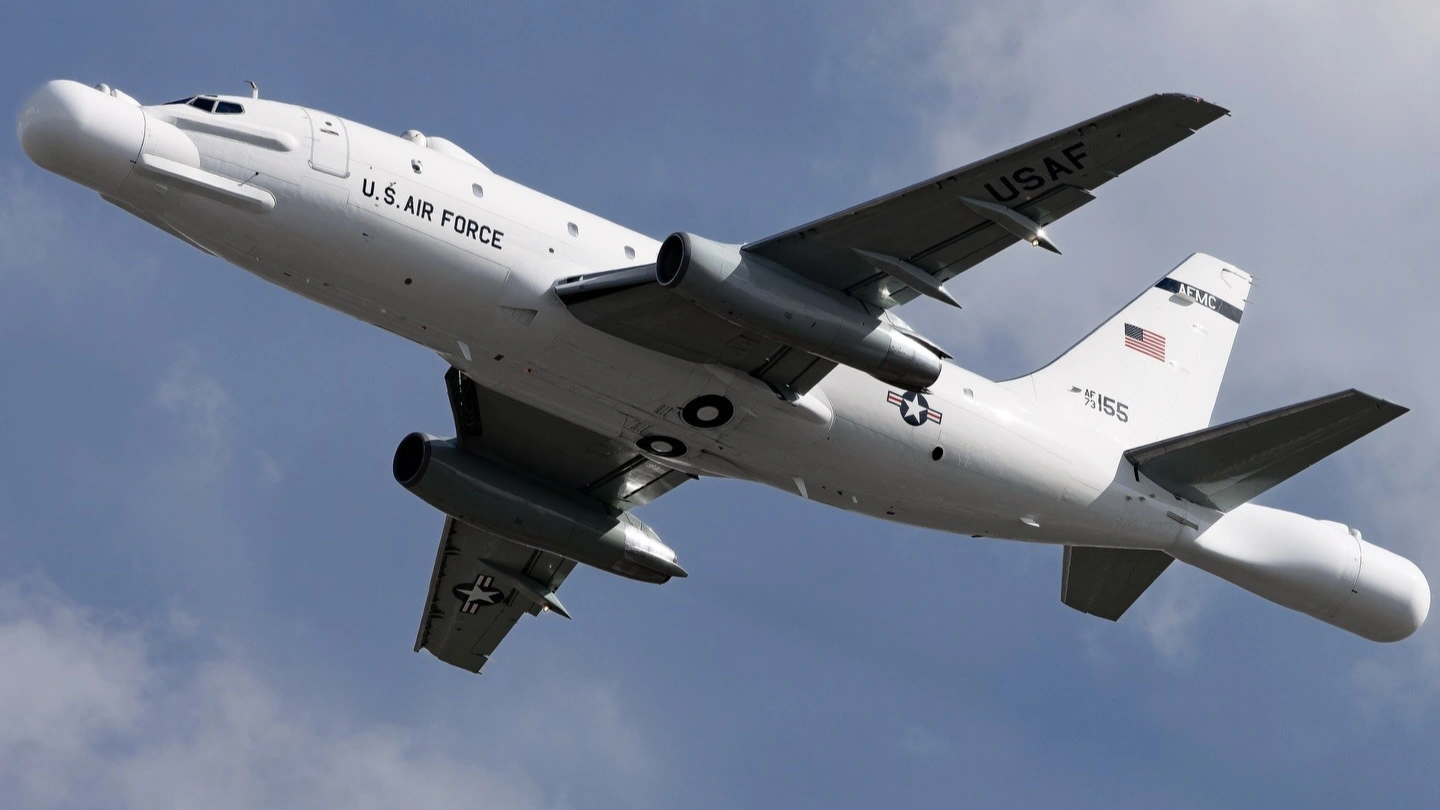
KENNEDY SPACE CENTER— The US Air Force’s rare and secretive NT-43A aircraft, known by its callsign RAT55, was spotted over Melbourne, Florida, ahead of NASA’s Artemis II lunar mission launch. The aircraft, typically associated with stealth aircraft testing in Nevada, appeared to be providing sensor and telemetry support for the historic crewed mission.
RAT55 flew an orbital pattern over Kennedy Space Center’s Launch Complex 39B before returning to MacDill Air Force Base. Its presence alongside NASA’s WB-57F research aircraft signals a rare expansion of the NT-43A’s operational role beyond its usual classified assignments, TWZ reported.

Most Secretive Aircraft Spotted
The NT-43A is a heavily modified Boeing 737-200, originally developed as the military T-43 variant. It is visually distinct, featuring a modified nose section and a large aft radome protruding from the rear fuselage.
The aircraft is based at Tonopah Test Range Airport (TTR) in Nevada, a high-security facility linked to classified aircraft programs. It is regularly observed near Area 51 and Edwards Air Force Base, both major U.S. military flight test centers.
Online tracking data confirmed the NT-43A flew under the callsign NASA522, though it was miscoded in the system as a C-130 Hercules.
It departed MacDill Air Force Base and conducted an oval-shaped orbit over restricted airspace near Launch Complex 39B before returning to base. The flight coincided with pre-launch support activity for the Artemis II mission.
The aircraft carries two large radar arrays along with modular electro-optical and infrared sensors. These systems make it well-suited for gathering telemetry, tracking flight signatures, and analyzing surface coatings, which are critical for thermal protection on rockets and spacecraft. RAT55 typically performs these functions in support of low-observable, or stealth, aircraft programs.
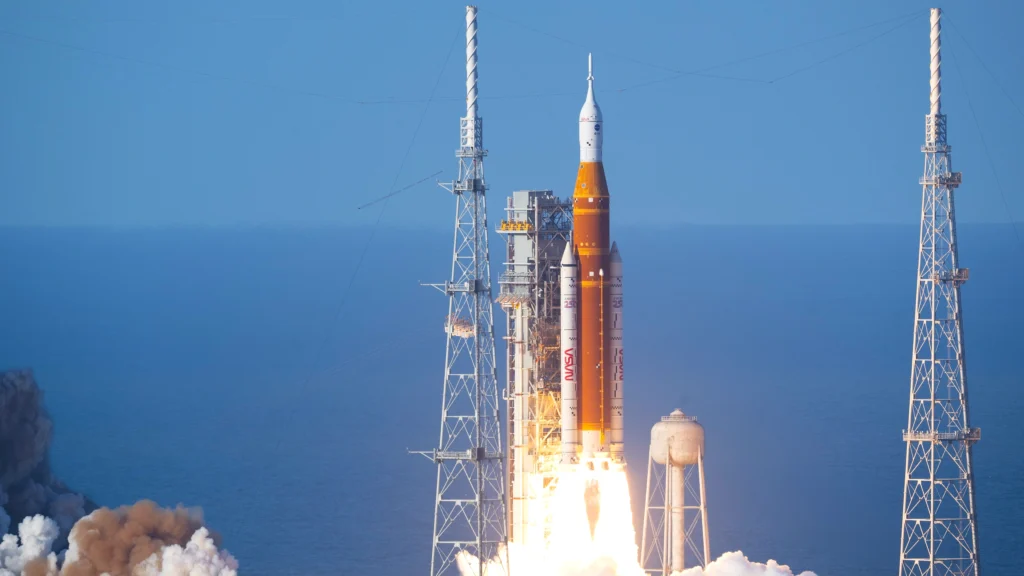
Artemis II Mission: A Historic Milestone in Space Exploration
NASA’s Artemis II mission launched from Launch Complex 39B at 6:24 PM EDT. A Space Launch System (SLS) rocket carried four astronauts inside an Orion capsule on a planned nine-and-a-half-day mission. This marks the first crewed lunar mission since Apollo 17 in December 1972.
The crew will not land on the Moon during this mission. Instead, they will perform a lunar flyby, aiming to travel approximately 252,000 miles from Earth, surpassing the current distance record set by the Apollo 13 crew in 1970 by roughly 4,000 miles.
The mission’s primary objective is to validate systems and procedures needed for future crewed lunar landings, the first of which is now planned for 2028.

Why the NT-43A Was Chosen and What It Brings to the Mission?
NASA routinely deploys fixed-wing aircraft to collect imagery and data during space launches. One of its WB-57F high-altitude research aircraft also participated in pre-launch tracking flights from the Kennedy Space Center’s Shuttle Landing Facility.
However, NASA operates only three WB-57Fs, and one suffered a belly landing in Houston, Texas, in January, with its current operational status remaining unclear.
The NT-43A offers a larger airframe than the WB-57F, along with optional dorsal fairings and additional payload capacity. This allows for more sensor systems to be installed simultaneously, making it a flexible platform for complex data-gathering missions.
Its ability to analyze specialized surface coatings is particularly relevant, as thermal protection materials are a critical component of SLS rocket and Orion capsule design.
The U.S. military, particularly the U.S. Navy, operates several dedicated range support and missile tracking aircraft. The Navy recently added the NC-37B, a modified Gulfstream G550, to its fleet, and repurposed RQ-4 Global Hawk drones are also used in this role.
The decision to deploy the NT-43A instead of, or alongside, these assets remains unexplained. The Air Force and NASA have been contacted for comment.

Historical Precedent: Air Force Support for NASA Lunar Missions
The Air Force’s involvement in NASA launch support is not without precedent. During the Apollo program in the 1960s and 1970s, the Air Force operated a fleet of EC-135N Apollo Range Instrumentation Aircraft (ARIA).
These aircraft, equipped with large nose-mounted radars, tracked Apollo missions and missile tests. They were later redesignated EC-135Es and continued serving in flight test roles until the last aircraft retired in 2000.
The NT-43A’s deployment for Artemis II echoes that earlier tradition, suggesting the aircraft’s mission profile may be expanding beyond its traditional stealth-related testing assignments. Whether this represents a one-time deployment or signals a broader new role for RAT55 in future space launches remains to be seen.
Feature Image By Dalton Hoch | Aviation Tampa Bay | Instagram
Stay tuned with us. Further, follow us on social media for the latest updates.
Join us on Telegram Group for the Latest Aviation Updates. Subsequently, follow us on Google News
