

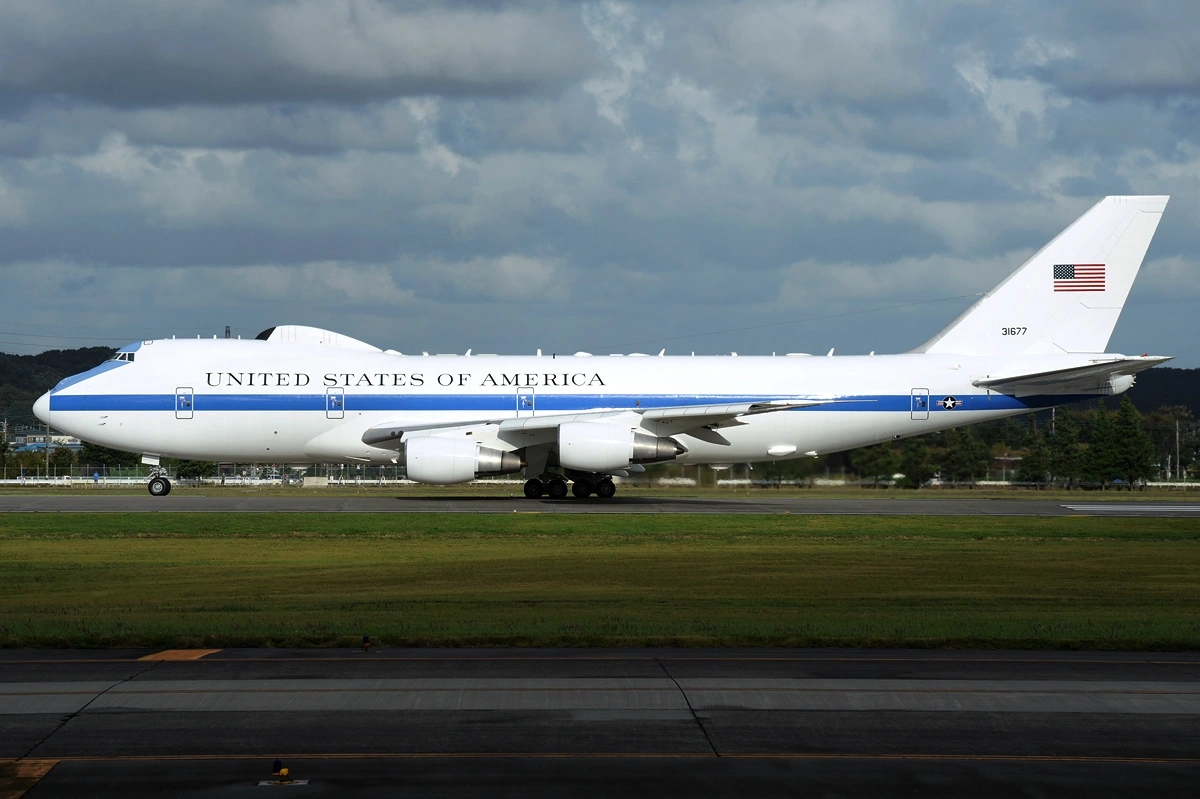
NEW YORK- Federal authorities arrested Tianrui Liang, a 21-year-old Chinese national, at John F. Kennedy International Airport (JFK) in New York on April 7, 2026, for allegedly photographing sensitive military aircraft at Offutt Air Force Base in Nebraska.
Liang, a student of aeronautical engineering at the University of Glasgow in Scotland, faces charges under 18 U.S.C. § 795, a federal law that prohibits unauthorized photography of designated military installations and equipment.
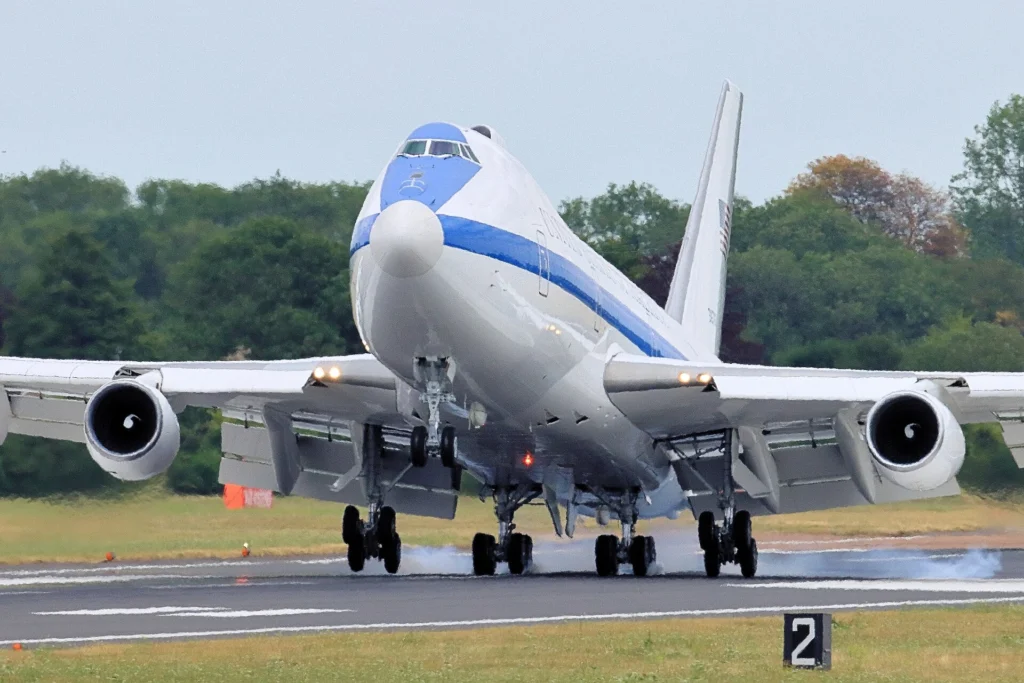
Liang allegedly photographed the Boeing E-4B Nightwatch and the Boeing RC-135 reconnaissance aircraft at Offutt, which serves as the headquarters of U.S. Strategic Command. He did not enter the base or face espionage charges.
Authorities say he used planespotting websites to identify vantage points and admitted the images were for his personal collection. A Nebraska federal judge ordered his detention as a flight risk after an initial magistrate judge had released him on bail.

Chinese Arrested for Photographing Boeing E-4B
Liang entered the United States on March 28, 2026, crossing the Canadian border from Vancouver (YVR) into Washington state on a valid B1/B2 visa.
He traveled with a friend studying in New York JFK and drove through Seattle (SEA), South Dakota, Montana, and Nebraska before reaching New York.
According to an FBI affidavit filed with the U.S. District Court for the Eastern District of New York, Liang first visited Ellsworth Air Force Base in South Dakota, intending to photograph B-1B Lancer bombers.
He then traveled to Offutt Air Force Base in Bellevue, Nebraska, where he photographed the E-4B and RC-135 aircraft from outside the installation. A witness reported seeing a male holding a camera with a telescopic lens near the base.
Offutt officials confirmed that Liang did not gain access to the installation and that the base is cooperating with the FBI investigation. Court filings also reveal that Liang planned to travel to Tinker Air Force Base in Oklahoma to photograph additional E-4B aircraft before departing the country.
When Liang arrived at JFK Airport to board a flight to Frankfurt en route to Glasgow, the FBI arrested him under an existing warrant issued in Nebraska, View from the Wing reported.
Federal Charges Under a Rarely Enforced Law
Liang faces charges under 18 U.S.C. § 795, which makes it unlawful to photograph, sketch, or map designated vital military and naval installations or equipment without prior permission from the commanding officer.
The law carries a penalty of up to one year in prison and a fine. Executive Order 10104, signed on February 1, 1950, defines the categories of classified military installations and equipment covered under this statute.
This law has been rarely enforced. However, when applied, it has disproportionately involved foreign nationals photographing U.S. military facilities. No espionage charges have been filed against Liang, and federal authorities have not alleged any connection between him and a foreign intelligence service.
The U.S. Department of Justice stated that the investigation into whether more serious charges apply remains ongoing.
After his arrest on April 7, Liang appeared before a federal magistrate judge in the Eastern District of New York on April 8. The judge released him on bail and denied the government’s motion for detention.
However, Chief District Court Judge Robert F. Rossiter Jr. in the District of Nebraska reversed the release on April 9, agreeing with prosecutors that Liang posed a considerable flight risk.
Liang was taken back into federal custody on April 10 and is now in the custody of the U.S. Marshals Service, awaiting further proceedings in Nebraska.
What Is the E-4B ‘Doomsday Plane’?
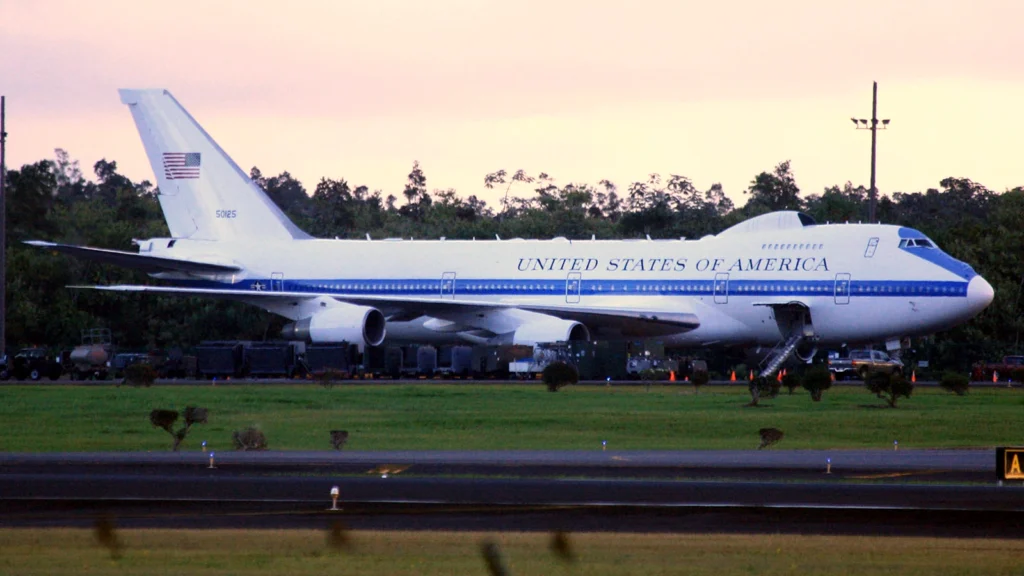
The Boeing E-4B Nightwatch serves as the National Airborne Operations Center (NAOC), a survivable airborne command-and-control platform for the President of the United States, the Secretary of Defense, and the Joint Chiefs of Staff. The U.S. Air Force assigns the E-4B fleet to the 595th Command and Control Group at Offutt Air Force Base.
The aircraft, built on the Boeing 747-200 platform, is hardened against electromagnetic pulse and nuclear effects. It supports in-flight refueling, long-range high-altitude operations, and can carry up to 111 personnel.
At least one E-4B remains on alert at all times to ensure continuity of government command in the event of nuclear attack, major natural disasters, or acts of terrorism. The fleet currently consists of four aircraft, with three entering service in the 1970s and one added in the 1980s.
Maintaining the aging E-4B fleet has become increasingly expensive. The Government Accountability Office estimates operating costs at approximately $372,496 per flight hour. Boeing ended 747 production entirely in 2022, making spare parts procurement extremely difficult.
The U.S. Air Force itself publishes photographs of the E-4B on its official website, which has led some observers to question whether prosecuting public photography of the aircraft is proportionate.
E-4C Replacement Program Moves Forward
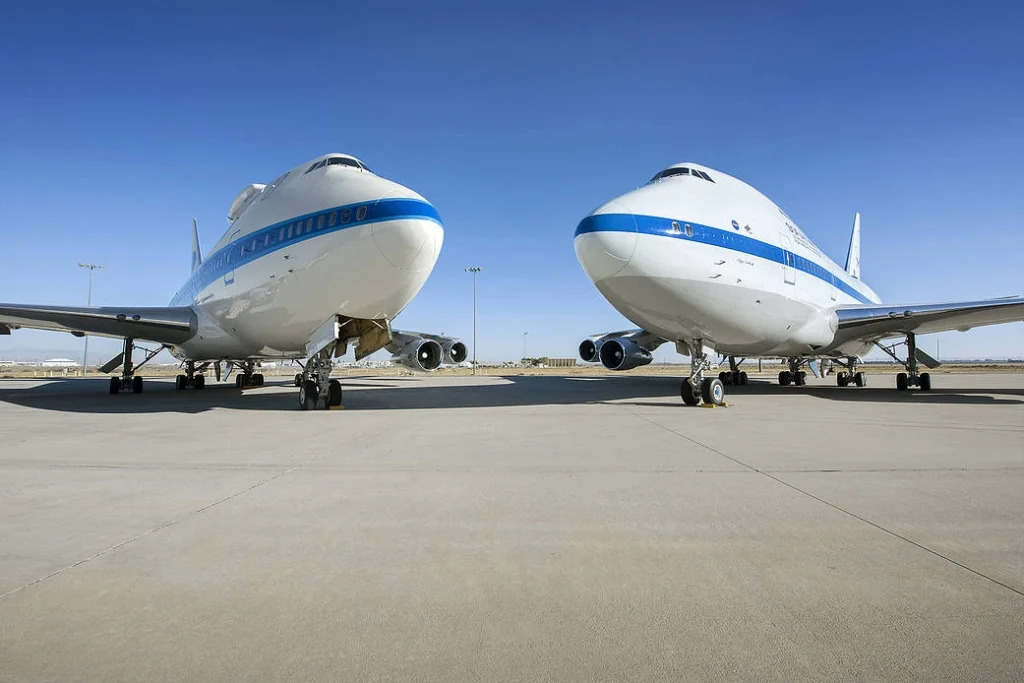
The U.S. Air Force awarded Sierra Nevada Corporation (SNC) a $13 billion contract in April 2024 to develop and produce the E-4C Survivable Airborne Operations Center (SAOC), the next-generation replacement for the E-4B fleet. Boeing withdrew its bid in 2023 over contract disagreements, leaving SNC as the sole competitor.
SNC acquired five Boeing 747-8I aircraft from Korean Air (KE) for conversion into the E-4C configuration.
The company began flight testing the first E-4C prototype on August 7, 2025, at its Aviation Innovation and Technology Center in Dayton, Ohio. Flight and ground testing will continue through 2026 at facilities in Dayton and Wichita, Kansas.
The Air Force initially planned to replace the four E-4Bs with a similar number of E-4Cs. However, U.S. Army Corps of Engineers planning documents from January 2026 indicate the fleet could grow to six to eight aircraft.
Construction plans at Offutt include a new two-bay maintenance hangar, fuel cell hangar, operations training facility, and expanded taxiway infrastructure to accommodate the larger fleet. Delivery of the full E-4C fleet is scheduled for completion by July 2036.
Legal Uncertainty and Broader Implications
The case of USA v. Liang raises questions about the scope and enforceability of military photography restrictions. Liang photographed aircraft that were publicly visible from outside the base perimeter.
The U.S. Air Force itself shares images of the E-4B on its official platforms. Legal analysts have noted that the public may not be reasonably aware of what specific equipment falls under the photography prohibition defined by Executive Order 10104.
The combination of Liang’s Chinese nationality, the sensitivity of Offutt as a STRATCOM headquarters, and the current geopolitical climate appears to have elevated enforcement attention.
Aviation enthusiast communities in the UK and Europe, where planespotting is widely practiced and generally tolerated near military bases, have followed the case closely. Liang would have been accustomed to a more permissive environment for aviation photography in Scotland.
A University of Glasgow spokesperson declined to comment on the matter, stating the university does not discuss ongoing police matters or individual students. The outcome of the case remains uncertain as the investigation continues.
Stay tuned with us. Further, follow us on social media for the latest updates.
Join us on Telegram Group for the Latest Aviation Updates. Subsequently, follow us on Google News
