


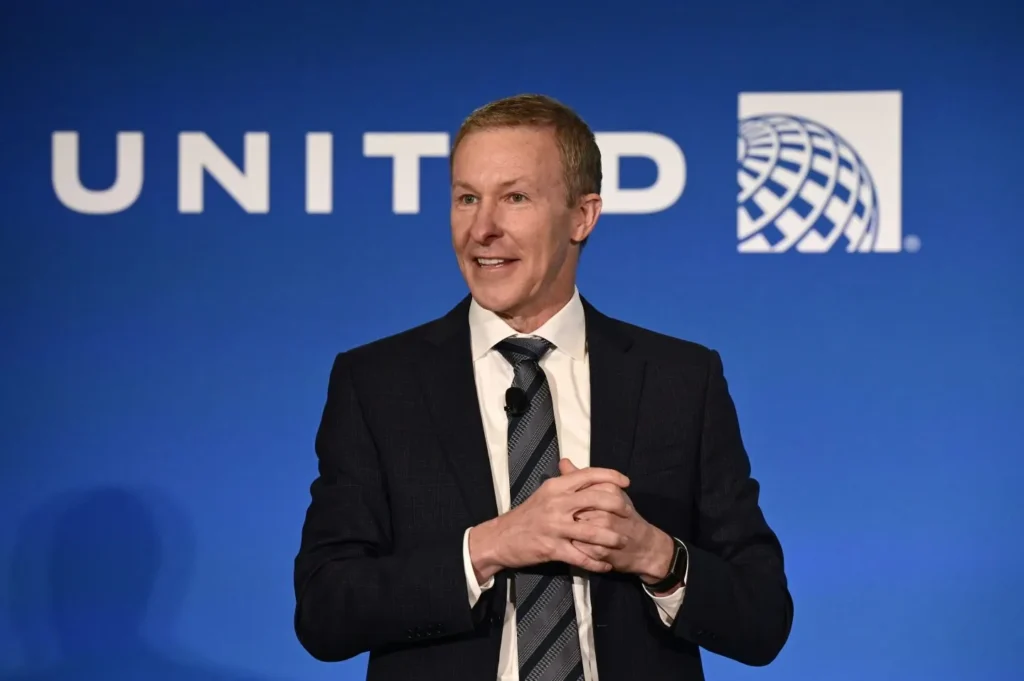
CHICAGO— United Airlines (UA) CEO Scott Kirby is redefining what it means to lead a century-old airline with a start-up mindset, focusing on culture, transparency, and employee pride as the foundation for long-term growth.
In a candid conversation with McKinsey Global Managing Partner Bob Sternfels, Kirby outlines how United Airlines, headquartered at Chicago O’Hare International Airport (ORD), is combining its legacy scale with a fresh, no-excuses operating philosophy — one built to withstand any business environment.
Scott Kirby Is Rebuilding United Airlines From the Inside Out

A Start-Up Mindset Inside a 100-Year-Old Airline
Kirby describes United Airlines (UA) today as “a five-year-old start-up embedded inside a 100-year-old airline.” The pandemic served as a reset moment, prompting leadership to overhaul both company culture and technology from the ground up.
Rather than returning to old habits, Kirby used the crisis as an opportunity to build a stronger, more agile organization.
While Kirby acknowledges that some aspects of air travel will remain constant — physical aircraft, routes, and airports — he points to evolving technology such as blended-wing body aircraft and potential supersonic travel as areas of gradual change. However, he believes the most meaningful shift for passengers will come from transparent communication.
A conversation with a Fortune 50 CEO a decade ago shaped this view: that travelers feel powerless because they lack real-time information. Kirby’s response has been to commit to sharing exactly what United knows, when they know it.

Hiring for Attitude, Training for Skill
When United (UA) opens flight attendant hiring for 2,000 to 3,000 positions, it routinely receives around 75,000 applications within hours. With that volume, identifying the right candidates becomes a process challenge.
Kirby’s approach is straightforward: hire for attitude and customer service mindset first, then train for the role.
To support this, Kirby introduced a peer-assessment model where well-regarded pilots escort interview candidates throughout the day, including lunch and facility tours. These pilots hold veto power over candidates, based on one simple question: “Is this someone I would want to take a four-day trip with?” The method filters for interpersonal qualities that formal interviews often miss.
Kirby also takes pride in United’s position as one of the few remaining employers where workers with a high school diploma can build a six-figure career.
Gate agents, ramp workers, and flight attendants at the top of the seniority scale earn high incomes with full benefits — a career path that has become increasingly rare across industries.
Ownership Over Excuses
A core principle Kirby carries from his time at the US Air Force Academy is the phrase “No excuses, sir.” He applies this directly to United’s (UA) operational culture.
When things go wrong — whether due to weather or any other external factor — the leadership team does not deflect blame. As United’s Chief Operating Officer frames it: “It may not be our fault, but it is our responsibility.”
This mindset shifts the organization’s focus from explaining problems to solving them, which Kirby views as a fundamental driver of performance and accountability.

Leadership as Energy and Inspiration
Kirby draws a sharp distinction between management and leadership. Management, in his view, handles compliance: attendance, checklists, and process. Leadership, by contrast, is about inspiration, vision, and how people feel.
As a CEO, he considers his role to be 100 percent leadership-focused. If he is checking compliance boxes, something has gone wrong further down the organization.
He also emphasizes the power of grounded optimism. Kirby believes leaders must give employees a genuine reason to feel positive about the future, but that optimism must be earned and fact-based, not naive. He points to self-fulfilling prophecies as a real force — when a team believes they will do something remarkable, they are far more likely to achieve it.
Personal Operating Model: Thinking Over Meetings
Kirby limits his daily meetings to no more than four hours, preserving the remainder of his day for unstructured thinking, calls, and reading. He reads approximately three hours per day across a wide range of subjects, allowing ideas from different domains to connect over time.
He also takes 20-minute naps during the workday, a habit he has maintained throughout his career.
His reasoning is practical: a tired brain operates below capacity, and decisions made at less than full capability carry real costs. United’s leadership team eventually installed a couch in his office to support the practice.
Stay tuned with us. Further, follow us on social media for the latest updates.
Join us on Telegram Group for the Latest Aviation Updates. Subsequently, follow us on Google News
