


NEW DELHI- Bathinda in Punjab tops the latest ranking of the world’s most polluted cities with an AQI (US) of 977, and all 10 listed cities are in India.
Smog across northern India also disrupts air travel, as IndiGo (6E) and Air India (AI) warn passengers about delays at Indira Gandhi International Airport (DEL). Bathinda Airport (BUP) serves the city at the top of the list.

Top 10 Most Polluted Cities in the World
The ten most polluted cities in this ranking sit in three states: Punjab, Haryana and Uttar Pradesh. Each carries a Hazardous status on the US AQI scale.
| Rank | City | AQI (US) | Status |
|---|---|---|---|
| 1 | Bathinda, Punjab | 977 | Hazardous |
| 2 | Panipat, Haryana | 954 | Hazardous |
| 3 | Kaithal, Haryana | 882 | Hazardous |
| 4 | Karnal, Haryana | 868 | Hazardous |
| 5 | Faridkot, Punjab | 736 | Hazardous |
| 6 | Kanpur, Uttar Pradesh | 701 | Hazardous |
| 7 | Muzaffarnagar, Uttar Pradesh | 596 | Hazardous |
| 8 | Patiala, Punjab | 549 | Hazardous |
| 9 | Sirsa, Haryana | 539 | Hazardous |
| 10 | Jaunpur, Uttar Pradesh | 526 | Hazardous |
Haryana holds 4 places, Punjab 3, and Uttar Pradesh three. The gap between first and tenth is wide, with Bathinda at 977 and Jaunpur at 526. Panipat follows at 954, and the top 4 cities all sit above 850.
A live ranking is a snapshot, not an annual verdict. Positions change by the hour, and trackers can rank cities differently. IQAir placed Lahore first on November 2, 2026, at AQI 530.

How to Read AQI Numbers
The US AQI labels any reading above 300 as Hazardous. EPA guidance calls values above 500 “Beyond the AQI” and says to follow the Hazardous recommendations. All ten cities here exceed 500.
India’s own National Air Quality Index, run by the Central Pollution Control Board (CPCB), uses six categories from Good to Severe, with Severe starting at 401. The two systems use different breakpoints, so a US AQI figure and a CPCB figure for the same air will not match.
Averaging periods also matter. The Centre for Research on Energy and Clean Air (CREA) named Panipat India’s most polluted city for September 2026, with a monthly average PM2.5 of 78 µg/m³. That figure falls in the Moderate band of CREA’s PM2.5 categories.
A monthly average and a live reading cover different time windows, so they should not be compared directly.
PM2.5 refers to particles smaller than 2.5 micrometres. They can enter the lungs and bloodstream. At Hazardous levels, the whole population faces a health risk, and children, older adults and people with heart or lung conditions face the highest risk.

What Drives Pollution Across North India
No single activity explains the readings. Vehicles, industry, dust, burning of crop residue and waste, and household fuel all add to the load.
Weather makes it worse in winter. Delhi-NCR records its lowest temperatures, weakest winds and lowest mixing heights between December and February, which suppresses dispersion.
The Commission for Air Quality Management (CAQM) estimated these PM2.5 shares: secondary particulates 27%, transport 23%, biomass burning 20%, dust 15% and industry 9%.
These shares describe Delhi, not each city in the ranking. Biomass burning in that estimate also covers municipal and residential waste, not only crop residue. It should not be read as stubble burning alone.
How Smog Disrupts Flight Operations
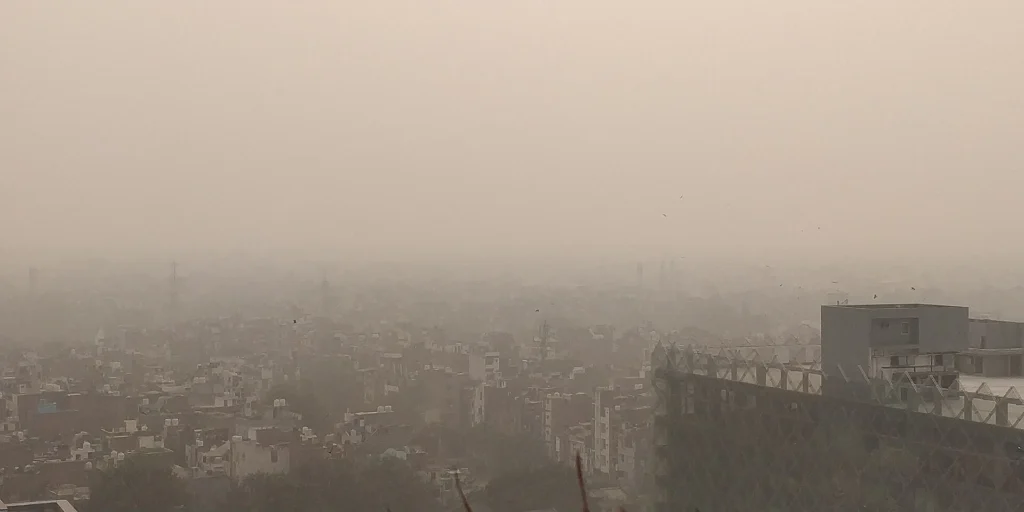
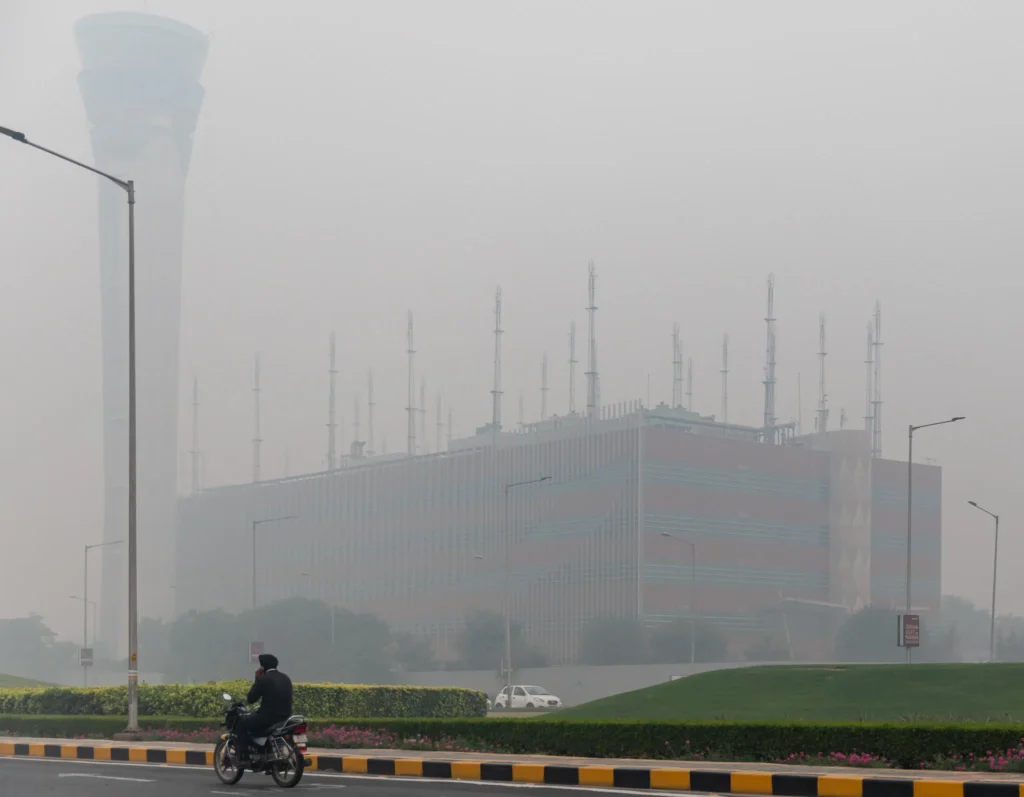
Low visibility, not the pollutant count itself, causes most smog-related delays. Aviation experts say winter smog, caused by trapped pollutants and low wind speeds, has consistently worsened visibility during the fog window in New Delhi in recent years.
Delhi is not in this top ten, but its airport shows the effect. On December 21, 2025, 110 flights were cancelled at Delhi’s airport and more than 370 were delayed because of low visibility. In November 2024, 9 flights were diverted to Jaipur and one to Lucknow during a low-visibility morning.
The airport manages these conditions with CAT III procedures. CAT III protocols allow aircraft to land in extremely low visibility using advanced autoland systems.
The airport operator has cautioned that flights not equipped for CAT III operations can face delays or diversions. The airport shifted to CAT III operations again on February 2, 2026, when smog and dense fog covered the city.
Airlines respond with advisories. IndiGo and Air India both asked travelers to check flight status before heading to the airport. Early morning carries the highest risk. Visibility has repeatedly dropped to critically low levels in the early morning hours, affecting both domestic and international flights.
A high AQI alone does not cancel flights. Runway visibility, wind, aircraft limits and instrument landing requirements decide operations.
Airports and Ground Access in Polluted Belt
Bathinda Airport is a civil enclave at Bhisiana Air Force Station, where the Indian Air Force provides air traffic control and emergency services. Alliance Air operated flights from the airport to Delhi from December 2016 until 2020.
FlyBig restarted operations in September 2023 with flights to Ghaziabad and Dehradun. Schedules have changed over the years, so passengers should confirm current service with the airline.
Many cities on the list rely on larger hubs. The Panipat district administration lists Indira Gandhi International Airport as the nearest airport, 99 km away.
Smog also hits ground links. During one Delhi smog episode, more than 90 trains were delayed by 6 to 7 hours because of low visibility.
Practical Tips for Travelers
- Check the live AQI for your destination before departure, since rankings and readings change through the day.
- Check flight status in the airline app before leaving for the airport.
- Choose later-morning or afternoon departures when possible, as early morning visibility is the weakest.
- Allow longer connection times when flying through Delhi in winter, and plan extra time for road and rail transfers.
- Carry an N95 or FFP2 mask and regular medication in cabin baggage, and limit outdoor exposure on Hazardous days.
Stay tuned with us. Further, follow us on social media for the latest updates.
Join us on Telegram Group for the Latest Aviation Updates. Subsequently, follow us on Google News
