


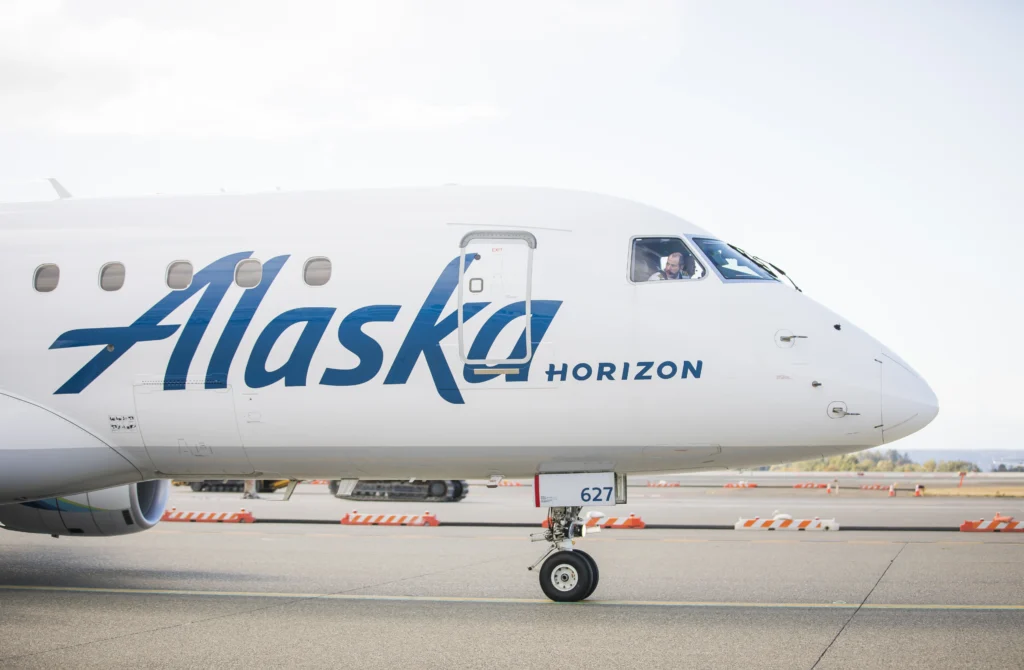
SEATAC, WASHINGTON- Horizon Air (QX), a regional subsidiary of Alaska Air Group, is facing a lawsuit from the Teamsters Union over allegations that the airline forces fatigued pilots to travel as passengers to another destination before receiving their required rest.
The complaint identifies five alleged incidents involving pilots based in Portland (PDX) and Seattle (SEA), who were reportedly ordered to deadhead to Vancouver (YVR), Ontario, California (ONT), and Reno (RNO) before starting their rest periods.
Teamsters Challenge Horizon Air’s Fatigue Rest Policy
The International Brotherhood of Teamsters Airline Division and its local affiliate, the Airline Professionals Association Teamsters Local Union No. 1224, filed the lawsuit against Horizon Air on October 23, 2026.
The case, registered as 2:26-cv-04086, was filed in the U.S. District Court for the Western District of Washington. The unions allege that Horizon Air violated the Railway Labor Act (RLA) by changing established working conditions without following the required negotiation procedures.
The dispute centres on how Horizon Air handles pilots who report fatigue while at their home bases. The union claims that a 2022 Letter of Agreement (LOA) requires the airline to release these pilots into a rest period before assigning them any further travel.
However, the lawsuit alleges that Horizon Air began requiring some pilots to travel to other locations before receiving their rest, effectively changing the agreed procedure.
The union is seeking a court declaration that Horizon Air violated federal labour law, along with an injunction requiring the airline to restore the previously agreed fatigue protections.
Horizon Air is a wholly owned subsidiary of Alaska Air Group. Its scheduled flights and passenger capacity are marketed exclusively by Alaska Airlines (AS), while the regional carrier operates its own flight operations, PYOK reported.
What the 2022 Agreement Says About Pilot Fatigue
Pilot fatigue is a significant aviation safety concern because it can affect alertness, decision-making, reaction times, and the ability to perform safety-related duties.
Under Federal Aviation Regulations, 14 CFR 117.3 defines fatigue as a physiological state of reduced mental or physical performance resulting from a lack of sleep or increased physical activity. Such a condition can reduce a flight crew member’s ability to operate an aircraft safely.
Federal regulations also require pilots to report when they are too fatigued to perform their assigned duties safely. Under 14 CFR 117.5, a pilot who reports being too fatigued to operate safely cannot accept a flight duty assignment.
Importantly, federal regulations distinguish between deadheading and rest. Under 14 CFR 117.3, deadhead transportation involves moving a flightcrew member as a passenger or non-operating crew member. The time spent travelling counts as duty rather than rest.
The Horizon Air dispute centres on how the airline must sequence deadheading and rest after a fatigue report.
Horizon Air and the Teamsters negotiated the relevant Letter of Agreement in 2022. Both parties signed the agreement on September 2, 2022, and pilots ratified it on September 16. Its provisions became effective on October 1, 2022.
The agreement introduced fatigue-related pay protections and established separate procedures depending on whether a pilot was a lineholder or reserve pilot and whether the fatigue report occurred at home base or away from base.
For lineholder pilots reporting fatigue at their home base, the agreement requires Horizon Air to immediately provide at least 10 hours of rest. Only after completing that rest period can the airline release the pilot, reconnect them with their original trip, or arrange deadhead transportation.
Reserve pilots receive similar protection. The agreement requires Horizon Air to immediately release reserve pilots into rest when they report fatigue from their home base.
However, the rules allow different arrangements when pilots report fatigue away from their home bases. In those circumstances, Horizon Air can direct certain pilots to deadhead to their next layover location or return to their home base before receiving rest, subject to applicable limitations.
According to the lawsuit, this distinction is central to the dispute. The union argues that Horizon Air cannot apply the away-from-base procedure to pilots who report fatigue at home.
Five Alleged Incidents Involving Fatigued Horizon Air Pilots
The complaint identifies at least five occasions when Horizon Air allegedly instructed pilots to deadhead to another destination before receiving rest.
The union claims it received no complaints about this practice between October 1, 2022, when the agreement became effective, and July 2026. However, it alleges that the airline began applying a different procedure in July 2026.
The first reported incident occurred on July 14, 2026, when reserve pilot Austin Braver reported fatigue at his home base in Portland, Oregon.
Instead of immediately releasing him into rest, a crew scheduler and a Flight Operations Duty Officer allegedly ordered him to deadhead to Vancouver, British Columbia, where he would begin his rest period. The complaint states that Braver had no choice but to follow the instruction.
A second incident occurred on July 22, 2026, involving lineholder pilot Kyle Boaz, who also reported fatigue while based in Portland.
According to the complaint, crew scheduling instructed Boaz to deadhead to Vancouver before receiving rest. He reportedly referred to the 2022 Letter of Agreement and challenged the instruction, but the scheduling team rejected his objection. He subsequently complied with the directive.
The third incident occurred on July 28, 2026, when lineholder pilot Zachary Ng reported fatigue at his Portland base.
Crew scheduling allegedly directed him to travel as a passenger to Ontario, California, before beginning his rest period. When Ng challenged the instruction and pointed to the 2022 agreement, the scheduler accused him of refusing the assignment.
The complaint claims that Ng faced the threat of disciplinary action and therefore complied with the instruction.
Another incident occurred on the same day involving lineholder pilot Mychal Hornbeck.
Hornbeck reported fatigue while at the airport in Portland and initially left to return home for rest. However, after arriving home, he received a message from crew scheduling assigning him to deadhead to Ontario, California, before beginning his rest.
Hornbeck questioned the instruction and explained that he had already left the airport. According to the complaint, the scheduler claimed that he had previously been informed of the deadhead assignment and indicated that the fatigue notation in his flight records would be replaced with an “XX” notation.
The fifth reported incident occurred on August 15, 2026, involving lineholder pilot Eric Widell, who reported fatigue at his home base in Seattle, Washington.
Despite the union already having sent a cease-and-desist letter to Horizon Air, crew scheduling allegedly directed Widell to deadhead to Reno, Nevada, before beginning his rest period.
The union claims that Widell also had no choice but to follow the instruction.
The complaint states that these five incidents demonstrate a pattern of requiring pilots reporting fatigue at their home bases to travel elsewhere before receiving rest.

Horizon Air Rejects Union’s Interpretation of Fatigue Agreement
The Teamsters initially attempted to resolve the dispute through internal labour procedures rather than immediately taking legal action.
Between July 22 and August 25, 2026, the union filed grievances concerning the reported incidents. Initially, it believed the scheduling instructions could have been isolated mistakes.
However, the union claims it later discovered that Horizon Air did not consider the instructions to be errors and intended to continue applying the disputed procedure.
On August 3, Local 1224 Chief Counsel Paul Rutter discussed the matter with Angela May, Senior Corporate Counsel for Alaska Airlines, who was acting on behalf of Horizon Air.
During the discussion, Rutter raised concerns that the repeated deadheading instructions represented a broader policy rather than isolated scheduling mistakes.
On August 7, the union sent Horizon Air a cease-and-desist letter demanding that the airline immediately stop requiring fatigued pilots at their home bases to deadhead before receiving rest.
Horizon Air responded on August 12, rejecting the union’s interpretation that its procedure violated the 2022 agreement or the Railway Labor Act.
According to the complaint, the airline argued that the parties had not intended the 2022 agreement to change its earlier fatigue-management practices. It also referred to previous instances of fatigued pilots being deadheaded and cited its Flight Operations Manual as further support for its position.
The union disputed this interpretation, arguing that the Letter of Agreement takes precedence over the airline’s internal operating procedures.
The disagreement continued during a September 17 meeting between Horizon Air and union representatives. Henry Simkins, Chairman of Local 1224’s Horizon Air Pilots Executive Council, requested that the airline suspend the disputed practice until an arbitrator could decide the matter.
Horizon Air representatives did not provide an answer during the meeting.
On September 30, Horizon Air Director of Labour Relations Frans Miller informed the union that the airline would maintain its existing practice while the dispute continued through the grievance and arbitration process.
Horizon Air Faces 99% No-Confidence Vote Against Operations Chief
The lawsuit comes amid wider tensions between Horizon Air pilots and the airline’s management.
On November 5, 2026, Teamsters announced that 99% of Horizon Air pilots had supported a vote of no confidence in Carlos Zendejas, the airline’s Senior Vice President of Operations.
The Horizon Air Pilots Executive Council subsequently called for Zendejas’ removal, citing concerns about operational management, working conditions, and the airline’s relationship with its pilots.
Sean Lenney, a Horizon Air pilot and member of Local 1224, criticised management over its handling of contractual commitments.
“Management cannot pick and choose which parts of our contract it wants to follow,” Lenney said.
He added that the fatigue protections were negotiated for a specific reason and that pilots would continue holding the airline accountable for its obligations.
Henry Simkins also criticised the airline’s leadership, stating that pilots had continued performing their duties safely and professionally while management had failed to address serious operational concerns.
The union said pilots deserved leadership that respected employees, honoured existing commitments, and accepted responsibility for the airline’s direction.
The leadership dispute adds another challenge for Horizon Air as it continues negotiating a successor labour agreement with its pilots.
What the Teamsters Want From the Lawsuit
The Teamsters filed the lawsuit under several provisions of the Railway Labor Act, including Sections 2 and 6.
The union argues that Horizon Air changed established working conditions without completing the legally required negotiation and mediation procedures. It also claims that the airline violated its obligation to maintain existing working conditions while negotiations continued.
According to the complaint, the union and Horizon Air have been negotiating changes to their collective bargaining agreement since February 2023. The two sides had continued holding bargaining meetings without reaching a successor agreement when the lawsuit was filed.
The complaint also identifies approximately 656 Horizon Air pilots as of October 1, 2026, represented by the union.
The Teamsters are asking the court to declare that Horizon Air violated the Railway Labor Act and issue preliminary and permanent injunctions requiring the airline to restore the 2022 agreement.
The requested relief includes an order requiring Horizon Air to immediately provide at least 10 hours of rest to union-represented pilots who report fatigue at their home bases. The union is also seeking legal costs and attorneys’ fees.
The lawsuit represents the union’s claims, and the court has yet to determine whether Horizon Air violated the agreement or federal labour law.
Stay tuned with us. Further, follow us on social media for the latest updates.
Join us on Telegram Group for the Latest Aviation Updates. Subsequently, follow us on Google News
