

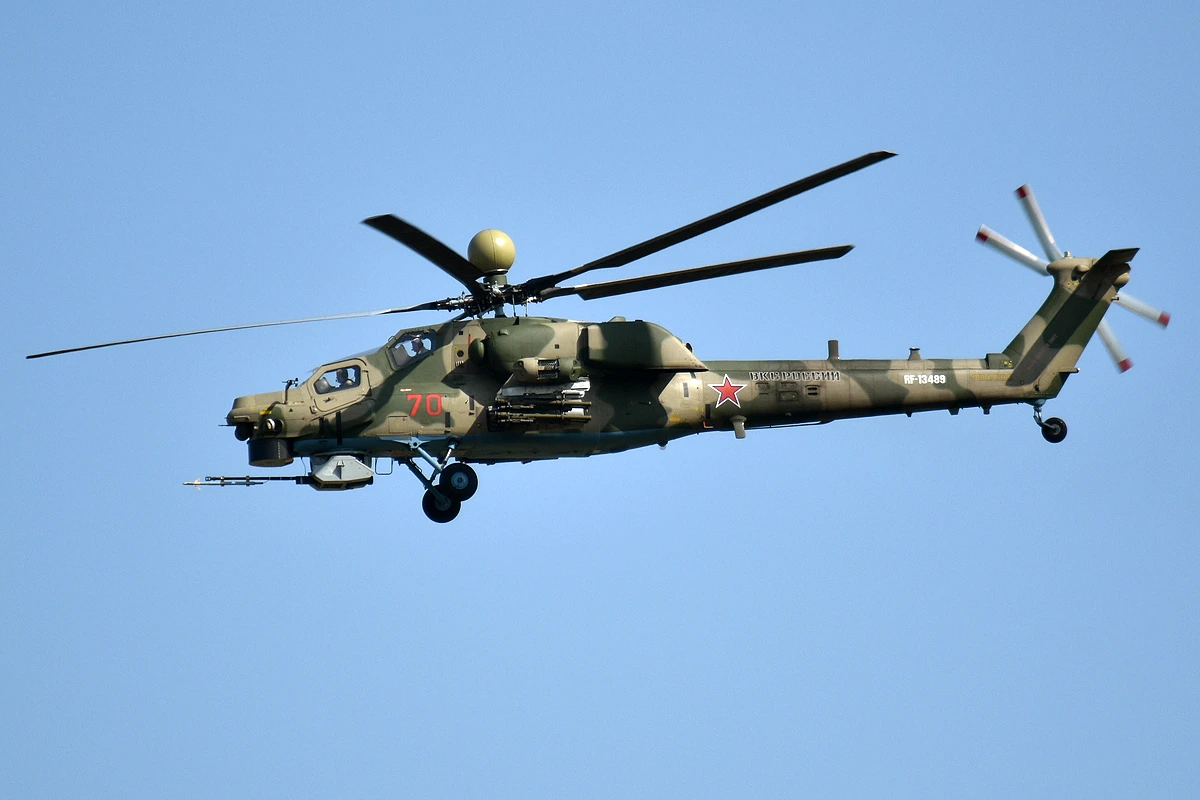
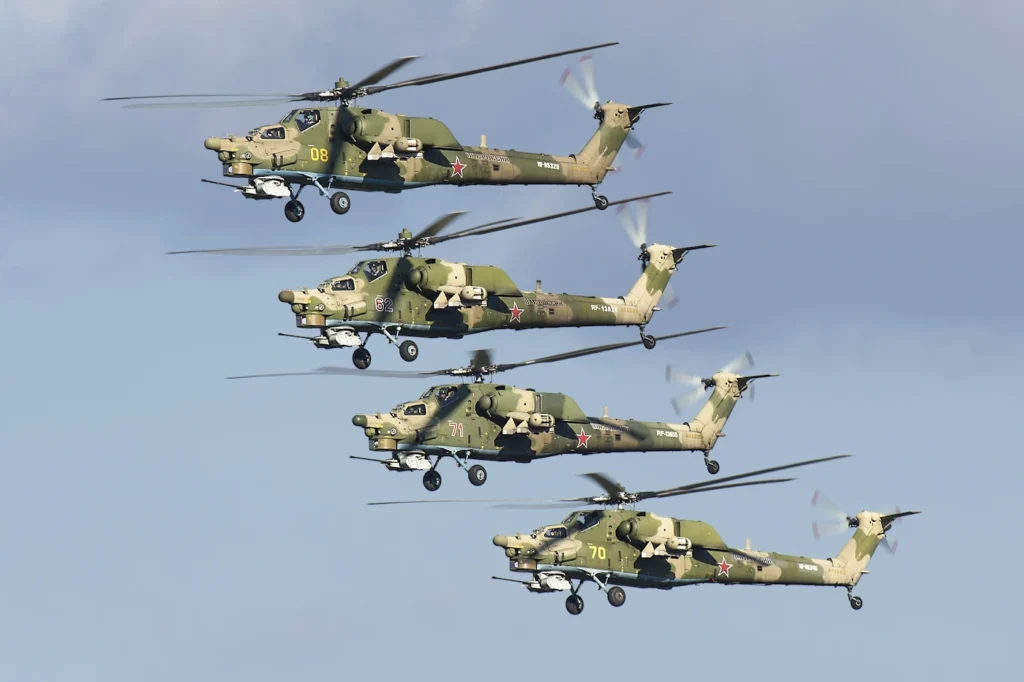
MOSCOW- Russia’s Defense Ministry has released footage of a Mi-28NM Havoc attack helicopter firing a small, low-cost cruise missile, reportedly during combat operations in Ukraine.
It is the clearest official sign yet that Russia is exploring a non-traditional launch platform for its emerging family of inexpensive standoff weapons.
The missile could be the S8000 Banderol or the Dan-T. Unconfirmed Ukrainian reports link the helicopter to launches against targets around Odesa (ODS), and Russia has pitched the Dan-T for export at an airshow in El Alamein (DBB), Egypt.
Russia Explores Helicopter Launches for Cheap Cruise Missiles
The video shows one missile leaving a pylon beneath the helicopter’s left-side stub wing. After the mission, the helicopter returns with an unfired missile still hanging under its right-side stub wing.
The Defense Ministry has not provided a date, a precise location, or details about the target. It has also not identified the weapon. The missile could be the S8000 Banderol or the Dan-T, two closely related and visually very similar Russian developments.
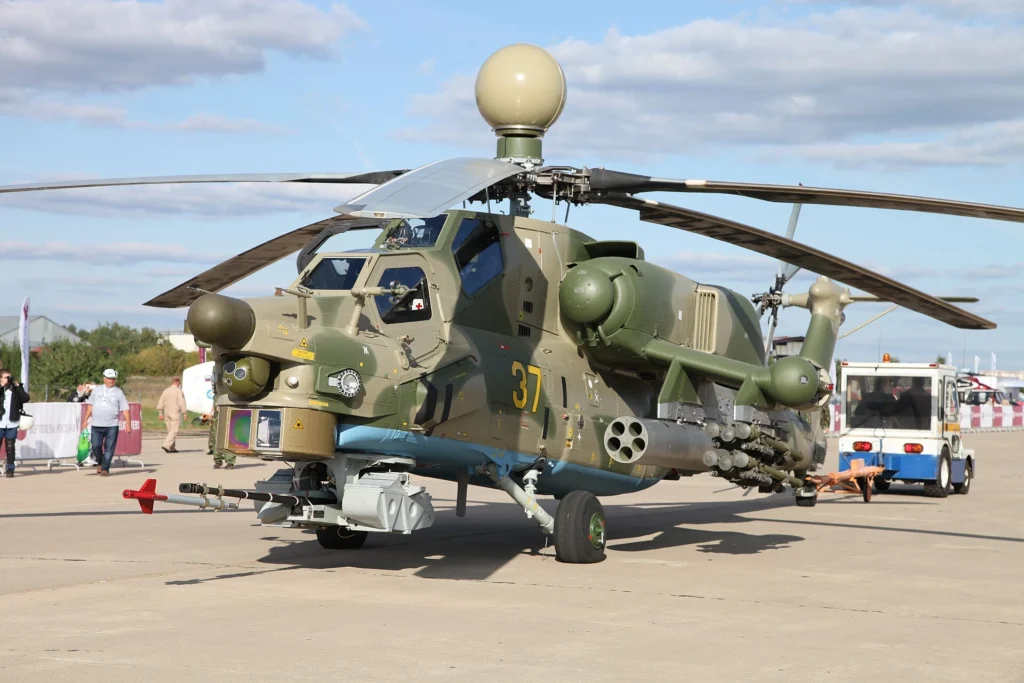
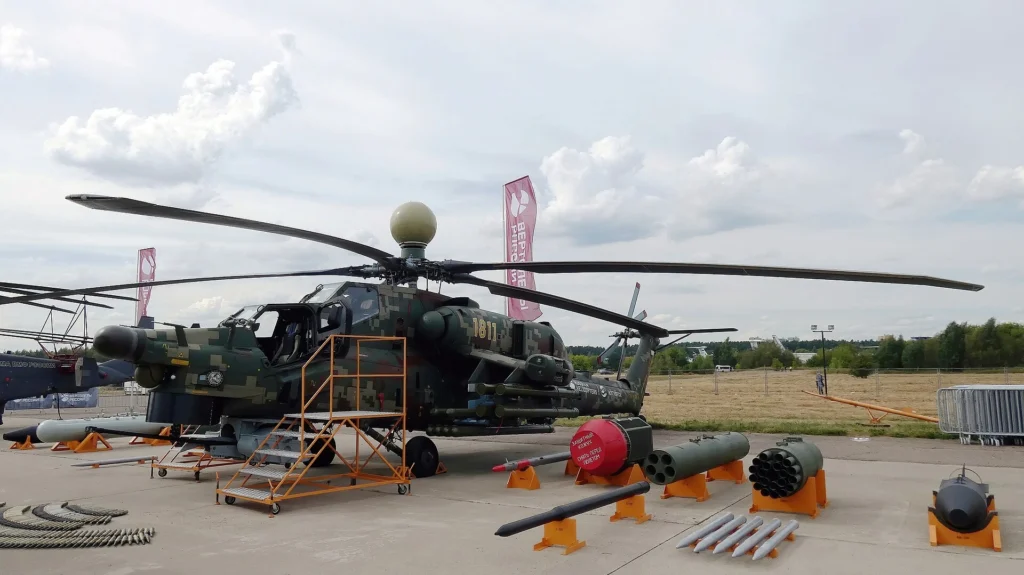
The footage is not entirely unexpected. Earlier this year, photographs began circulating of a Mi-28NM on the ground carrying what appeared to be the same missile.
In August, unconfirmed reports from Ukraine said Russia was using the helicopter as a Banderol launch platform. These reports included launches from over the Sea of Azov against targets around Odesa.
Using a helicopter to launch this type of weapon is particularly unusual. A relatively slow, low-flying platform like the Mi-28 is much more vulnerable to enemy air defenses than a fixed-wing tactical aircraft.
However, the reported range of the Banderol and Dan-T would allow the helicopter to launch well away from the intended target. It could potentially fire from across the border while remaining in Russian airspace.
For comparison, the Kh-38 (or LMUR) missile is otherwise the farthest-reaching Mi-28 weapon. Its maximum range is a little over nine miles.
Banderol Specifications and Warhead Figures
Russian company Kronstadt developed the Banderol. Ukrainian military intelligence (GUR) first detailed it in the spring of 2025. According to GUR, the missile has the following characteristics:
- Length of approximately 16.4 feet
- Pop-out wings
- A small turbojet engine
- A speed of around 310 miles per hour
- A range of up to 310 miles
Warhead figures vary by source. Some accounts put the warhead at approximately 110 pounds. GUR’s May 2025 disclosure listed a warhead weighing up to 150 kilograms (331 pounds).
Other reports describe a warhead module of roughly 115 kilograms (about 250 pounds). Public information does not settle which figure applies to the missile in the footage.
Foreign Components
GUR’s analysis also listed the foreign components it identified. Production involves “around 30 companies” supplying “more than 20 key components,” with potentially additional parts yet to be identified. The reported components include:
- Engine: A small commercial SW800Pro turbojet from the Chinese company Swiwin
- Satellite navigation: A Russian-made Kometa digital antenna designed to resist jamming
- Telemetry: An RFD900x module made in Australia, or its Chinese copy
- Power and control: Murata batteries from Japan and a Dynamixel servo
- Electronics: Microchips from manufacturers in the United States, China, Switzerland, Japan and South Korea
The Banderol first emerged publicly through Ukrainian intelligence reporting, but Moscow eventually began acknowledging the weapon. In July 2026, Russian state television showed it beneath the wing of a Kronstadt Orion drone. That was its first official presentation, although the missile was heavily obscured.
Ukrainian reporting indicates the weapon has already seen operational use. Between mid-May and mid-July, the Ukrainian Air Force recorded 16 strikes involving the Banderol. It reported five launches in a single barrage on July 16.
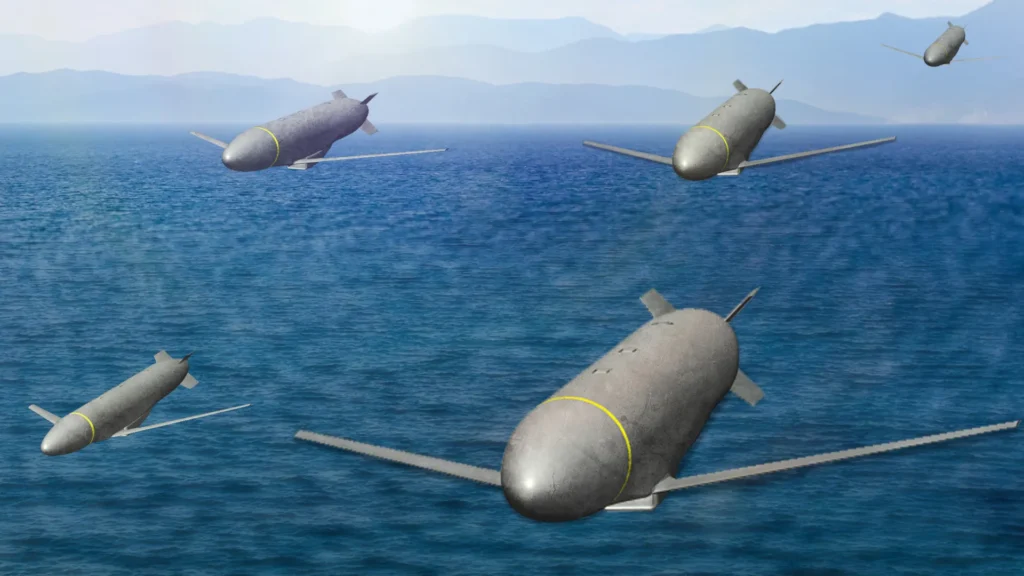
Dan-T Missile and Procurement Plans
The other possible candidate is the Dan-T. It is apparently derived from the Dan-M target drone, with a warhead of roughly 300 pounds added. It also has a reported range of around 310 miles. Its reported cost is approximately 35 percent lower than the Banderol’s.
Indications suggest the Dan-T could become the more widely procured weapon. Reports from Ukraine say Russia’s Aerospace Forces may have decided to focus procurement on the Dan-T, with plans to acquire tens of thousands of missiles.
Unlike the Banderol, the Dan-T is also reportedly intended for launch from combat aircraft and ground-based launchers. In September, Russia pitched the weapon for export at the El Alamein International Airshow in Egypt.
Russia’s Push for Lower-Cost Standoff Weapons
For many months, Russia has sought to expand its arsenal of weapons that can strike Ukrainian targets from standoff distances.
Mounting losses of Russian tactical aircraft to Ukrainian ground-based air defenses have underscored the need for weapons that can precisely hit targets at and well behind the front lines. Such weapons avoid exposing expensive aircraft to excessive risk.
Russia has already fielded the UMPK, a fairly crude type of guided glide bomb. It has caused considerable difficulties for Ukrainian air defenses since its introduction around early 2023. More refined winged precision-guided glide bombs have since followed the UMPK series.
These weapons are unpowered. The small turbojet engine fitted to the Banderol and Dan-T puts them in the cruise missile category.
Their reported range of up to 310 miles is particularly significant, if accurate. That range comes at the expense of warhead size, especially compared with larger Russian cruise missiles.
The navigation and electronic warfare protection systems are also important. An inertial navigation system combined with a jamming-resistant satellite navigation system should provide some resilience against the electronic warfare jamming Ukraine increasingly employs.
Satellite navigation can also correct accumulated drift, which matters because inertial navigation systems lose accuracy over longer distances.
In essence, the Banderol and Dan-T offer Russia a lower-cost, potentially higher-volume complement to its more sophisticated cruise missiles. TWZ previously described the economics behind this approach:
“The Banderol is particularly relevant in the context of the economics of the Ukraine conflict. Russian forces have increasingly used combinations of relatively inexpensive one-way attack drones and more expensive cruise and ballistic missiles. The drones can be produced in large numbers and used to complicate air-defense operations, while the more capable missiles provide greater speed, range, payload, or penetration capability. A small turbojet-powered weapon such as Banderol offers another point on that spectrum.”
Launching these weapons from non-traditional platforms, including drones, attack helicopters, and potentially ground-based systems, would give Russia greater flexibility.
Bomber fleets and fixed-wing tactical aircraft could concentrate on their primary roles and established weapons, while other platforms take on part of the standoff strike mission.
For the Kremlin, the appeal lies not only in low cost but also in fielding the weapons across a wider variety of platforms. This further complicates Ukraine’s efforts to deal with incoming attacks.
Mi-28 Losses and Fleet Impact
For the Mi-28NM, the ability to employ a long-range cruise missile could provide a useful additional role. This is particularly true after the helicopter fleet suffered heavy losses during the war in Ukraine.
According to the open-source tracking group Oryx, Russia has lost 21 Mi-28s since launching its full-scale invasion of Ukraine four years ago. The real figure could be higher, because Oryx only tabulates losses it can confirm visually. Russia began the conflict with around 110 Mi-28s of all versions. Other Russian battlefield helicopter types have suffered even heavier attrition, which reflects the danger rotorcraft face close to the front lines.
US Marines Explores Similar Capability
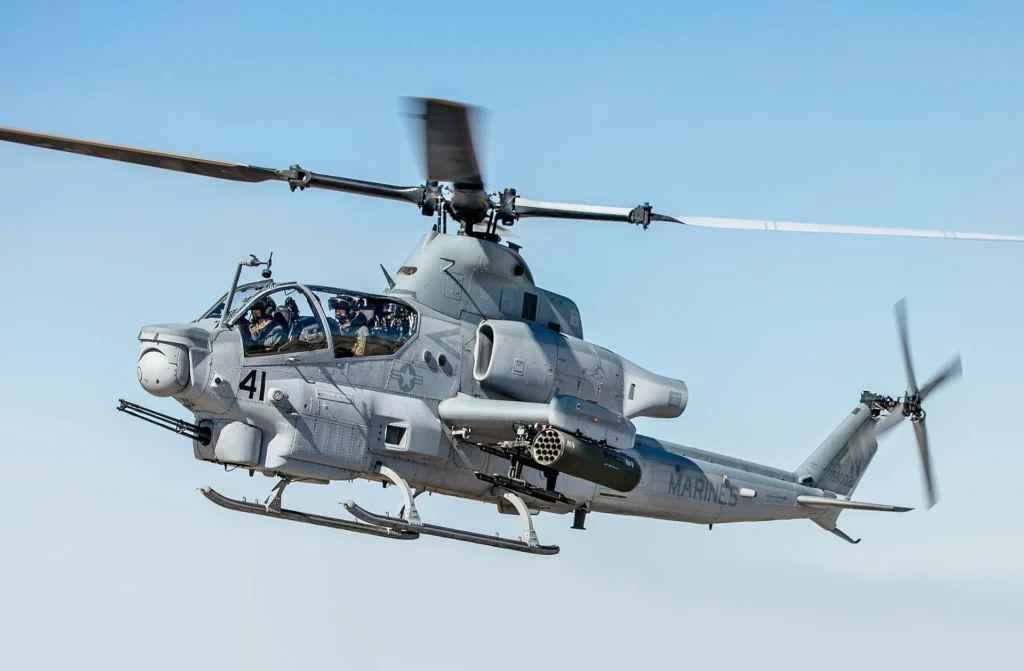
Russia is not alone in exploring this concept. The U.S. Marine Corps is working to give its AH-1Z Viper attack helicopters a new long-range strike capability through L3Harris’ modular Red Wolf launched-effects family.
The weapon has already been test-fired from an AH-1Z. It is being developed under the Marines’ Long Range Attack Missile (LRAM) effort, with a reported range in the low hundreds of miles.
Beyond its kinetic strike role, Red Wolf can be configured for missions such as communications relay and electronic warfare. It has also been pitched for US Army helicopters and tiltrotors.
The effort reflects a broader push to give rotary-wing aircraft precision effects well beyond the range of their traditional weapons. It also raises questions about where the boundaries between cruise missiles, drones, and other launched effects are increasingly drawn.
Stay tuned with us. Further, follow us on social media for the latest updates.
Join us on Telegram Group for the Latest Aviation Updates. Subsequently, follow us on Google News
